
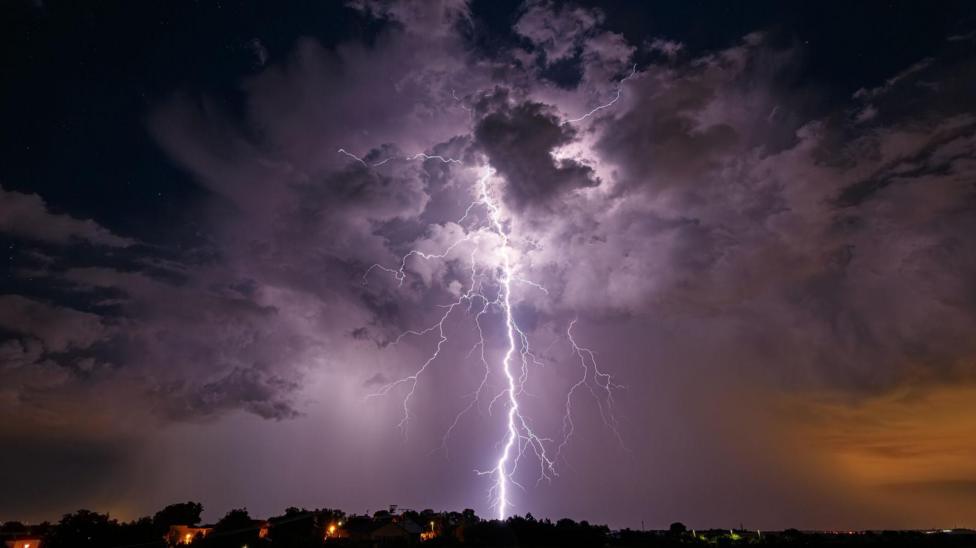
At least 28 people have been reported killed by lightning in Bangladesh in the past four days, 14 of them on 26 April alone. The Bangladesh Meteorological Department counts 3,658 lightning deaths in the ten years from 2015 to 2025. After more than fifty people died in two days in 2016, the Ministry of Disaster Management and Relief declared lightning a national disaster. A decade later, in a country whose economy still rests on farming, the people it kills are overwhelmingly those working in the fields.
Professor Dr M A Farukh of the Institute of Environmental Science and Disaster Management at Bangladesh Agricultural University told BBC Bangla that 87 percent of those killed by lightning in Bangladesh were in open spaces. "If you analyse the data of the past 20 years, you will see that every year lightning kills more than twice as many people as floods," he said, adding that ten years after the national-disaster declaration the government has yet to take adequate measures.
Lightning needs three ingredients: moisture in the air, unstable air and an upward force. Bangladesh's position supplies all three. Warm, humid air arrives from the Bay of Bengal and the Indian Ocean to the south; cold air comes down from the hills and the Himalayas to the north; where they meet, thunder clouds form. This year unusually high moisture over the Bay has produced more cloud, and Professor Farukh says heat, humidity and the heatwaves passing over the country have combined to increase thunderstorms. The US Centers for Disease Control puts global lightning at 6,000 strikes a minute. The air around a bolt heats to about 30,000 degrees Celsius and expands so violently that the shock wave is heard as thunder.
Thunder can be heard without rain in what is called a dry thunderstorm, when rain evaporates in hot, dry air before it reaches the ground; such storms are notorious for starting wildfires. The old saying that lightning never strikes the same place twice has no scientific basis, according to Encyclopaedia Britannica; any spot that favours a strike can be hit repeatedly.
When lightning hits a person, current passes through the body and damages the nervous system; brain injury and cardiac arrest can follow. Even a minor strike can leave muscle pain, headache, nausea, confusion, memory loss, dizziness and poor balance, and in the longer term slowed reactions, chronic pain, sleep problems, ringing in the ears, depression and personality change. Victims are treated like anyone who has suffered an electric shock: restore breathing and heartbeat within minutes with artificial respiration and CPR, and get them to hospital without delay. A struck person carries no residual charge, so there is no danger in touching them.
Last week the story of a father sitting up all night to guard the body of a child killed by lightning went viral. Bodies of lightning victims are stolen because of the superstition that they turn magnetic. Sohel Mahmud, former head of forensic medicine at Dhaka Medical College Hospital, has told BBC Bangla that there is no difference between the body of a lightning victim and that of a person killed by electric shock.
The only protection is shelter. The US National Weather Service says no outdoor location is safe. A thunderstorm usually lasts 40 minutes to an hour, and that is the time to stay indoors, in rubber shoes if going out cannot be avoided. Anyone caught in a paddy field or open ground should crouch low on the toes with fingers in the ears, well away from tall trees, electricity poles, metal objects and mobile towers. Fishermen on a river or at sea should stop and get under the boat's canopy. Indoors, keep away from electrical appliances, sinks, taps, concrete walls and floors, windows and doors.
Source: BBC Bangla

Comments
(0)