
Antonella Leoni is an Italian calligrapher who lives in Cairo, the capital of Egypt. She has a deep love of Arabic calligraphy and of marbling, and is a specialist in Islamic art. A piece in Desh Rupantor describes her work.
In 2003 she took a postgraduate diploma in Asian art and the arts of the Islamic world from Royal Holloway, University of London, and the British Museum. In 2010 she earned a master's in fine arts in Chinese painting in Milan, and in 2019 a diploma in Arabic calligraphy and illumination from the Khalil Agha academy in Cairo.
Verses of the Quran, hadith and old poetry inspire her work. So does the ancient art of marbling, in which the pattern of colour formed on water is as unique as DNA and can never be reproduced exactly.
In her process, marbling can look like the simplest step, but it decides the character of the finished piece: once the pattern floating on the water is lifted onto paper, nothing can be corrected. For her, the process stands for the abstract expression at the heart of Islamic art, and for a core idea of Islam, surrender to the Creator.
The piece says that this union of old technique and spirituality is what sets her work apart. Blending several artistic traditions and cultures, her pieces are beautiful to look at and also invite reflection; by writing the most beautiful words, she seems to want to make beauty and its spiritual meaning last, so that artist and viewer are both enriched.
Written for Desh Rupantor by Maisara Jannat.
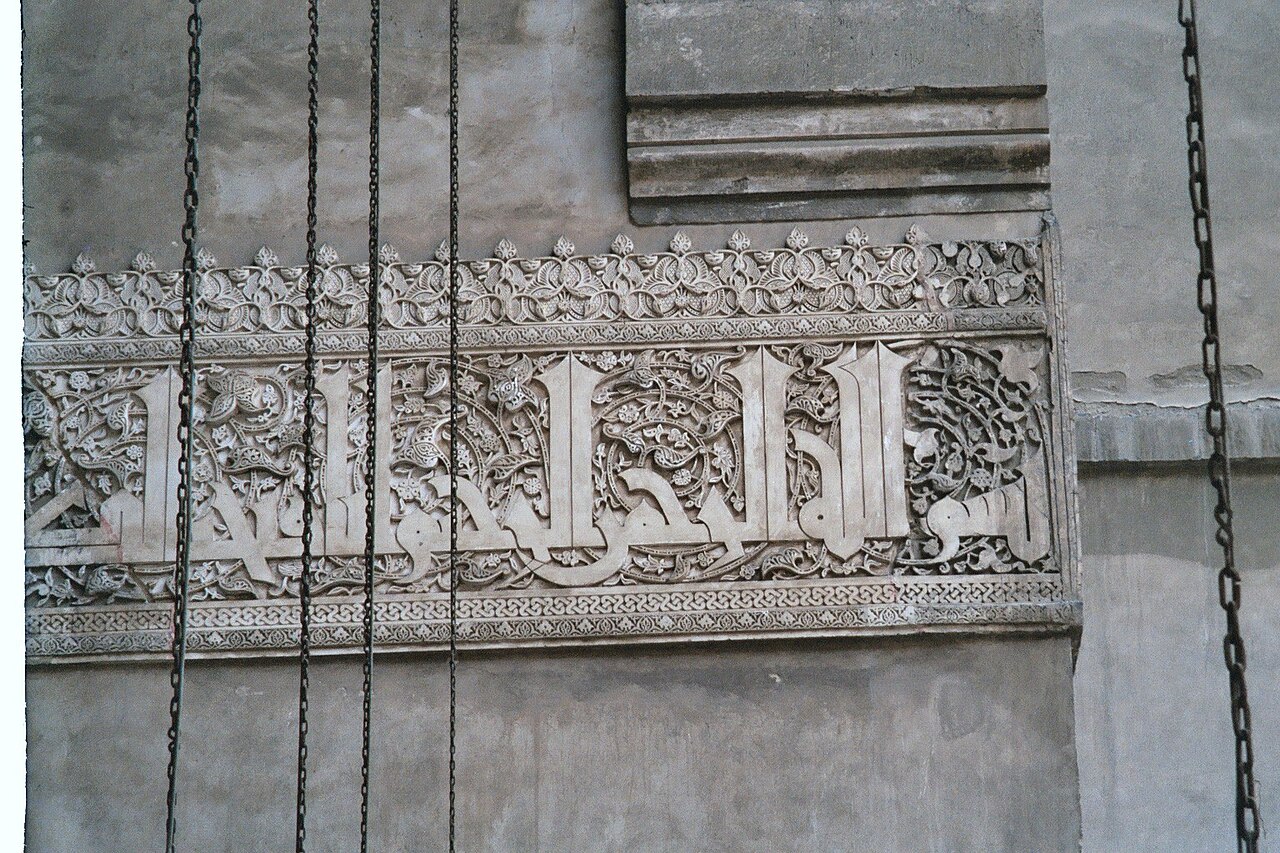
Photo: Kufic Bismillah on the wall of the Sultan Hassan mosque, Cairo, Mbenoist / Wikimedia Commons (CC BY-SA 3.0)
Source: Desh Rupantor

Comments
(0)