
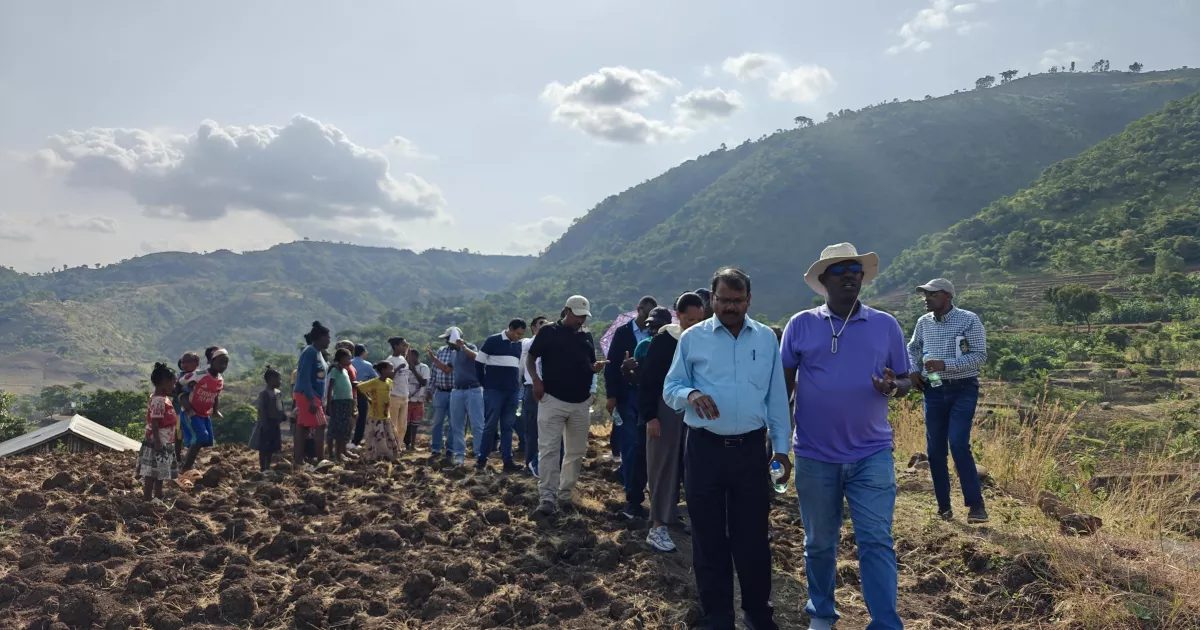
Twenty-eight people from Ethiopia's agricultural research and development system met in Arba Minch from 28 to 31 July for a training in agroecological and landscape-based natural resource management, run by the CGIAR Capacity Sharing Accelerator and the CGIAR Multifunctional Landscapes Science Program with ICRISAT.
The participants came from the Ministry of Agriculture — including its CALM, RLLP and PACT projects — the Agricultural Transformation Institute, the Ethiopian Institute of Agricultural Research, the Amhara Agricultural Research Institute, four universities (Bahir Dar, Haramaya, Hawassa and Sodo), GIZ, the World Resources Institute, national think tanks, and NGOs including World Vision, Farm Africa and Welthungerhilfe.
The teaching came from the Indian Council of Agricultural Research and ICRISAT, which brought Indian experience of landscape-based resource management: interventions in Uttar Pradesh, soil and water conservation practices matched to different agroecological conditions, standard procedures for capturing minimum-dataset parameters, and the use of that data to build decision-support systems for landscape work.
"Landscape challenges do not exist in isolation," said Himanshu Pathak, director general of ICRISAT. "Land, water, agriculture, ecosystems and livelihoods are deeply interconnected, and our responses must reflect that reality."
The four days were built around a training-needs assessment done with the participants beforehand, and the classroom work was paired with a field visit to a micro-watershed managed with GIZ support, so that the technical discussion sat against actual practice. ICRISAT scientists covered water budgeting and hydrology, ecosystem services, banana value-chain and enterprise models, aerobic composting, biochar preparation and decision-support systems.
"Capacity sharing works best when knowledge moves in both directions," said Charles Kleinermann, who leads the CGIAR Capacity Sharing Accelerator. That framing matters: the point was not to transfer an Indian model but to let Ethiopian researchers adapt, test and rebuild it for their own ecological and institutional conditions.
South-South exchange of this kind is the cheapest form of agricultural research there is. India's semi-arid watersheds and Ethiopia's highlands share the problems that matter — erosion, unreliable rain, degraded common land — and the methods for measuring and treating them travel far better between them than they do from a temperate research station.
Source: CGIAR

Comments
(0)