
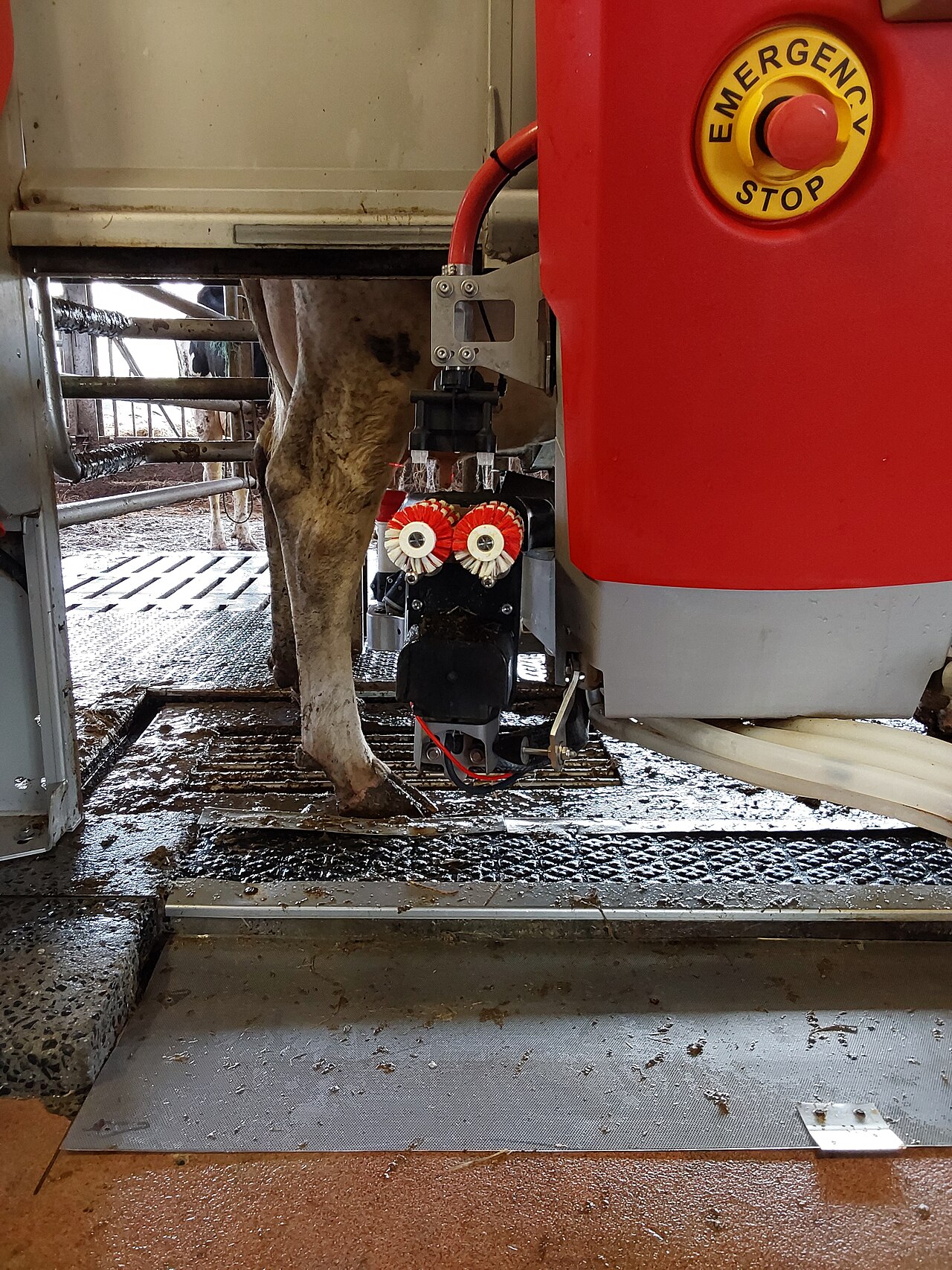
Six robotic milking units now milk more than 360 Jersey cows around the clock at Goedgeleë, the Human family's farm near Protem in the Western Cape, and the whole dairy is run by two employees. It is South Africa's second robotic dairy, after Job Legemaat's installation near Rayton in 2016, Farmer's Weekly reported after visiting the farm.
The robots came out of a hard choice. Pierre Human began milking Jerseys in 1983, and by the time his son Pierre-Jacques returned to the farm after his studies, the industry was in trouble: milk prices were under pressure, costs kept climbing, and the number of South African dairy farmers had fallen from nearly 6,500 in 1999 to fewer than 1,700 by 2016. The family had to expand and modernise or leave dairying. They stayed, and spent almost 10 years planning, visiting Legemaat's robots and, in Pierre-Jacques' case, robotic and conventional dairies in the United States and the Netherlands.
The system runs on voluntary cow traffic. Cows move freely between an open resting paddock, a covered feeding area and the six GEA R9500 robots. When a cow approaches a robot, the computer decides whether she is due for milking; if not, a gate sends her on to the feed. Inside the robot, teat cleaning, stimulation, pre-dipping, milking and post-dipping are automatic, and each quarter of the udder is milked and monitored on its own, so that mastitis in one quarter does not spoil the rest of the milk. The best cows visit up to five times a day and give up to 40 litres; the average cow visits about 3.2 times and gives 12 to 30 litres.
The bigger change is the data. From the control room Pierre-Jacques follows each cow's milk yield, milk quality, feed intake, fertility, activity and health in real time. A cow that needs a vet or artificial insemination is drafted automatically into a special-care pen with feed, water and a rubber floor, and the software sends SMS alerts when yield, milk composition or herd health changes. The dairy can be watched remotely by phone or camera. Each cow also gets her own concentrate ration from a precision-feeding programme, matched to her production, body condition and needs, on top of silage grown on the farm.
The family says the result is calmer cows and better milk. The herd's somatic cell count stays between 80,000 and 100,000 cells per millilitre, a sign of good udder health, and milk goes every second day to Mooivallei Dairy in Bonnievale. "Since installing the robots and introducing precision feeding, the efficiency of the entire operation has improved substantially," Pierre-Jacques said.
The farm was also built to save resources. A robotic scraper pushes manure into a pit; the liquid is reused as grey water for cleaning and the solids go back to the fields as fertiliser. Wide roof overhangs shade the cows and harvest rainwater, a solar-powered feed pusher designed by Pierre keeps feed within reach, and a standby generator with an uninterruptible power supply keeps the robots milking through power cuts. Worldwide, more than 40,000 dairy farms now use automated milking, three decades after the first robot was installed in the Netherlands in 1992.
The story was reported by Hanlie du Plessis for Farmer's Weekly.
Photo: .Anja. / Wikimedia Commons (CC BY-SA 4.0). A cow being milked by a milking robot.
Source: Farmers Weekly South Africa

Comments
(0)