
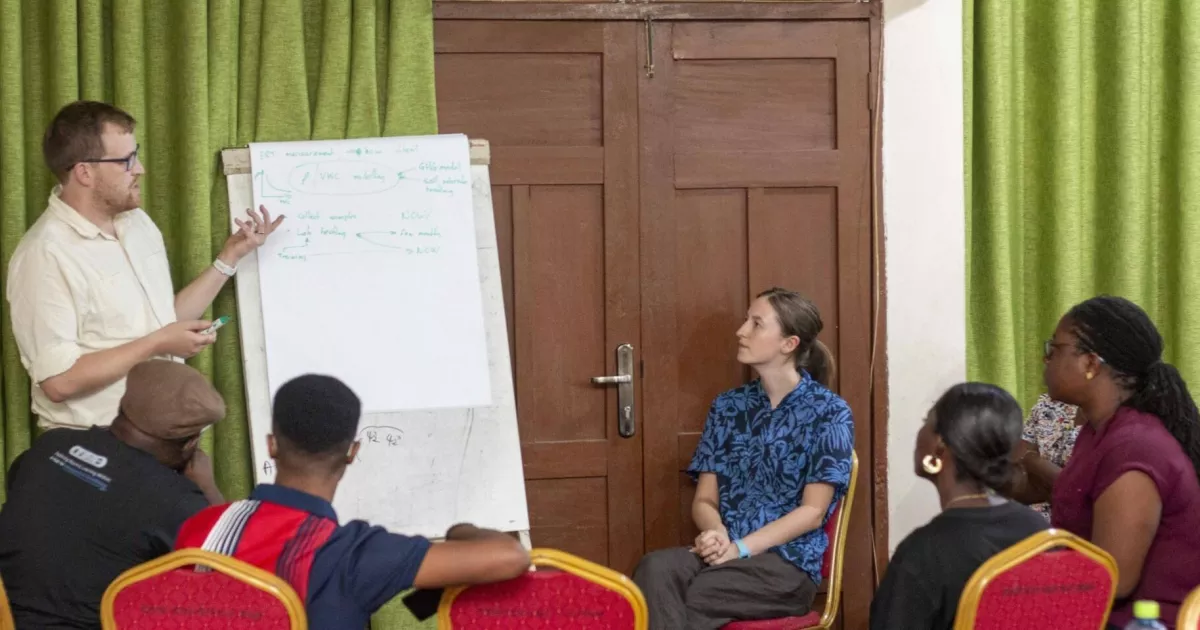
Researchers in Ghana are using a geophysical imaging method to see what happens to rainwater once it disappears beneath a maize field, in a project designed to test whether climate-smart practices such as residue retention and cover cropping really keep more water within reach of crop roots.
The project, Geophysics for climate smart agriculture in Africa, brings together the British Geological Survey (BGS), the University of Nottingham, the Alliance of Bioversity International and CIAT, Kwame Nkrumah University of Science and Technology (KNUST) and the CSIR-Crops Research Institute (CSIR-CRI). It was described by Patricia Amankwaa-Yeboah and Grace Asante Yeboah in an Alliance story published on 8 September 2026.
Field experiments at CSIR-CRI compare conventional maize management with cover cropping and different levels of crop-residue mulching. Above ground, the crop can be seen, rainfall measured and yield weighed; below ground, soil structure, pores, water, roots and groundwater interact in ways that spot measurements of soil moisture cannot capture.
The tool is electrical resistivity tomography (ERT), which measures changes in the electrical resistivity of the subsurface. Because resistivity tracks moisture, repeated surveys show how water infiltrates, moves and is stored across the soil profile through the season. Project lead Russel Swift said the method lets researchers observe the subsurface as a dynamic system rather than a set of isolated readings.
As rainfall becomes more variable and dry spells fall within the growing season, a soil's ability to capture, store and supply water can decide whether a crop keeps growing or suffers water stress. The research also examines how these dynamics affect groundwater recharge, nutrient movement and the conditions that drive nitrous oxide emissions.
A second strand builds low-cost, open-source resistivity instruments at KNUST so that West African researchers can design, build, run and maintain the equipment themselves. Dr. Cyril Boateng said the aim is for Ghanaian researchers to own the tools, the knowledge and the systems needed for future monitoring. The University of Nottingham's Dr. Murray Lark leads the statistical work to tell which differences between management systems are consistent, meaningful and explainable.
Early-career researchers are gaining experience across geophysics, field trials, soil science, agronomy, engineering and data science. For farmers, the payoff would be firmer evidence on which soil-cover practices actually hold water for the crop under Ghana's changing rains.
Source: CGIAR

Comments
(0)