
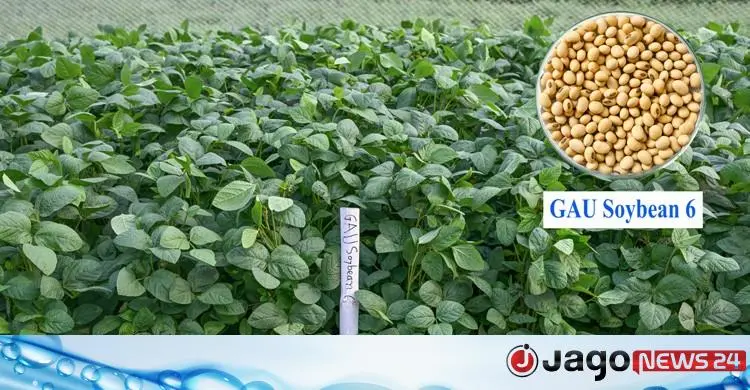
Gazipur Agricultural University (GAU) has developed "GAU Soybean 6", the country's first highly drought-tolerant inbred soybean variety. It was developed under the leadership of agronomist Professor Dr M A Mannan of the Department of Agronomy after a decade of research, bringing the number of crop varieties developed by GAU to 94.
From 250 germplasm lines
About 250 germplasm lines collected from the World Vegetable Center (Asian Vegetable Research and Development Center) in Taiwan, the Bangladesh Agricultural Research Institute (BARI) and South Korea were tested rigorously for three years, and line G00056 was selected as drought-tolerant. After five years of successful field evaluation in Noakhali, Lakshmipur and Bhola with support from Solidaridad Network Asia, the National Seed Board formally released the variety on 11 November last year.
Key traits
Professor Mannan said the variety can survive and give high yields even under severe drought at 50 to 60 per cent of field capacity, overcoming the limits on soybean farming in coastal char lands. Each plant bears 80 to 100 pods, and because the seeds are large, 1,000 seeds weigh about 230 grams. It easily yields 3.2 to 3.8 tonnes per hectare.
Its seeds have low trypsin levels, which raises protein absorption in poultry feed, making it valuable for the poultry industry. It matures in three months to three months and 10 days. Soybean contains about 40 to 45 per cent high-quality protein and 18 to 20 per cent oil and is rich in essential amino acids, vitamins and minerals.
A new option for drought-prone land
"GAU Soybean 6 is the combined harvest of our long research, the sun and rain of the field and farmers' dreams," Professor Mannan said. Soybean on drought-prone land had been risky, and the variety would open new possibilities against the salinity, lack of rain and uncertain weather of coastal chars, he said.
Vice-Chancellor Professor Dr G K M Mustafizur Rahman called the variety a landmark achievement that could become a symbol of sustainable agriculture, strengthening food security and bringing stability to farmers' lives. The research team has earlier developed five other high-yielding soybean varieties, including ones tolerant of salinity and waterlogging.
Source: Jagonews24 (reported by Md Aminul Islam). First published in Bengali on The Agro News.
Comments
(0)