
Agriculture is one of the main foundations of Bangladesh's economy, employment and food security. But climate change, shrinking farmland, rising production costs, labour and water shortages, soil degradation, pests and diseases, market uncertainty and the challenge of producing safe food together mean the conventional farming system now needs a major change.
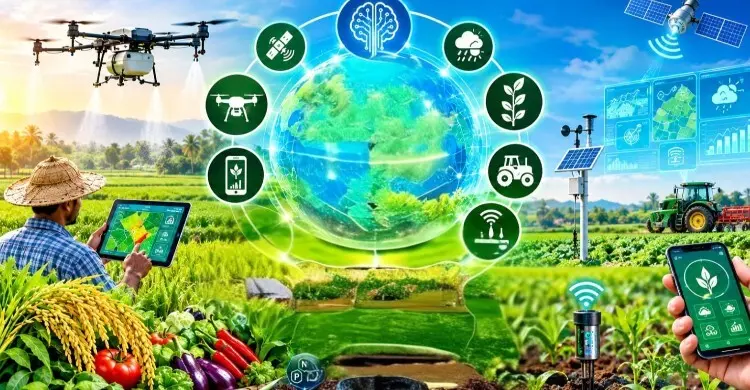
The biggest opportunity for that change comes from the Fourth Industrial Revolution. Artificial Intelligence (AI), the Internet of Things (IoT), big data, robotics, drones, satellite technology, cloud computing and automation are not only modernising agriculture; they are changing how farm decisions are made. For Bangladesh, the question is no longer whether to use technology in farming, but how quickly, how effectively and how farmer-friendly its adoption can be.
Keeping the young generation in agriculture
The future of Bangladesh's agriculture depends not only on land and output but on how far the new generation can be drawn into it. Many young people see farming as a traditional, physically demanding occupation and are losing interest. A lack of varied employment and modern technology is one reason young people leave villages for towns.
Today's young people, however, are comfortable with smartphones, apps, social media, data, automation and AI. If that interest can be linked to farming, agriculture can become a digital, knowledge-based and technology-driven enterprise sector rather than simple cultivation. A young farmer who can check weather, soil condition, disease forecasts, irrigation needs, fertiliser management, market prices and likely sale prices on a mobile phone will see farming differently.
AI, IoT and big data: the backbone of future farming
- AI can make farmers' decisions more data-driven: detecting crop diseases and pests from images, issuing early warnings from weather and field data, setting fertiliser and pesticide needs, forecasting yields and analysing markets.
- IoT can turn a field into a smart farm, with sensors collecting soil moisture, temperature, pH, EC, salinity and NPK data so that irrigation and fertiliser decisions rest on real data rather than guesswork.
- Big data can bring scattered information on weather, soil, varieties, diseases, production, markets, farmer behaviour and climate together, making area-based planning more effective.
In short, AI supports decisions, IoT gathers data from the field, and big data turns that data into wider decisions. Together they could form one of the foundations of smart agriculture.
New horizons for education and research
Interest in AI, IoT and big data is growing quickly among agricultural institutes, universities, teachers, students, researchers and young agri-entrepreneurs. If agriculture students learn AI models, data analysis, GIS, remote sensing, IoT sensors, drone technology, robotics and digital agriculture alongside conventional agricultural science, they can become the next generation of farm leaders.
Research laboratories also need to be linked to the field. Research that is not tested and usable on farmers' land has limited economic and social impact, so a two-way "lab to land" and "land to lab" system is needed, in which field problems reach the lab and lab solutions return quickly to the field.
Time for an agricultural innovation market
As these technologies develop, a key question arises: where is the market for innovation? If technology stays in projects, research and exhibitions, the desired change will not come. Bangladesh needs a strong agricultural innovation market where agritech innovators, startups, universities, researchers, entrepreneurs, farmers, banks, investors and government bodies can work together.
If a young person builds an IoT soil sensor, a student develops an AI-based disease detection system, or a startup creates a digital advisory platform, it should be given a chance in the field rather than being left at the trial stage. That requires innovation sandboxes, pilot farms, technology validation centres and an innovation fund. Public procurement could also open special opportunities for agricultural innovation, making it easier to use locally developed technologies in government projects once they are proven in the field.
Source: Jagonews24. First published in Bengali on The Agro News.

Comments
(0)