
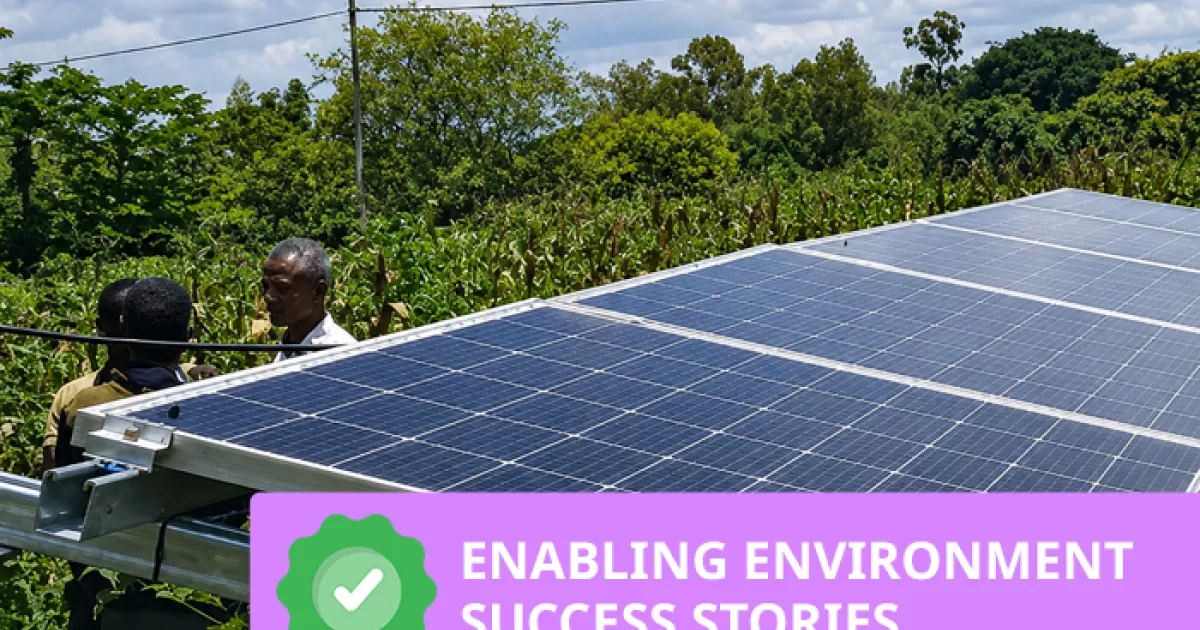
Ethiopia has one of the largest irrigation potentials in Sub-Saharan Africa — more than 5.3 million hectares — and has developed about 10 per cent of it. Public money alone has not been able to close that gap, and without service contracts, clear regulation or ways to reduce risk, private firms had little reason to try. Schemes were built and then left to Water User Associations to maintain on their own, which is how infrastructure deteriorates.
The International Water Management Institute (IWMI) has worked with Ethiopia's Ministry of Agriculture, Ministry of Water and Energy, regional bureaus and private-sector associations to write the country's first national public-private partnership strategy and implementation guideline for small-scale irrigation.
It began with a needs assessment across four regions — Sidama, Central Ethiopia, South Ethiopia and Hareri — looking at market conditions, governance gaps and how the existing schemes were actually performing. That produced a Business Model Compendium setting out seven practical partnership models, each with its own allocation of risk, route to financial viability and definition of the service being delivered.
The models were then tested rather than published. IWMI and its partners ran operation-and-maintenance business models on schemes in Sidama and Central Ethiopia, examining private service delivery, tariff structures and performance-based contracting, and measuring what farmers were actually willing to pay and how reliable the service proved. The multi-stakeholder Agricultural Water Management Task Force carried those findings into the national strategy, which sets standardised procurement procedures, model contracts and regulatory roles.
The validated models are already feeding into larger programmes, including the World Bank-funded Crisis-Resilient Social Protection programme and projects supported by IFAD and the IFC.
The gap the strategy addresses is the one between a scheme being built and a scheme still working five years later. Ethiopia's answer is to define who is paid to keep it working, and on what terms — a question that irrigation programmes across South Asia, Bangladesh included, have answered less clearly.
Source: CGIAR

Comments
(0)