
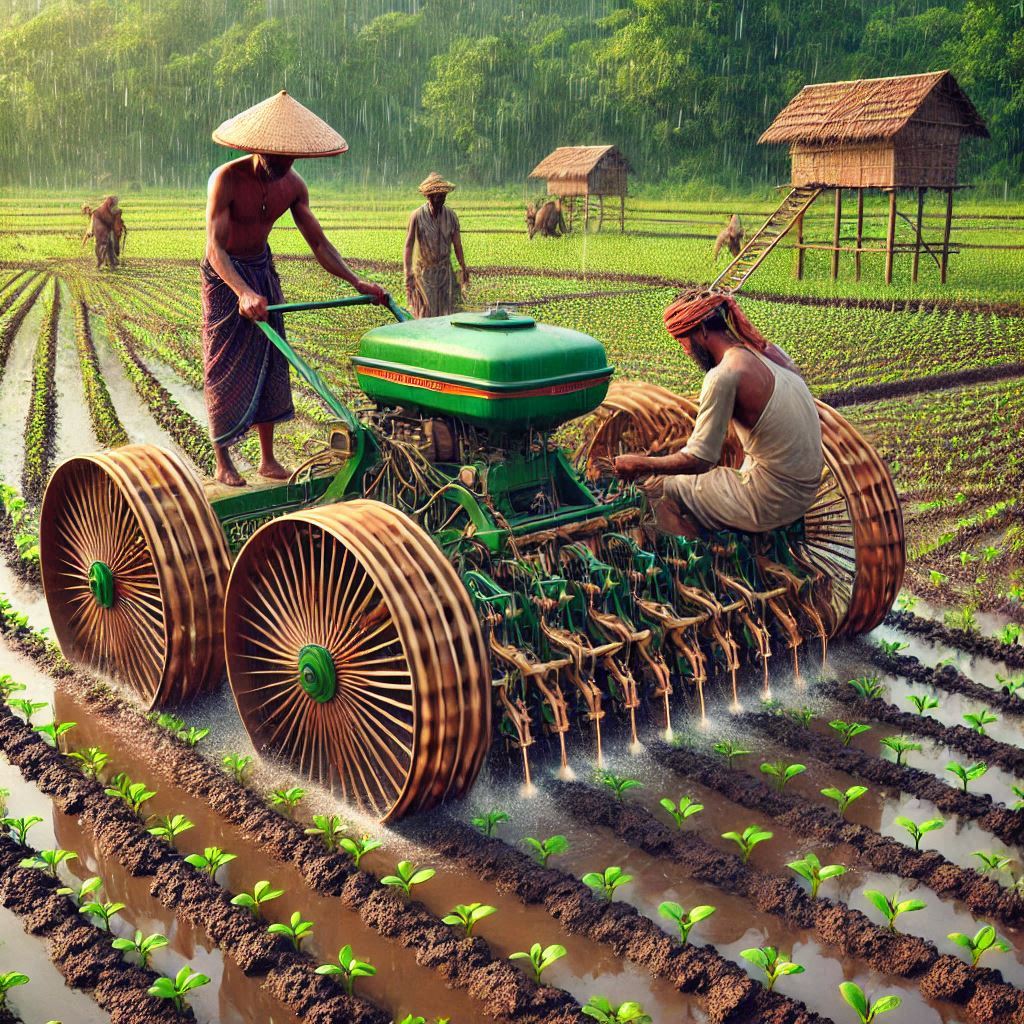
Continuous rain and waterlogging can ruin fields and even seedbeds, which are hard to re-create, leaving farmers in despair. The "drum seeder", developed by agricultural scientists, is a way to help farmers in such situations, allowing them to sow again without a new seedbed.
How the machine is built
The drum seeder is a modern sowing implement with six plastic drums arranged along a 2.3-metre iron rod. Two plastic wheels sit at the ends of the rod, with a handle for pulling. Each drum is 25 cm long and 55 cm in diameter and has two rows of holes 20 cm apart at its ends; one row can be closed with an attached rubber belt when needed.
Benefits
- Sprouted seed is sown directly in rows in puddled soil, so there is no need to raise seedlings, uproot and transplant them, greatly reducing labour and production costs.
- Rice and other crops, including vegetables, can be sown easily.
- Rice sown with the machine needs 30 percent less seed.
- Row sowing at the right density makes weeding and other care easier, and fewer pest and disease problems raise yields by an average of 20 to 25 percent.
- The machine is light and easy to carry; one person can sow at least one bigha an hour.
Weed control
Weeding is easier with drum-seeded crops, and herbicides can also be used. Herbicide should be applied when only a little water is standing in the field, and a shallow layer of water must be kept for the next three to five days. The drum seeder method works best on land with few weeds; where weeds are heavy, the field must be cleaned first.
Source: Staff Correspondent, The Agro News. First published in Bengali on The Agro News.
Comments
(0)