
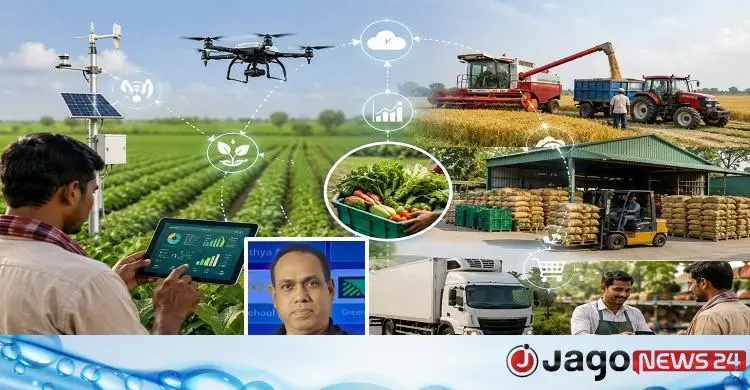
Bangladesh's agriculture is on the threshold of transformation. Facing population growth, climate change, rising costs, volatile markets and food security challenges, raising output is not enough; how produce reaches consumers quickly, safely, fairly and efficiently matters just as much. The writer argues that a digital supply chain opens a new horizon.
A digital supply chain is not simply an online platform for buying and selling. It is an integrated system that makes the whole value chain, from production, collection, storage, transport and processing to marketing and consumption, technology-driven, transparent, accountable and efficient, using Artificial Intelligence (AI), the Internet of Things (IoT), big data, blockchain, GIS, remote sensing, smart sensors and digital payments.
What it offers
- **Transparency:** every step is recorded digitally, so farmers, traders, processors, distributors and consumers can see and verify information, reducing irregularities.
- **Accountability:** accurate records of who did what, when and where make it easy to assign responsibility, vital for food safety, quality control and exports.
- **Traceability:** scanning a QR code on a mango or vegetable could show which farmer in which district grew it, when it was harvested, what inputs were used and how it was transported. Traceability is now a key condition in international markets.
- **Fair prices and market links:** real-time price, demand and supply data help farmers decide when and where to sell, weaken middlemen's information advantage and connect farmers directly with wholesalers, processors, supermarkets and exporters.
- **Digital payments:** mobile financial services, banking and digital wallets make transactions fast, safe and recorded.
- **Demand forecasting:** market data analysis can predict demand, making production planning more realistic and reducing waste.
- **Logistics and cold chain:** digital monitoring improves transport and cold storage for perishable fruit, vegetables, milk, fish and flowers, significantly cutting post-harvest losses.
- **Contract farming:** digital contracts record quality standards, prices, delivery schedules and payments, reducing disputes.
- **Sustainability:** data-based management ensures efficient use of fertiliser, water and pesticides.
Challenges
High-speed rural internet, digital infrastructure, farmers' technical knowledge, data security, quality data management and coordination between institutions are needed, together with public-private partnership, skilled people and investment.
Conclusion
The writer calls for an integrated national digital agricultural supply chain ecosystem connecting farmers, extension services, researchers, tech companies, financial institutions, logistics providers, processors, exporters and consumers on one platform. The future of farming, the writer argues, is a competition in safe food, fair prices, efficient supply and sustainability, and the digital supply chain is one of the main drivers of that transformation.
Source: Jagonews24. First published in Bengali on The Agro News.

Comments
(0)