
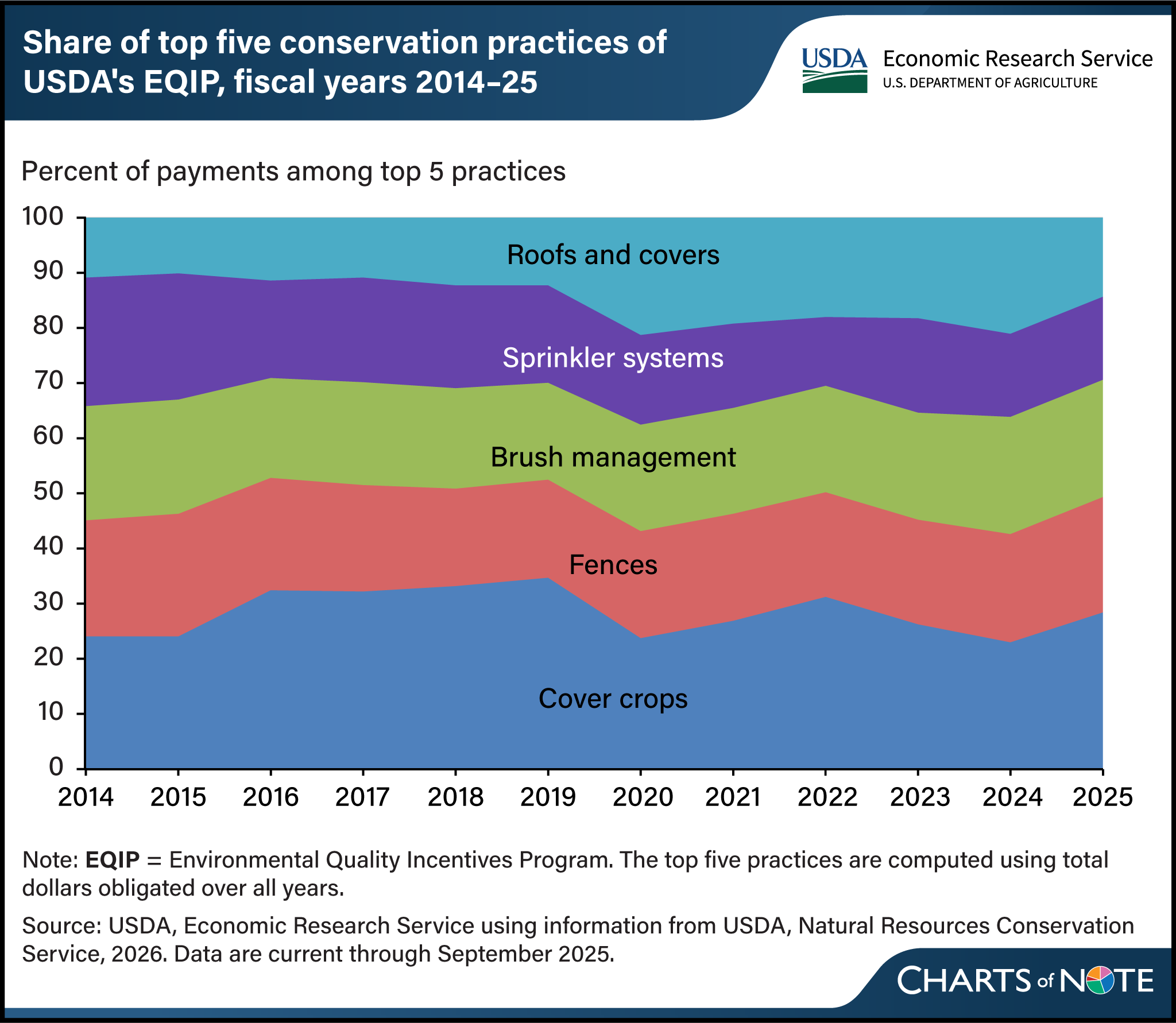
Cover cropping has been the most heavily funded practice under the U.S. government's largest working-lands conservation programme for more than a decade, according to a Chart of Note from USDA's Economic Research Service (ERS).
The Environmental Quality Incentives Program (EQIP) is a voluntary programme run by USDA's Natural Resources Conservation Service (NRCS). It gives agricultural producers and forest landowners financial and technical help to put conservation practices in place that address natural resource concerns such as soil erosion, water quality and wildlife habitat.
Across fiscal years 2014 to 2025, cover cropping was the top-funded practice measured by total dollars obligated, and it was also the top-funded practice in most individual years over the period, ERS found.
Fences, used to keep livestock out of waterways and to make other conservation activities possible, and brush management were both close behind. Sprinkler systems, and roofs and covers for waste management and other hazardous material containment facilities, rounded out the top five.
NRCS targets EQIP money to producers and landowners to meet a balance of federal, state and local priorities. Funding for the programme was approximately $1.6 billion in 2025, excluding money provided under the Inflation Reduction Act.
For a farmer thinking about which conservation practice to take on, the ranking shows where the programme's money has actually gone: soil cover between cash crops first, then livestock exclusion and rangeland brush control, irrigation upgrades and manure facilities. The chart, prepared by ERS economists Andrew B. Rosenberg and Kate Binzen Fuller, updates information in the ERS report Status and Trends of USDA Conservation Programs, 2002–2025, published in March 2026, in which EQIP funding is one of five conservation trends analysed.
Source: USDA Economic Research Service

Comments
(0)