
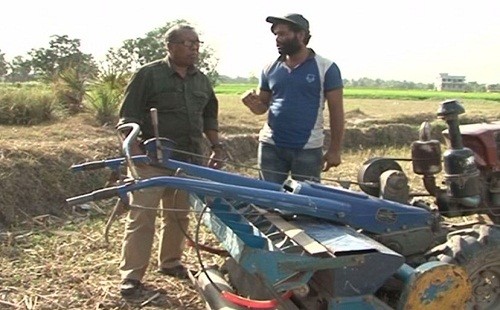
Raising cropping intensity while protecting soil, water and the environment is the challenge of the time, and it is even greater in drought-prone areas. Farmers have found new hope in conservation agriculture.
One machine, minimal tillage
With minimal tillage, measured seed and irrigation, farmers get the yields they want while cropping intensity rises. A power tiller-operated planter is all that is needed; it draws rows suited to each crop.
Farmer Sabbir Ahmed of Bijoynagar, Godagari, Rajshahi, said he can grow wheat, mung bean, lentil, maize and rice on the same land. With this method, watered wheat does not turn red, the ears ripen together, and rat attacks have fallen by about 80 per cent.
Why rats stay away
Dr Elias Hossain, chief scientific officer at the Regional Agricultural Research Institute, Rajshahi, said rats cannot move easily across the furrows and ridges. The technology is most useful in the Rajshahi and Rangpur regions but applies to all of Bangladesh, especially where the water table has fallen, and it has spread to several districts.
Lower costs
Farmer Ali said it needs less ploughing and less water. Shafiqul Islam, machine operator at the Wheat Research Centre, Rajshahi, said the machine prepares a bigha in 40 to 50 minutes for 400 to 500 taka, against 1,000 to 1,200 taka with a plough.
A global practice
Scientists say 54 countries adopted conservation agriculture long ago, including Mexico, China, Japan and India, and Bangladesh must follow in a changing climate. Spreading it to difficult areas could bring a new revolution in crop production.
Source: Shykh Seraj, Hridoye Mati O Manush. First published in Bengali on The Agro News.
Comments
(0)