
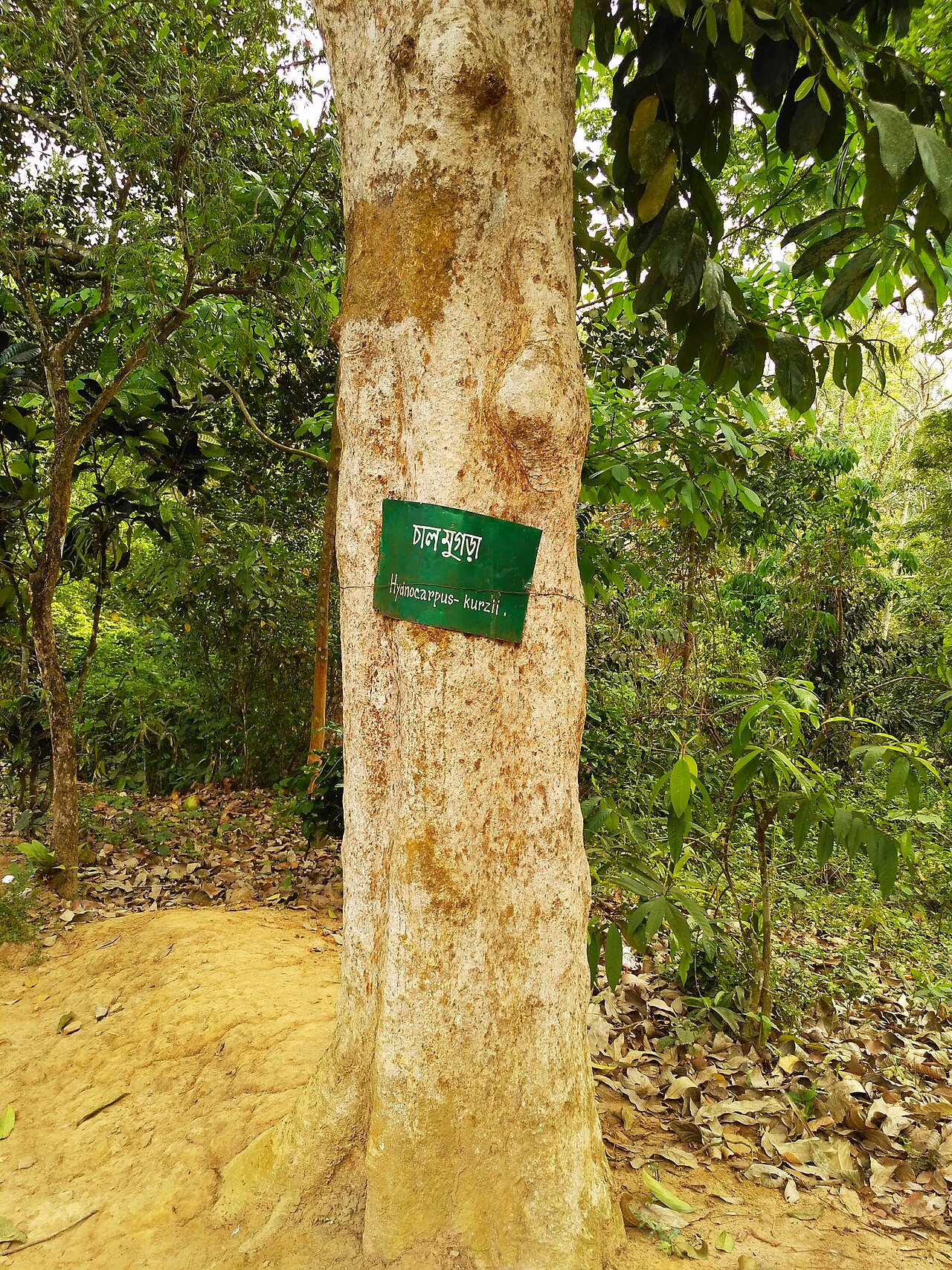
The chalmugra (Hydnocarpus kurzii), also called dalmugri, a handsome tree of the hill forests, is now critically endangered. The 2024 Red List published by the Bangladesh National Herbarium and the IUCN placed it among the country's critically endangered plants. Nature and environment writer Mokarram Hossain set out its current state in Prothom Alo.
The tree has been recorded surviving in the wild at ten sites in forests of Bandarban, Chattogram, Cox's Bazar, Khagrachhari, Rangamati and Moulvibazar. The latest survey, in 2022, found only one to three mature trees at each site. Altogether fewer than 100 trees remain in their natural habitat, under five per site on average, far below the threshold for "critically endangered". According to available data, its numbers in Bangladesh and India have fallen by 50 percent in the past ten years.
The main cause of its rapid decline is over-collection of the seeds, whose oil is used in folk treatment of leprosy and other skin diseases. The tree's natural rate of regeneration is also very low.
It is found at Poli and Remakri Prangsa in Bandarban; Sitakunda, Hazarikhil, Baroiyadhala and Dhopachhari in Chattogram; Bhomarighona in Cox's Bazar; near Alutila in Khagrachhari; Rampahar, Damaichhari, Farua, Kassalong-Massalong and Pablakhali in Rangamati; and Lawachara and Sreemangal in Moulvibazar. It has recently been planted at a few sites, and there are specimens at the National Botanical Garden in Mirpur, Dhaka.
The chalmugra is a medium-sized evergreen that grows 12 to 15 metres tall, with a straight, round trunk and smooth, thick, greenish-grey bark. Its thick, lance-shaped leaves are dark green with pointed tips and wavy edges. Fragrant pale yellow flowers open singly or in clusters from summer into the monsoon, and the round, hard, thick brown fruit, holding several seeds, ripens in late autumn.
It is a tree of the humid tropics, growing up to 1,800 metres above sea level, and does best where daytime temperatures run between 28 and 34 degrees Celsius and annual rainfall is 3,500 to 6,500 millimetres. It tolerates full sun or light shade and almost any soil, though it grows best on well-drained sandy loam. It is also cultivated in South-East Asia, tropical Africa and tropical South America.
Reported by Mokarram Hossain, nature and environment writer, for Prothom Alo.
Photo: Chalmugra tree in Lawachara National Park, Salim_Khandoker / Wikimedia Commons (CC BY-SA 3.0)
Source: Prothom Alo


Comments
(0)