
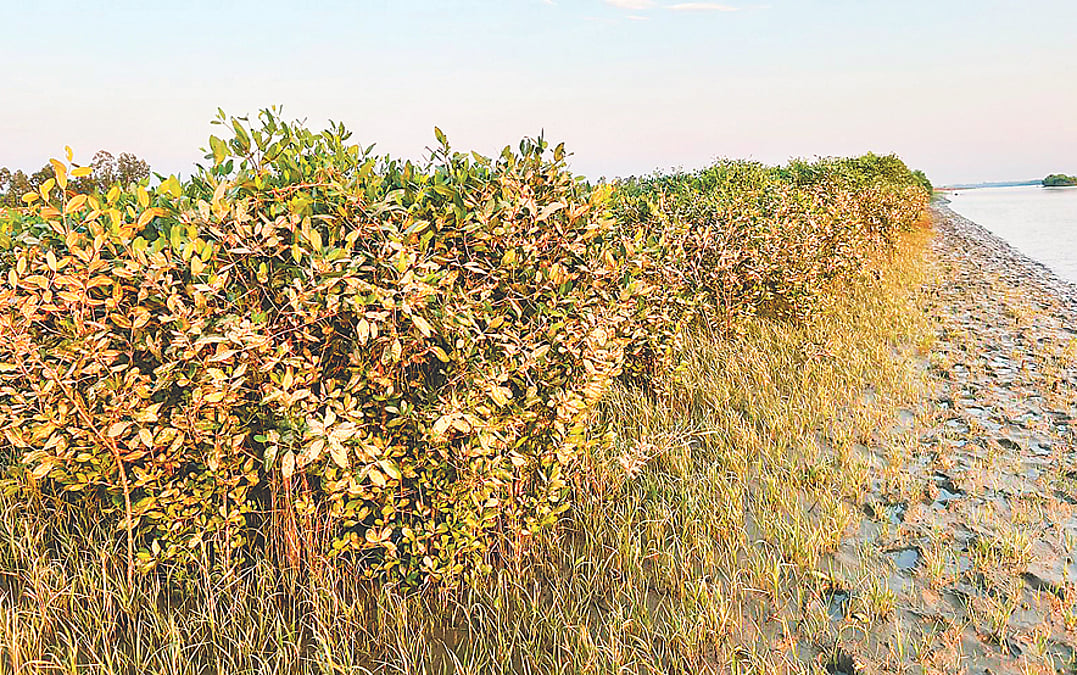
Baen mangroves planted on trial plots are raising hopes of bringing back the Chakaria Sundarbans, the ancient mangrove forest in Cox's Bazar's Chakaria upazila that has all but disappeared, Prothom Alo's Mostafa Yousuf reports in a special report. Survival rates are described as satisfactory, and those involved say the forest's biodiversity can be restored if four conditions, starting with the return of tidal flow, are met.
Lying along the Matamuhuri river on the road from Chattogram to Cox's Bazar, the Chakaria Sundarbans was one of the subcontinent's oldest mangrove forests and was declared a reserved forest in 1903. In the 1950s it covered about 21,102 acres. Later, 4,000 acres were kept under the Forest Department and the rest was leased to individuals and organisations for shrimp farming. Organised encroachment and what the paper calls the wrong policy of the government of the day have left a single tree standing.
Since July last year the NGO CODEC (Community Development Centre) has planted 80,000 baen saplings on 25 acres in the Badarkhali channel, part of the forest, and says their survival rate is satisfactory. In June this year another 40,000 baen were planted on 25 acres in Rampura mouza. On the 10th of this month the Forest Department mapped the sites set aside for planting and promised regular guarding. The Arannayk Foundation is also planting mangrove seedlings.
CODEC project officer Sheetal Kumar Nath said baen had performed best of the mangrove species planted in the Badarkhali channel, and the results of this year's planting are awaited. "There are many shrimp-farm embankments in the Chakaria Sundarbans. Because of them the tidal flow does not reach here. We have to think about how to bring it back," he said.
Professor Khaled Misbahuzzaman of Chittagong University's Institute of Forestry and Environmental Sciences, who took part in a 2014 study in the International Journal of Ecology that tracked 240 mangrove seedlings for three months, said two baen species, white baen and morcha baen, had survived better than others, with morcha baen growing faster. He listed four barriers: leaseholders who see mangroves as a threat to their business, polders and shrimp-farm dykes that block the tide, forest soil degraded by four decades of salt and shrimp farming, and the altered course of water through the forest. Political will is needed, he said.
State Minister for Environment, Forest and Climate Change Sheikh Faridul Islam, who visited the forest on 10 August, told the paper that 4,000 acres remain recorded in the Forest Department's name despite the leases, and that because the fisheries, agriculture and land ministries never demarcated the leased plots, leaseholders have taken Forest Department land as well. "Our first goal is to recover the forest land in the Forest Department's name," he said, after which other leases would be cancelled step by step and biodiversity restored.
Bangladesh Paribesh Andolon general secretary Md Alamgir Kabir said the government's pledge to plant 250 million trees would gain a unique achievement if the Chakaria Sundarbans returned, which needs a coordinated eviction drive and a phased expert plan. The report cites UNEP on the role of mangroves in protecting coasts and fisheries, and notes that Vietnam restored some 35,000 acres of the war-destroyed Can Gio mangroves by 1996 by matching species to tested soil.
Source: Prothom Alo — Reporting: Mostafa Yousuf, Prothom Alo
Comments
(0)