
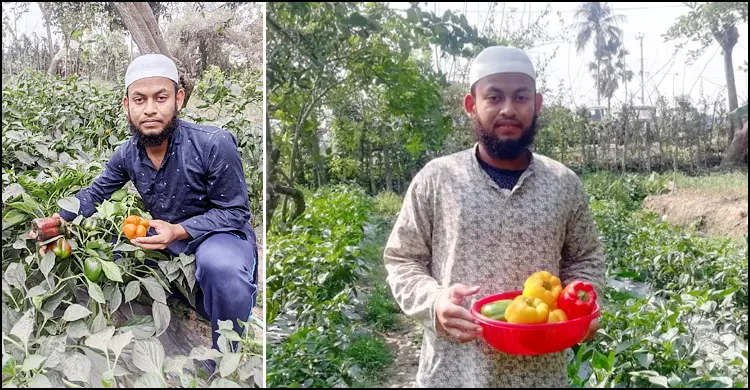
Md. Sohel Rana, a third-year student in the Agrotechnology Discipline of Khulna University, has succeeded in growing capsicum in low light. The research was conducted at the Germplasm Centre under the supervision of Prof. Dr. Md. Abdul Mannan of the discipline.
The research
Sohel researched red, yellow, green, orange and purple capsicum, growing them in an environmentally friendly way in low sunlight using mulching sheets. Even in shaded conditions, each plant bore about 10 to 15, and up to 20, capsicums weighing about 70 to 200 grams each, and each plant yielded 700 to 900 grams on average.
Managing pests and diseases
- The biggest obstacle is mite and insect attack, especially aphids, thrips and whiteflies. He applied imidacloprid- or acetamiprid-group insecticides such as Builder or Tundra the day after transplanting.
- Using carbofuran-group Furadan with chemical fertiliser at land preparation prevented bacterial wilt; the first flowers always drop, and a plant growth regulator is used to reduce flower drop.
- Chilli leaf curl virus is very harmful; infected plants must be removed and buried or burned, and its vectors, whiteflies, aphids and thrips, controlled.
- Neem oil and kaolin (organic) gave good results against aphids and thrips, though good-quality kaolin is hard to find in Bangladesh. Lambda-cyhalothrin and thiamethoxam insecticides (Karate, Alteemo Plus) or acetamiprid (Tundra) were used against whiteflies and aphids, and spinosad products against thrips.
- Mite attack curls leaves downwards, virus attack upwards; miticides such as Vertimec, Intrepid or abamectin were used, with fungicides such as carbendazim or mancozeb added at each spray and insecticides rotated because mites become resistant.
Growing conditions and returns
Capsicum grows best at 16 to 21°C, and planting in November gives good yields. Above 30°C fruits stay small, sunburn spots appear and plants do not live long; above 21°C yields start to fall, when a polyhouse cover is needed. In his project, mulching sheets were used to keep temperatures down. Green capsicum is ready in 90 to 100 days, and coloured ones in 125 to 135 days. Rows and plants are spaced 45 cm apart, and with everything right, yields reach 20 to 25 tonnes a hectare.
Sohel told Jagonews24 that capsicum, as an exotic vegetable, fetches much higher prices than others, with strong demand from large hotels and restaurants; the wholesale price is Tk 200 to Tk 300 a kg, and a plant costing Tk 30 to Tk 40 can earn Tk 150 to Tk 200. Growing it could make farmers self-reliant and benefit agriculture in the south.
Source: Jagonews24. First published in Bengali on The Agro News.
Comments
(0)