
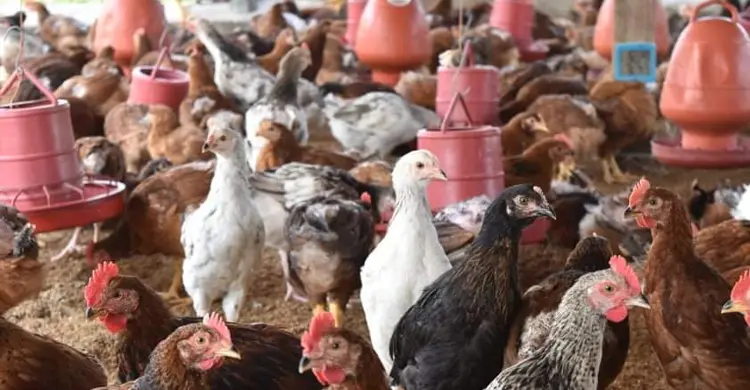
As living standards change, tastes and diets change too, and demand for animal protein has risen. Broilers supply a large share of meat. Local (desi) chicken has a unique taste but is in very short supply. Against this backdrop, the Bangladesh Livestock Research Institute (BLRI) has used local germplasm to develop a high-meat chicken breed named "Subarna", whose meat tastes like desi chicken.
Why a local breed
According to the Department of Livestock Services, 40 to 45 per cent of the country's meat comes from poultry, and meeting Vision 2041 requires producing 35,000 to 40,000 tonnes of chicken meat a day. But climate change directly affects the industry, and the parents of all broiler and layer breeds are imported, so production suffers as the climate changes.
Scientists in BLRI's Poultry Production Research Division developed the breed, named BLRI Meat Chicken-1 (Subarna), through continuous selection and breeding of local germplasm, combining a female line adapted to local weather with an improved local male line.
Performance
At eight weeks, the multi-colour table chicken averages 975 grams to one kilogram, eating about 2.2 to 2.4 kg of feed. Mortality is very low, at most 1.5 per cent in BLRI trials, and the breed is highly disease-resistant; with good biosecurity, disease is rare. Raising 1,000 birds for eight weeks can earn 40,000 to 60,000 taka, or 180,000 to 240,000 taka a year from four batches. Because its taste and mixed-colour feathers resemble desi chicken, farmers can get a slightly higher price, while the cost stays close to broilers.
Litter should be dry rice husk, 1-2 inches deep in summer and 3-4 inches in winter, turned regularly and changed if wet. Droppings can be used for biogas or as fertiliser.
Commercial production
Dr Md Rakibul Hasan, chief scientific officer of the division, said Subarna will be priced like Sonali chicken, within people's reach. Parent stock need not be imported, cutting costs; a hen lays about 250 eggs a year, giving 180 to 185 chicks. Paragon has started commercial production, and its first chicks were due on the market the following week.
Source: Jagonews24. First published in Bengali on The Agro News.

Comments
(0)