
Rotational grazing can improve veld condition and keep palatable grasses productive, but only if livestock numbers match the forage the land grows and the grass is given time to recover, according to Dr Lesego Motshekga, a senior lecturer in pasture science at the University of Limpopo, speaking to Farmer's Weekly in South Africa.
"Rotational grazing controls the grazing pressure and the recovery time for our rangeland," she said. It will not mend a farm that carries more animals than it can feed: moving too many animals between camps does not solve a shortage of grass, and overgrazing follows however often the herd is moved. Nor do more camps by themselves mean better management, she said; a farm with few camps can do well with the right stocking rate, and one with many can still degrade if animals stay too long or return too soon.
Her practical rule is "take half, leave half": move animals on when about 40% to 50% of the leaf material in a camp has been eaten, so the remaining leaves can drive regrowth. She warned against fixed periods such as 14 or 21 days set by the calendar, because a stay that is safe in a wet spell can overgraze in a dry one. Farmers should walk their camps and judge recovery from the vegetation.
In semi-arid Limpopo the main growing season runs from October to April, depending on rain. In spring, when perennial grasses push new shoots on stored reserves, severe or repeated grazing should be avoided. In early summer she suggests short grazing periods of roughly three to 10 days with longer rests; in January and February, at peak growth, grazing days can be increased if the veld keeps recovering; by March and April pressure should come down again. Winter, she said, is not automatically a recovery period, since dormant grass is not regrowing.
She also recommends resting selected camps for a full growing season, from October to April in the Limpopo case, so grasses can complete their cycle, strengthen their roots and set seed that replenishes the soil seed bank after drought, fire or overgrazing.
Each camp needs reliable water, the costs of fencing, water points and labour should be counted before a system is built, and animals with higher needs, such as growing, lactating and breeding stock, can be given the better forage. Water points and supplementary feed draw animals together, so their placement matters. With an El Nino year under way, she advised farmers to review stocking rates and to be cautious about adding animals after a good season.
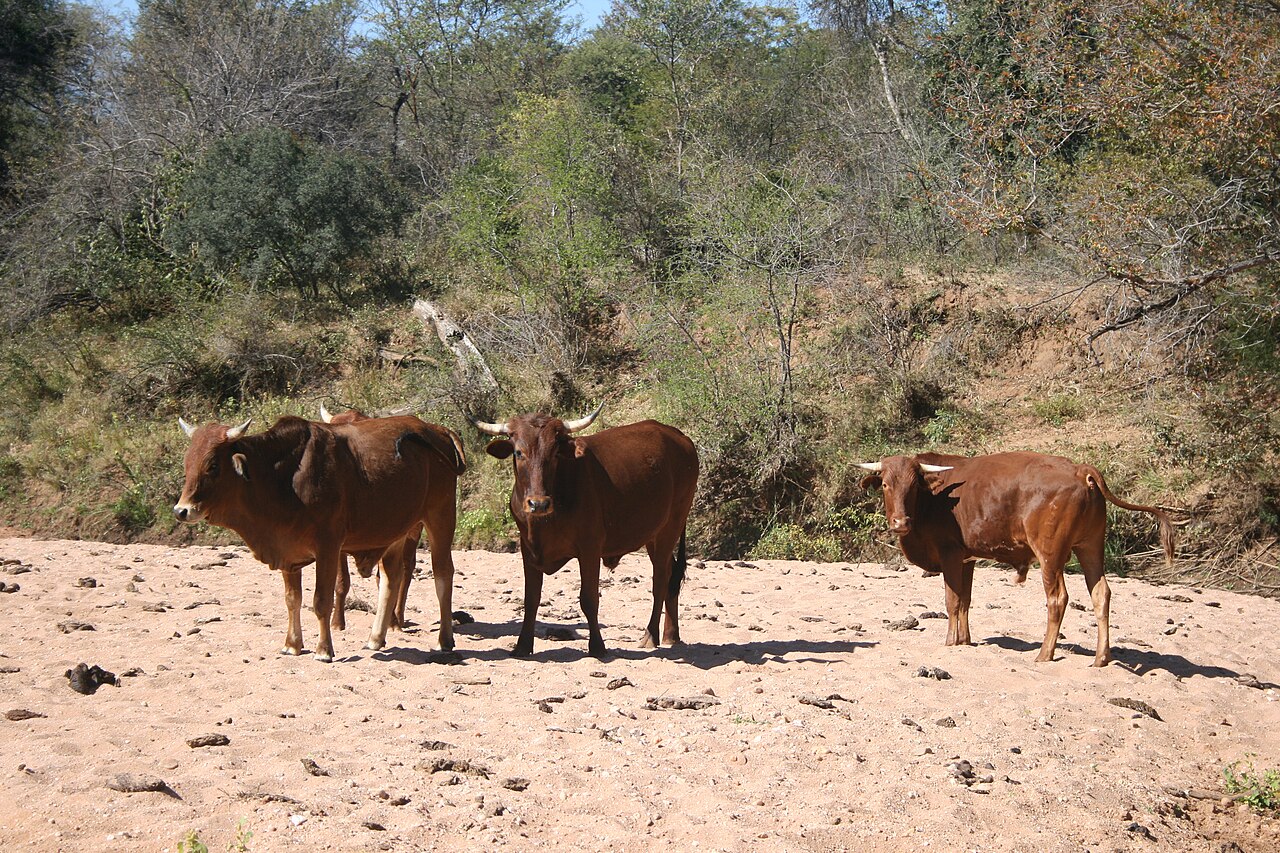
Photo: JMK / Wikimedia Commons (CC BY-SA 4.0), cattle on the bed of the Mogalakwena River in Limpopo
Source: Farmers Weekly South Africa

Comments
(0)