
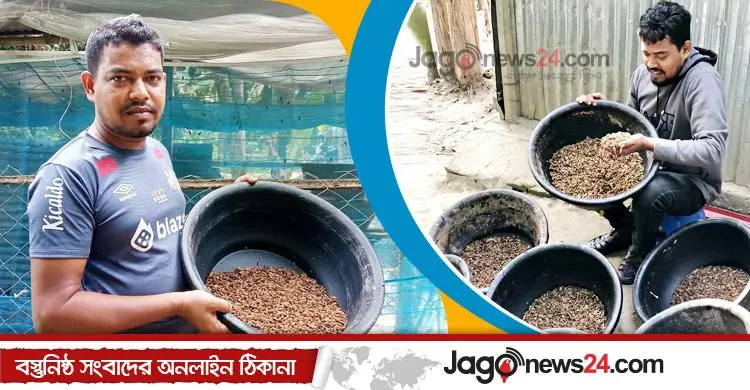
Shimul of Parsidhai village in Atghoria upazila, Pabna, completed a diploma in fashion design and started out in a job, but wanted to become a duck-farming entrepreneur. He lost 1.8 million taka. Inspired by YouTube videos, he then turned to farming an insect called the black soldier fly, and it changed his fortunes. He now earns about 200,000 taka a month on average, and the number of such farms is growing.
From losses to larvae
In 2018 he left his job in Dhaka to set up a commercial duck farm at home, but it failed, leaving him with 1.8 million taka of debt. After watching videos on black soldier fly farming, he trained first at Bangladesh Agricultural University and then with the Pabna NGO Program for Community Development (PCD), which also helped him with credit, technology and market links. Within three years he repaid 1.6 million taka of loans and now owns three farms, including in Cox's Bazar and Pabna.
How it works
The adult flies are kept in a net in a place with daylight and air. After mating, they lay eggs in layers of wood. The hatched larvae are moved elsewhere after 8 to 10 days and, within 20 to 30 days, grow into grubs that are fed to fish, ducks and chickens. Larvae left longer turn into flies, which live 8 to 10 days. The larvae are fed rotten chicken offal, fish and other waste.
Shimul has exported mother flies to India, Nepal, Bhutan and Pakistan and sells to traders locally and in Dhaka. He is now setting up a large farm in Cox's Bazar for about 3 million taka.
A growing sector
Bangladesh has about 60,000 poultry and duck farms. To supply feed, more than 280 entrepreneurs in 25 districts farm black soldier fly commercially, producing over 70 tonnes a month worth about 5 million taka. The International Fund for Agricultural Development (IFAD), the Palli Karma-Sahayak Foundation (PKSF), DANIDA and others have funded the development of these entrepreneurs.
Pabna district fisheries officer Dipak Kumar Pal said commercial fish and poultry feed contains at most 33 per cent protein, while these larvae contain 43 to 55 per cent. A kilogram costs 10 to 12 taka to produce and sells for 50 to 80 taka. PCD executive director Md Shafiqul Alam said the organisation supported Shimul with training, credit and technology from the start.
"At first many people mocked me for farming insects, some even despised me," Shimul said. "With patience and hard work, success will come."
Source: Jagonews24 (reported by Alamgir Hossain Nabil). First published in Bengali on The Agro News.
Comments
(0)