
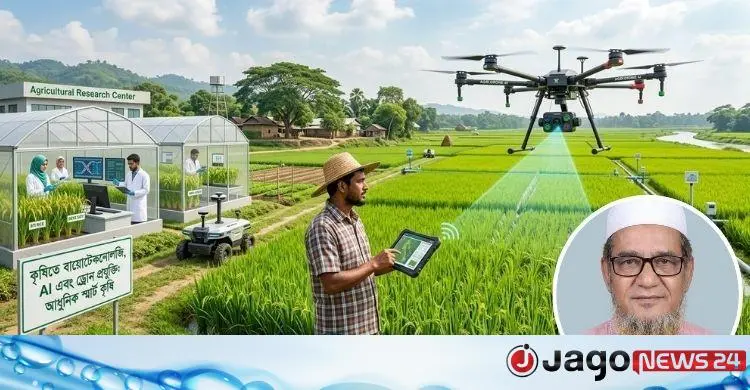
Bangladesh is small in area but large in population, in the intensity and diversity of its farming and in the natural vitality of its fertile soil. Its farming families have revived agriculture after disaster after disaster for a thousand years, making the country one of the world's leading producers of rice, potatoes, vegetables, fruit, jute and fish. Its 180 million people now face their biggest threat from weather: cyclones, tidal surges, floods, salinity, drought, storms, excessive or scant rain, heatwaves and cold waves, arriving increasingly out of season.
What biotechnology offers
Biotechnology uses living microorganisms and their components to make commercial products for human welfare. In plants it covers improving plant resources, extracting useful components, developing new disease-resistant varieties and conserving plant diversity. Its most widely applied form is tissue culture, which can produce seedless fruit and crops that do not set seed, and has given rise to plant industries in many countries.
- **Golden Rice:** Thousands of children in Bangladesh and other Asian countries go blind for lack of vitamin A. In 1999, Swiss scientist Ingo Potrykus and German scientist Peter Beyer and their colleagues used genetic engineering to develop vitamin A-rich Golden Rice, known as "super rice", to address this among rice eaters in Asia, Africa and Latin America.
- **Cleaner farming:** Environmental biotechnology, eco-friendly agrochemicals and microbial fertilisers can cut pollution, and biopesticides are replacing chemical pesticides worldwide.
- **Genetic engineering and cloning:** These have made it possible to replicate plants and animals, decode gene maps and create plants with desired traits.
India is advancing rapidly in biotechnology, and biotechnology products are the main export of Moldova, a small European country. Bangladesh is still at an early stage, although biotechnology could help tackle salinity in the south-west, viruses in shrimp, the country's main export, and the protection of Sundarbans biodiversity. Agricultural and technology universities could play an important role.
Government push on AI and drones
The government is expanding the use of AI and drones and aims to turn agriculture into a technology-driven, profitable, competitive and sustainable sector through research, innovation and mechanisation. Its measures include:
- farmer registration, a farmer database, digital services, mobile weather and market information, e-extension and online service platforms;
- farmer card distribution to bring about 27.5 million farmers onto a digital platform;
- remote sensing, Artificial Intelligence (AI), the Internet of Things (IoT), drones, GIS, satellite data and big data to monitor crop health and yield, detect diseases, and manage fertiliser, irrigation and production planning;
- precision agriculture advice on which crop suits which area and season, fertiliser needs and weather, and more use of organic fertiliser and biofertilisers.
Conclusion
These steps, the writer says, are making agriculture more productive, profitable, export-oriented and climate-smart. Skilled people and better laboratories are needed, and the challenge ahead is for Bangladesh to overcome its obstacles and advance in biotechnology.
Source: Jagonews24. First published in Bengali on The Agro News.
Comments
(0)