
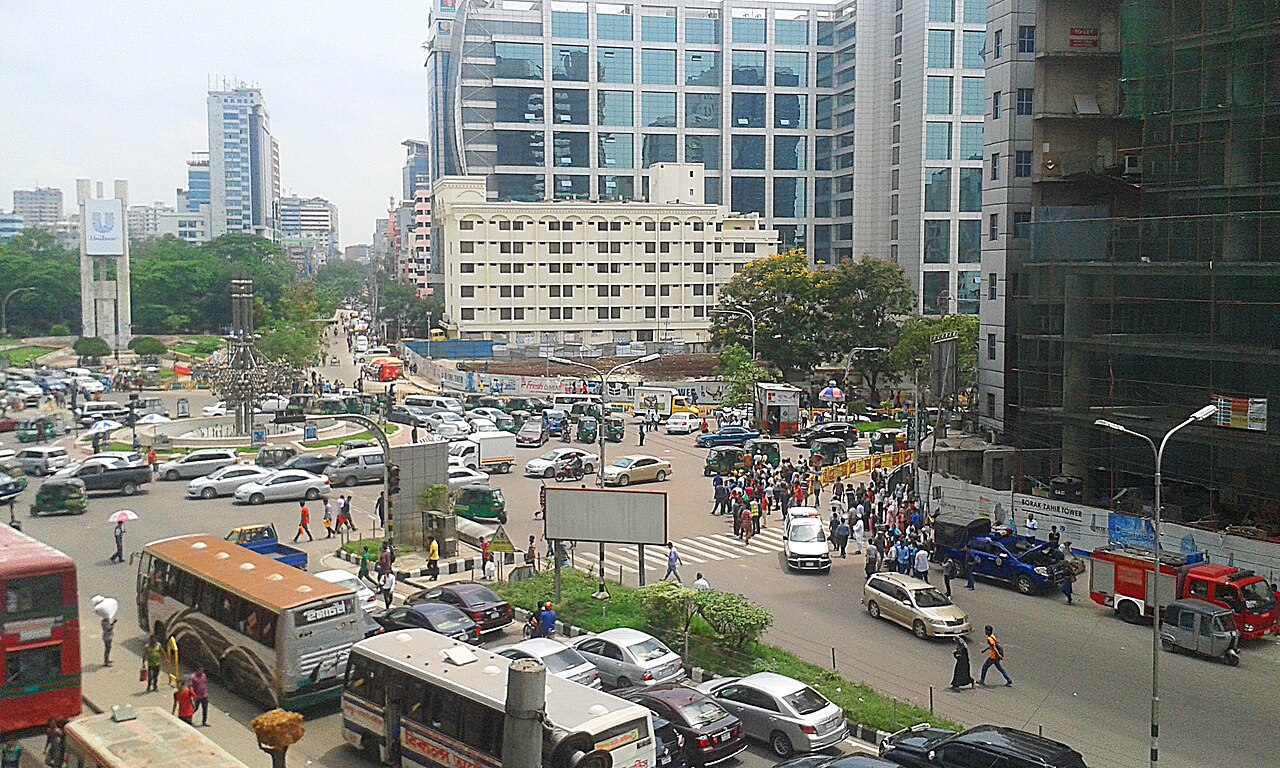
On 22 September 2025 Jagonews24 published a guide to Bazardor, a free Android app of the Directorate of National Consumer Rights Protection (DNCRP) that shows the daily prices of more than a hundred essential goods. The app lists rice, flour, edible oil, sugar, salt, pulses, potatoes, spices, fish, meat, milk, eggs, vegetables and fruit, as well as cooking gas and other fuels. The directorate had launched it in Dhaka on 23 June 2025, and in September it was promoting it so that shoppers anywhere in Bangladesh could check what an essential should cost before they reached the market.
Knowing the right price of an item on a given day is hard for ordinary shoppers. A buyer may go round several shops comparing the prices of onions, green chillies, vegetables, fish or meat and find them all much the same, with no independent figure to compare them against. The name of the app, which means "market price" in Bengali, describes what it offers: one official reference figure for each product, updated every day and readable on a phone.
A consumer directorate's app, launched in June 2025
The director general of the Directorate of National Consumer Rights Protection inaugurated the Android application on Monday, 23 June 2025, Khoborsangjog and Desh Rupantor reported that day. At the launch it was announced that the app would let anyone, from anywhere and at any time, see the highest retail prices of goods in the retail markets of all 64 districts of Bangladesh. The directorate itself supplies the daily retail price information shown in the app.
The app was built free of charge by Daffodil Institute of IT, to the directorate's requirements. The app's developer said at the launch that Bazardor would ensure the free flow of information needed to stop the manipulation of prices in commodity markets, and that this would make it easier to secure fair prices of essential farm products for consumers. The director general said that when consumers know the real highest price of a product, cheating over prices would gradually decline.
Bazardor can be downloaded on any Android phone. With users' convenience in mind, the developers also made it usable offline, so that prices can be checked even when the phone has no internet connection. In September 2025 the app was offered through the Google Play Store; the reports of the time describe it only as an Android application.
Three months after the launch the directorate stepped up its promotion. On Thursday, 18 September 2025, an assistant director of the directorate, who is also an executive magistrate, urged people in a video message to use it. "You go to market every day, but are you unsure which price of an essential is the correct one? Worry no more! The Directorate of National Consumer Rights Protection has brought the Bazardor app. Here you will find the market prices of daily essentials updated every day. Install the Bazardor app from the Google Play Store, know the daily market prices and stay aware," he said, according to Khoborsangjog. Jagonews24's guide four days later repeated the same message: shoppers need no longer be unsure of the correct price of essentials when they go to market.
How to check a price in the Bazardor app
According to the descriptions published in June and September 2025, using the app takes only a few steps:
- Open the Google Play Store on an Android phone, search for Bazardor (in Bengali, বাজারদর) and download and install the app.
- When the app opens for the first time, register your division and your district, so that the prices shown are those for your area.
- Choose one of the two main options on the home screen: "Food items" (খাদ্যসামগ্রী) or "Others" (অন্যান্য).
- Inside the option, pick the group you need, such as rice, pulses, spices, fish and meat, vegetables, fruit or fuel.
- Select the particular product, for example coarse rice, large-grain lentils or a 12 kg LPG cylinder, to see that day's price.
- Because the app also works offline, the price can be read at the market itself even where there is no mobile internet.
The figure the app shows is meant as a reference. At the launch the directorate described it as the highest retail price in the district markets, so a shopper can hold it against the price a trader asks. The directorate's hope, in its director general's words, was that informed consumers would make overcharging harder over time.
Rice, flour, oil, sugar, pulses and spices
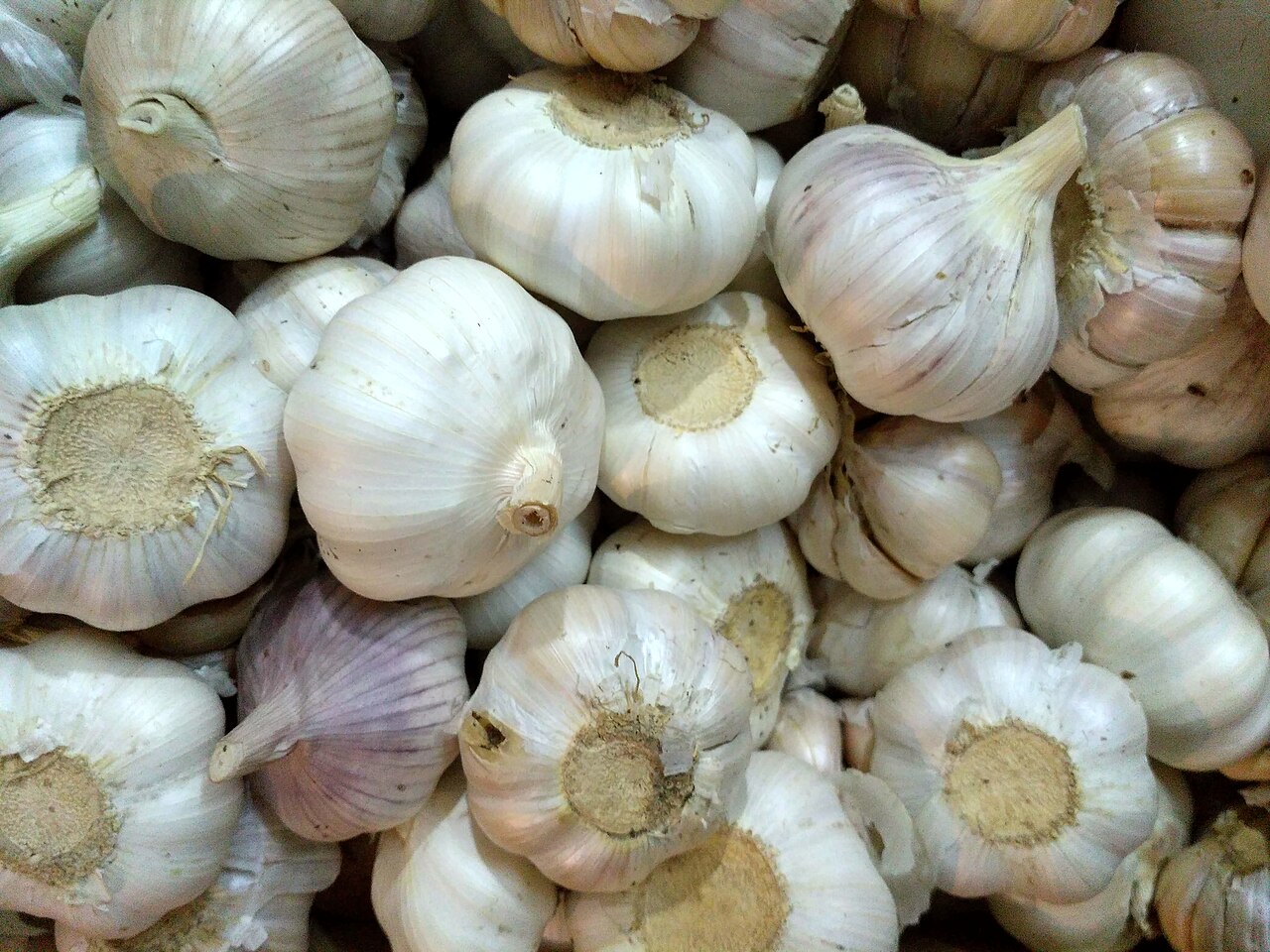
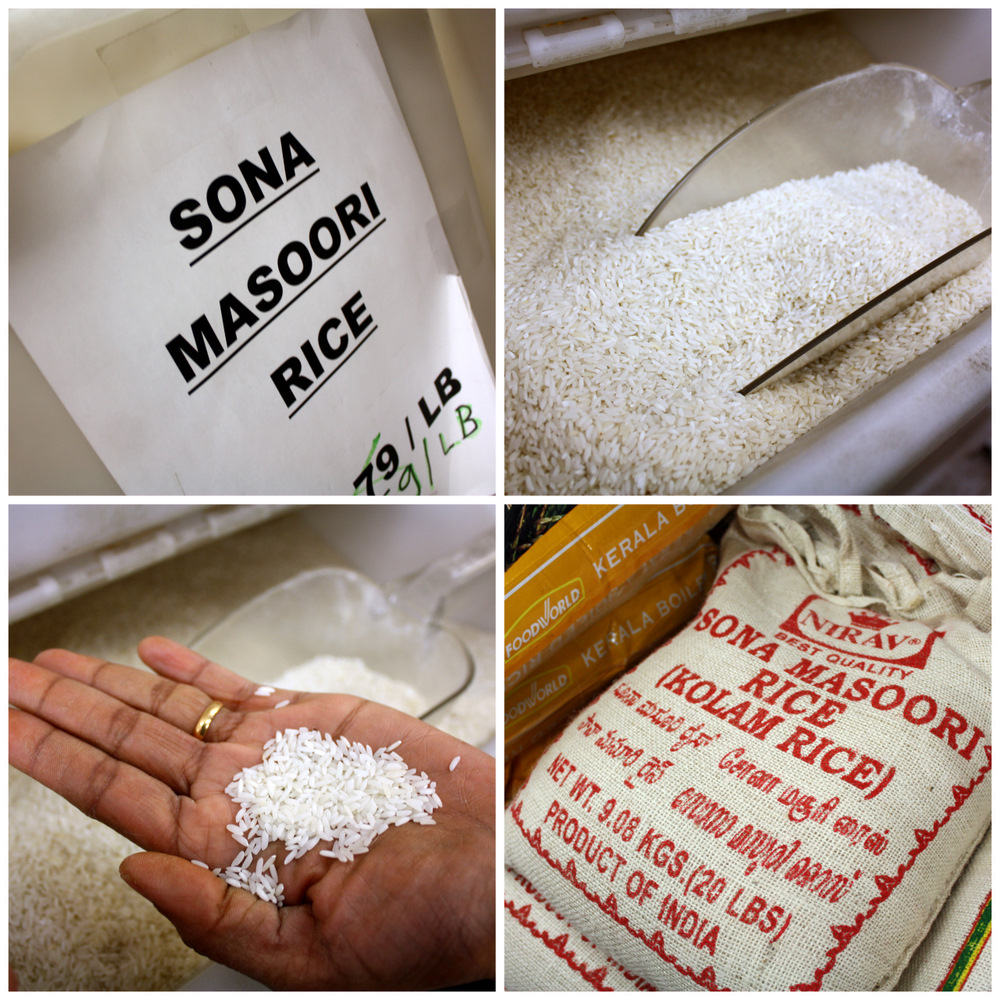
The app has two main sections, "Food items" and "Others". The food section covers rice, atta and maida, edible oil, sugar, salt, pulses, potatoes, spices, fish and meat, milk, eggs, leafy and other vegetables, and fruit, with prices updated daily. Rice, the staple food, is listed in five kinds: fine rice (Nazirshail or Miniket), medium rice (Pajam or Atash), coarse rice (Swarna or China IRRI), aromatic rice and Kataribhog, a fine aromatic rice.
For atta and maida, prices are given for both loose and packaged flour, and the same group shows the price of packaged semolina (suji). Sugar is split into loose and packaged and into white and brown, each with its own price. Salt too has separate loose and packaged prices. Among pulses, the app separates masur (red lentil) by grain size into large, medium and small; mung into fine and coarse; and anchor dal as a further item.
Potatoes are listed as Diamond, red and Holland varieties, with sweet potato alongside. The spice list is long. It covers local onion, garlic (local and imported), green chilli, dried chilli (local and imported), local turmeric, local ginger, cumin, cinnamon, cloves, cardamom, coriander and bay leaf, so that the cost of the ingredients of an everyday curry can be checked item by item.
Several of these items are ones the state has stepped in on before. Banglapedia notes that in emergencies the state-owned Trading Corporation of Bangladesh imports onion, lentil, salt, dry chillies, dates and ginger, and the Department of Agricultural Marketing and the Ministry of Commerce had tried to cap the prices of onion, lentil, edible oil and sugar in earlier years, as described below.
Fish, meat, eggs, milk, vegetables and fruit
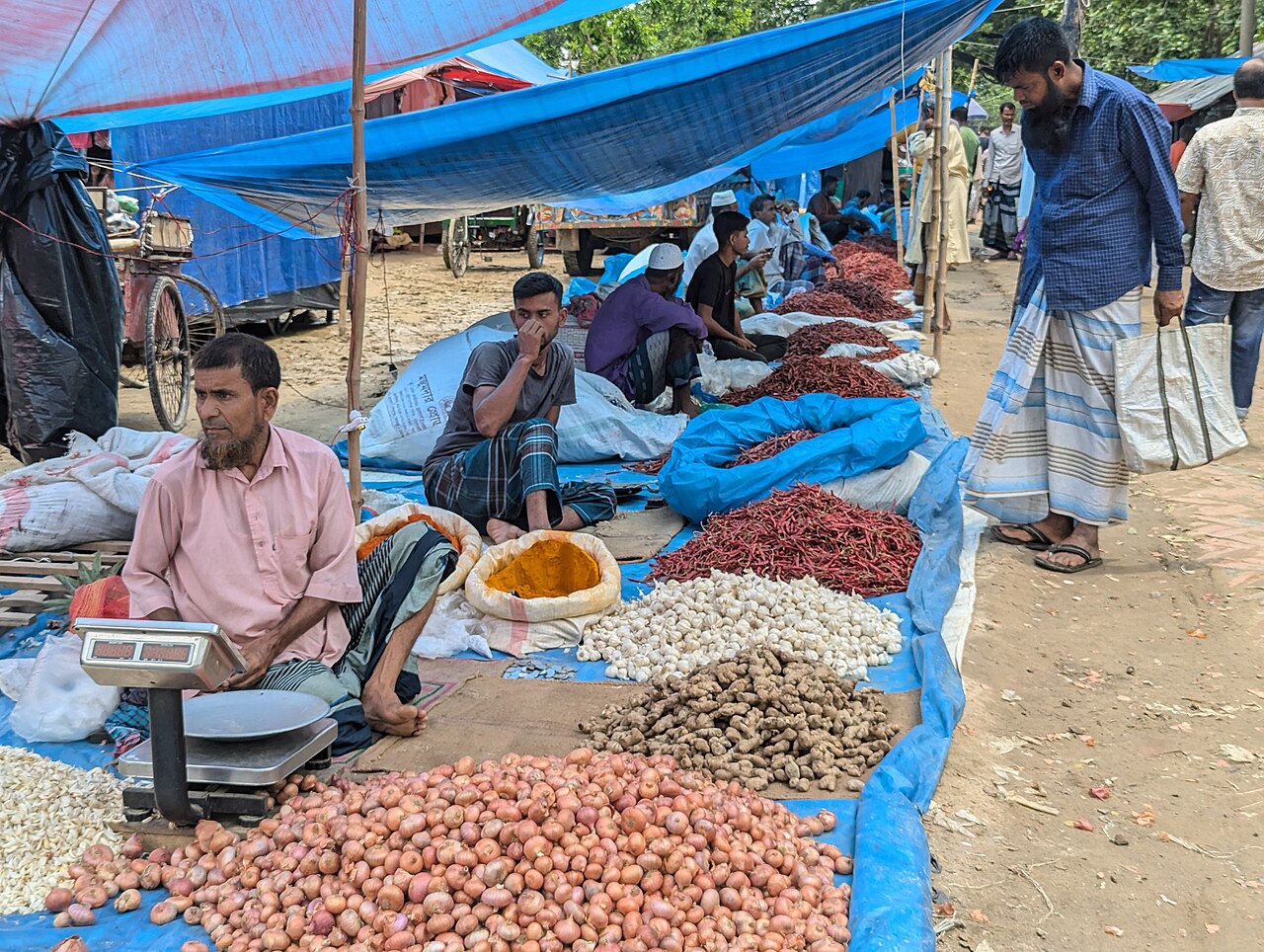
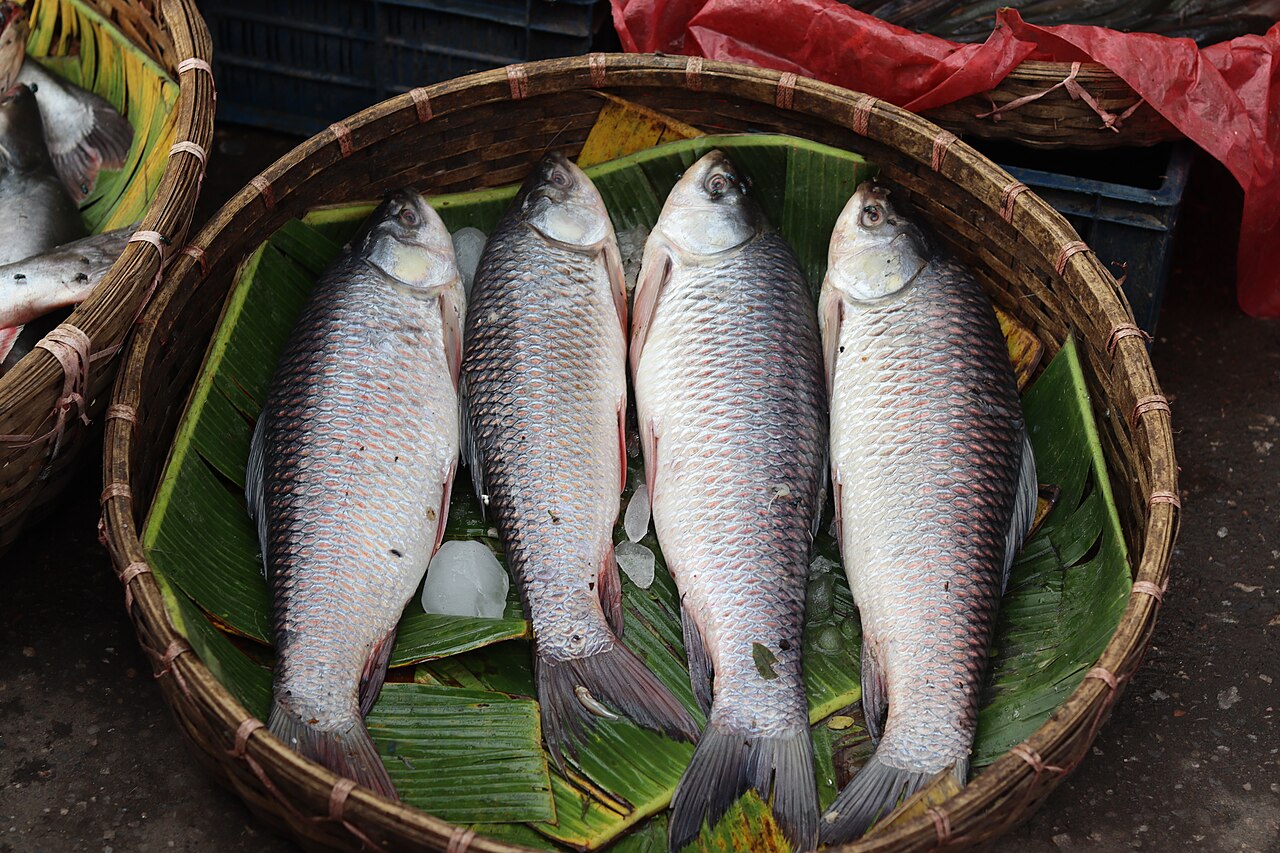
The fish and meat group is the largest in the app. Before buying, a shopper can look up the daily price of rohu, catla, chital, boal, air, silver carp, gold carp, grass carp, hilsa (under one kilogram and over one kilogram), pangas (farmed and river), shrimp (small, medium and large), mola, kachki, shol, shing (local and farmed), magur (local and farmed), koi (local and farmed), tilapia, baim, tengra, taki, batashi, shulsha, gajar, pabda, cheuwa, bele, puti, sar puti, rupchanda, poa, coral (red and white), surma, rita and loitta.
For meat the app lists beef, buffalo, castrated goat (khashi) and female goat, chicken (cock or Sonali, broiler, local and turkey), duck (local, goose and China duck), pigeon and quail. The dairy and egg entries cover liquid milk, chicken eggs (brown, white and local), duck eggs and quail eggs.
Leafy and other vegetables include Malabar spinach (pui shak), red amaranth (lal shak), water spinach (kalmi shak), spinach, jute leaves, taro leaves, pointed gourd, aubergine (long and round), yardlong bean, jali, sweet pumpkin, green papaya, ripe papaya, tomato, bottle gourd (small, medium and large), snake gourd, ridge gourd, bitter gourd, carrot, okra, lemons (round, long, pomelo and kagzi), coriander leaves, green banana, cucumber, sponge gourd, teasle gourd, taro corms (kachur mukhi), satkara and chui jhal.
The fruit list includes guava (Kazi and local), jackfruit (small, medium and large), pineapple, pomelo, jamun, jujube (boroi), mangoes (Fazli, Himsagar, Langra, Amrapali, Kathimitha, Lakhmanbhog, Gopalbhog, Haribhanga, Gobindabhog, Banana mango, Katimon and BARI Aam-4), apples (green and Fuji), malta (imported and local), dates (ordinary, Mariam and Ajwa), oranges (local and Chinese), latkan, tamarind, pomegranate, green coconut, coconut, bananas (Sabri, Sagar and Champa), grapes (red and black) and dragon fruit.
Taken together, these lists show why the reports spoke of more than a hundred products: the app separates not only goods but also their kinds, sizes and origins, which is how prices differ in a real market. A kilogram of hilsa under one kilogram in weight, for example, does not cost the same as one over a kilogram, and local shing or magur sells at a different price from the farmed fish.
Fuel prices in the "Others" section
The "Others" section was, by September 2025, used only for fuel. It shows the daily prices of liquefied petroleum gas (LPG) in 12 kg, 12.5 kg, 30 kg and 35 kg cylinders, and of diesel, kerosene, octane and petrol. Jagonews24 described the cylinder sizes as 12 kg, 30 kg and other weights; the directorate's September promotion listed all four.
Prices and the cost of living in 2025
The app arrived after a long period of high prices. Data from the Bangladesh Bureau of Statistics (BBS), reported by the Dhaka Tribune on 7 September 2025, put point-to-point inflation in August 2025 at 8.29 percent, down from 8.55 percent in July. It was the smallest increase since August 2022, the bureau's data showed, and the easing came mainly from non-food prices while food prices continued to rise.
The same BBS data showed wage growth for low-paid skilled and unskilled workers at 8.15 percent in August 2025, the 43rd month in a row in which wages had risen more slowly than prices. The Bangladesh Bank had set a target of keeping inflation within 6.5 percent in the 2025-26 financial year. For households whose wages lag behind prices, paying even a few taka more than necessary for rice, oil or fish matters, and that is the gap a daily price reference is meant to narrow.
Earlier efforts to set and publish prices
Bazardor was not the first government attempt to tell consumers what goods should cost. The Department of Agricultural Marketing (DAM), an agency under the Ministry of Agriculture, fixed what it called "reasonable prices" for 29 farm products on Friday, 15 March 2024, during Ramadan, Prothom Alo reported two days later. The department said it acted under section 4(ঝ) of the Agricultural Marketing Act 2018, which lists among its functions the setting and implementation of minimum and reasonable prices of farm products. It worked out production costs and added a set margin at the producer, wholesale and retail stages.
The figures it published show how the method worked. Broiler chicken cost 146 taka a kilogram to produce, the department said, and it set the retail price at 175 taka. For beef, a production cost of 588 taka a kilogram became 605 taka at the producer stage, 632 taka wholesale and 664 taka retail, while the beef was then selling at 730 to 780 taka a kilogram. A kilogram of potatoes cost less than 14 taka to produce and had a reasonable price of 29 taka, yet sold at 40 taka in Dhaka's Kathalbagan market. The list also covered pulses, fish, meat, eggs, onions and other spices, vegetables, dates, chira (flattened rice) and Sagar bananas.
Prothom Alo found that the rates were mostly not followed. Comparing the official list with the market price list of the Trading Corporation of Bangladesh (TCB) and visiting four Dhaka markets, it found that of the 29 items only imported ginger, anchor dal gram flour and the banana known as Nepali Sagar were selling at the set prices. Traders at Karwan Bazar, Kathalbagan, Malibagh and Shahjahanpur said they had not been told of the new rates, and that they could not sell at them in any case because they had bought at higher prices. DAM itself could not take legal action when its prices were ignored: it could file complaints, and magistrates would decide.
Earlier attempts had fared the same way. DAM had fixed prices for chickpeas, onions, edible oil, lentils, sugar and dates in 2021, without effect in the market, and in September 2023 the Ministry of Commerce had set the prices of six products, which were not followed either. The Bangladesh Trade and Tariff Commission, under the commerce ministry, can also set prices after analysing production and import costs; in March 2024 the commerce ministry's fixed prices applied to edible oil, sugar and ordinary dates. The president of the Consumers Association of Bangladesh (CAB), himself a former commerce secretary, told Prothom Alo that prices depend on supply, and that fixing prices had to go together with better supply, control of extortion, enforcement and efforts to raise incomes.
TCB is the oldest of these institutions. According to Banglapedia, it is an autonomous state-owned trading enterprise under the Ministry of Commerce, set up in 1972 by Presidential Order No 68, with its head office at Karwan Bazar in Dhaka. One of its original functions was to keep watch on the supply and price situation of essential goods. To ease the hardship of low-income people when prices rise, it imports sugar, soybean oil, lentils and gram and sells them through dealers across the country; its Banglapedia entry gives the number of dealers as 2,849. TCB also publishes a daily retail market price list on its website, the list Prothom Alo used in its 2024 comparison. What the DNCRP's app added was a daily figure for each district, delivered straight to a buyer's phone.
What the consumer rights law says
The directorate behind Bazardor exists under the Consumer Rights Protection Act 2009 (Act No 26 of 2009), dated 6 April 2009. Section 18 of the Act provides for a directorate named the Directorate of National Consumer Rights Protection, with its head office in Dhaka under section 19 and district offices where the government decides. Under section 21 its director general may take all measures needed to protect consumers' rights, prevent acts against those rights and settle complaints, including monitoring weights and measures, adulteration, fake goods, expiry dates and false advertising.
The Act defines acts against consumer rights. They include selling or offering to sell a product, medicine or service above the price fixed under any law or rule; knowingly selling adulterated goods; selling goods mixed with substances banned in food; deceiving buyers with false advertising; not supplying what was paid for; giving short weight or short measure; using weights, scales or measuring tapes that show more than the true amount; making fake goods or medicine; and selling expired goods or medicine.
Two provisions concern prices directly. Under section 38, a trader who, in breach of a duty imposed by law or rule, does not hang a price list in an easily visible place in the shop faces up to one year's imprisonment, a fine of up to 50,000 taka, or both. Under section 40, selling or offering to sell a product, medicine or service above a price fixed under any law or rule carries the same maximum penalty. The Act also sets up district consumer rights protection committees chaired by the deputy commissioner, and allows upazila and union committees.
Any consumer can complain. Under section 76, a person may file a written complaint about an act against consumer rights with the director general or an officer he authorises; the complaint is investigated, and if it is proved the officer may impose an administrative fine. If the fine is recovered, 25 percent of it is to be paid to the complainant, unless the complainant is an official or employee of the directorate. Section 60 requires the complaint to be made within 30 days of the cause arising. A price checked in Bazardor, set beside the trader's price, gives a shopper the information needed to judge whether a complaint is worth making.
Photo: Masum-al-hasan / Wikimedia Commons (CC BY-SA 4.0)
Sources: Jagonews24, Khoborsangjog, Desh Rupantor, Prothom Alo, Dhaka Tribune, Banglapedia, Trading Corporation of Bangladesh, Consumer Rights Protection Act 2009 (Laws of Bangladesh)
Comments
(0)