
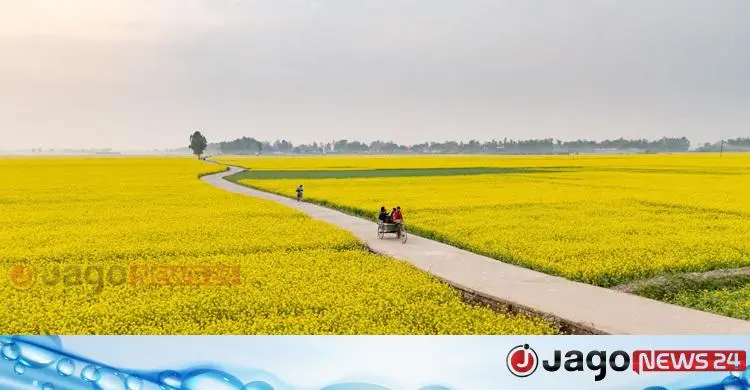
The gap between the Aman and Boro rice seasons is short, and much land used to lie fallow. Mustard grown between the two crops has become popular across the country, and agricultural scientists have been working on short-duration varieties with this in mind. The newest direction is BARI Mustard-20.
The variety
BARI Mustard-20 is short-duration and high-yielding, giving 10 to 15 per cent more than existing varieties, and tolerates salinity and drought. Developed by the Bangladesh Agricultural Research Institute (BARI), it is being spread in Sirajganj, one of the main mustard-growing districts, with help from the PARTNER project (Program on Agricultural and Rural Transformation for Nutrition, Entrepreneurship and Resilience in Bangladesh).
Farmers in several parts of Sirajganj are adopting it because it yields well in a short time and improves on BARI-14 and earlier varieties.
A 100-bigha demonstration
A 100-bigha demonstration of the new variety has been set up in the Jamuna char village of Purba Mohonpur in Soydabad union, Sirajganj Sadar, on the land of 35 farmers under the PARTNER project. Sirajul Islam, assistant scientific officer in BARI's on-farm research division, said farmers were given seed, fertiliser and other technology as pilot production. The mustard can be harvested in 75 to 80 days and should yield six to seven maunds per bigha with more oil, after which Boro will be planted.
Farmer Abdul Awal said his three and a half bighas in the demonstration used to lie fallow after the Aman harvest; this year he grew BARI Mustard-20 on the agriculture department's advice.
Mustard and honey
Sirajganj grows mustard on more than 90,000 hectares. This year the area is 90,550 hectares, up from 87,000 last year, and about 146,000 tonnes are expected, said A K Monjure Mowla, deputy director of the Department of Agricultural Extension (DAE). Other BARI varieties give four to five maunds per bigha; BARI-20 yields more and its short duration encourages farmers to add a crop before Boro.
Ullapara upazila, the district's top mustard area, is now the country's leading upazila for honey, producing 183 tonnes last year and an expected 195 tonnes this year, said upazila agriculture officer Subarna Yasmin. The district's honey target is 404,000 kg, and the market value of mustard and honey is 12 to 12.5 billion taka.
PARTNER programme coordinator Abul Kalam Azad said Bangladesh needs 2.4 million tonnes of edible oil a year but produces only 200,000 to 250,000 tonnes. To close that gap, the project has set up 657 mustard demonstrations nationwide this year, including new BARI-20 plots.
Source: Jagonews24. First published in Bengali on The Agro News.
Comments
(0)