
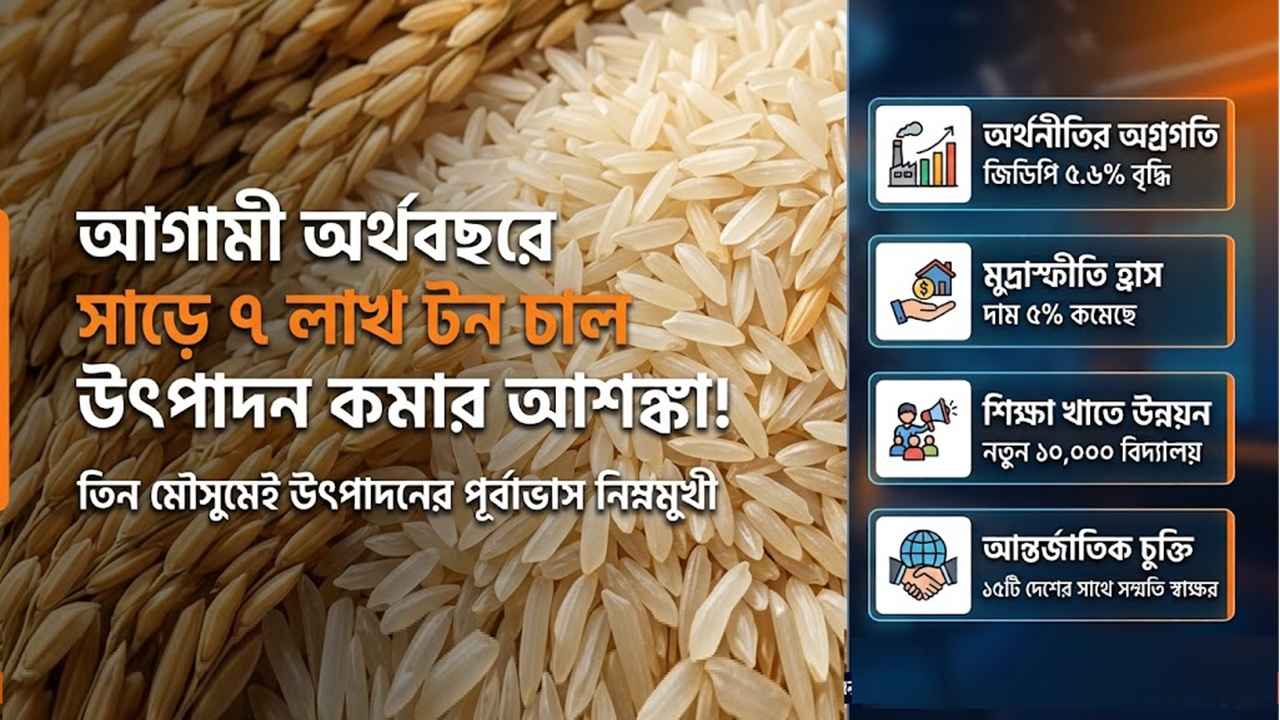
Bangladesh's rice production across the boro, aus and aman seasons may fall in the 2026-27 marketing year, Dhaka Mail's Abdul Hakim reports. Calculations based on Department of Agricultural Extension (DAE) data put total output in 2025-26 at 37.65 million tonnes and the coming year's at 36.9 million tonnes, a drop of 750,000 tonnes in one year.
Total rice acreage may also shrink by 100,000 hectares, from 11.75 million to 11.65 million hectares. Boro and aman acreage is expected to stay unchanged but yield less, while aus is forecast to lose both area and output.
In boro, the main season, production on 4.9 million hectares may slip from 20.5 million to 20.3 million tonnes, about one per cent. Aus area may fall from 1.05 million to 950,000 hectares and output from 2.35 million to 2.1 million tonnes, a decline of about 10.64 per cent. Aman on 5.8 million hectares may yield 14.5 million tonnes against 14.8 million, about two per cent less. The 2026-27 figure would still be 300,000 tonnes above the 36.6 million tonnes of 2024-25.
The UN Food and Agriculture Organization has warned that global rice output may fall 1.6 per cent in 2026-27, mostly in Asia, citing a possible El Nino, lower farm-gate paddy prices and higher input costs. For Bangladesh the FAO projects 41.5 million tonnes in fiscal 2025-26 and 41.3 million in 2026-27, a 0.5 per cent decline.
DAE Director General Md Abdur Rahim told the paper that regular rainfall has cut the need for irrigation in aman, that about 5.9 million hectares of aman are in good condition and that a bumper harvest of about 18 million tonnes of rice is expected. More than five million hectares will go under boro, he said, and despite the fuel and gas shortage no major impact on rice output is feared; by his count boro (about 21.5 million tonnes), aman and aus (about three million) bring the country's rice output close to 43 million tonnes.
Agricultural economist Dr Jahangir Alam said irrigation problems have appeared before boro has even begun; with about half of irrigation running on electricity and half on diesel tube-wells, a continuing fuel shortage could disrupt boro and later seasons and push food inflation higher. He urged a shift to solar-powered irrigation.
Professor A S M Golam Hafeez Kennedy, secretary general of the Bangladesh Agricultural Economists Association, said farming depends directly on fuel for irrigation, mechanised tillage and threshing, and for fertiliser production; if gas shortages disrupt the urea plants the government must arrange imports and keep fertiliser affordable. Forecasts, he added, should state their reasons, weighing weather, floods, drought and disease, especially with the aman crop still in the field.
Source: Dhaka Mail — Reporting: Abdul Hakim

Comments
(0)