
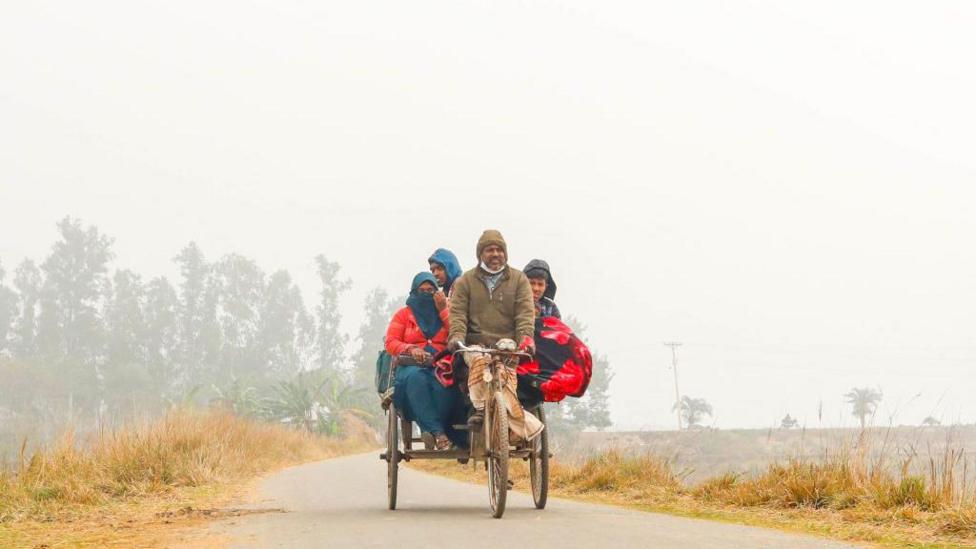
A Bengali proverb has it that the cold of Poush chills the buffalo while the cold of Magh drives away the tiger. This year the middle of Poush has been enough to disrupt daily life across Bangladesh. In the last days of December the sun did not appear for several days running; on 29 December in particular the country was wrapped in dense fog, and the sensation of fine droplets on the face led some people to imagine snow. The weather archive shows the region has known far harsher winters.
The Bangladesh Meteorological Department (BMD) has 48 stations and records going back to 1947. They show the temperature dropping below three degrees Celsius more than once. Sreemangal in Sylhet recorded 3.3 degrees in 1964 and 2.8 degrees on 4 February 1968. Exactly fifty years later, in January 2018, Tetulia in Panchagarh recorded 2.6 degrees Celsius, still the lowest in the country's history. That same year Saidpur in Rangpur division fell to 2.9 degrees, Dimla in Nilphamari to 3, Rajarhat in Kurigram to 3.1 and Dinajpur to 3.2. Earlier, in 2013, Rangpur, Dinajpur and Saidpur recorded 3.5, 3.2 and 3 degrees, and Rajshahi reached 3.4 degrees in 2003.
The north is coldest because it is the gateway for cold waves. Meteorologist Md Bazlur Rashid explains that the Himalayas block air from the north, so the cold air of Delhi, Bihar, Uttar Pradesh, Kashmir and West Bengal enters Bangladesh along the Rajshahi-Jashore-Kushtia belt, and the northern districts lie first in its path. Dense fog there keeps sunlight off the ground by day, and the wide open fields lose heat quickly at night.
The record lows were produced by a combination of prolonged fog, strong cold waves, clear night skies and, at times, high-altitude jet winds descending to the surface. Mr Rashid warns that the old readings cannot be treated as exact: there were fewer stations and many used manual thermometers. A high-pressure belt at the foot of the Himalayas can send icy air into Bangladesh, and when the jet stream dips, the cold is felt more keenly.
The real cause of the biting sensation is heavy fog, which stops the ground from warming. Meteorologist Abul Kalam Mallik said: "When the fog lifts, the feeling of cold eases. The main ways fog lifts are rain and a rise in wind speed; wind above eight to 15 kilometres an hour clears it." That needs a high-pressure belt over the Bay of Bengal and an active extension of a western disturbance. Mr Rashid notes that on 29 December the gap between day and night temperatures was only 1.7 degrees, something he had not seen in 20 years and which now happens every winter.
The ten record lows came at irregular intervals of four, 35, ten or five years, so Mr Rashid does not read them as climate change in themselves. What the BMD's analysis does show is that winter is getting shorter. Kenneth Kunkel's study of US weather data from 1895 to 2000 found snowfall starting about a month later than a century earlier; the season slipped a week between 1971-80 and 2007-16, and the winter of 2016 was more than a month shorter than that of 1916. Mr Rashid blames pollution for the thicker fog seen in Bangladesh since 2000: smoke and dust combine with fog into a low-lying mist that feels like drizzle or snow on the skin.
For growers of boro seedlings, potatoes and winter vegetables the shift matters directly. Prolonged fog and weak sunlight raise disease pressure in the field, and a shorter winter changes the arithmetic of the whole rabi season.
Source: BBC Bangla


Comments
(0)