
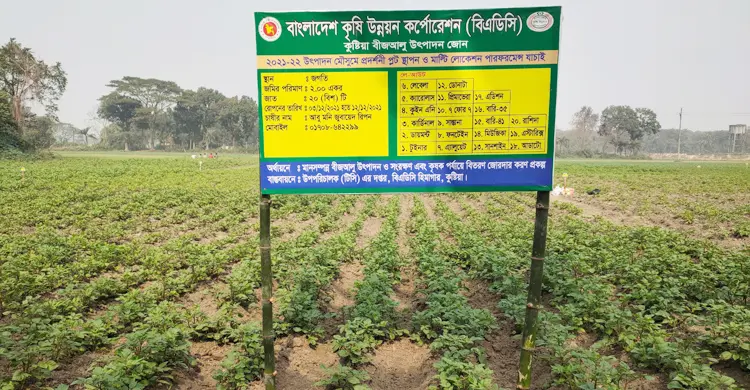
For the first time in Kushtia, the Bangladesh Agricultural Development Corporation (BADC) has grown 20 new potato varieties suitable for export and industrial use, on about two acres in the Sadar upazila as a trial.
Farmers are interested because the varieties yield twice as much as conventional ones and resist disease better, and officials hope the initiative will play a big role in food security.
Field day
A plot demonstration, multi-location performance evaluation and field day were held on Tuesday, chaired by BADC Kushtia joint director Liakat Ali, with Department of Agricultural Extension (DAE) Kushtia deputy director Sushanta Kumar Pramanik as chief guest.
In the 2021-22 season, the BADC cold store in Kushtia set up the demonstration plots on about two acres in Jagati village, funded by a project to strengthen quality seed potato production, storage and distribution. The varieties include Sunshine, Prada, Santana, Edison, Queen Anne and Labella.
Higher dry matter and yields
With high dry matter, the potatoes are suitable for export and processing and resist disease. According to BADC, Bangladesh produces 16 million tonnes of potatoes on 500,000 hectares, of which 8 million tonnes meet domestic demand; much of the rest cannot be exported because of disease, but these varieties could be.
Muhammad Ashraful Alam, deputy director (seed potato) of the BADC cold store, said conventional varieties yield 20 to 22 tonnes per hectare, while the new ones yield more than 40 tonnes, almost double, with less land for the same cost. Spreading BADC's imported varieties to farmers in place of old ones would raise yields, meet food needs and boost exports, he said, and the field day was held to raise farmers' interest.
Officials from BADC, the Bangladesh Agricultural Research Institute (BARI), the Bangladesh Rice Research Institute (BRRI), the Department of Agricultural Marketing and NGOs attended, along with contract seed potato growers and seed dealers.
Source: Jagonews24 (reported by Al-Mamun Sagor). First published in Bengali on The Agro News.
Comments
(0)