
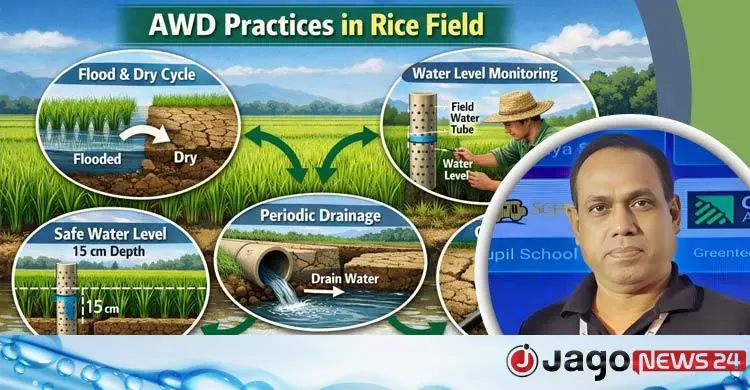
Scientific irrigation management is essential for raising productivity. Boro rice supplies a large share of Bangladesh's rice and plays a vital role in food security and the farm economy. With a growing population, shrinking farmland and climate change, more yield must come from every unit of land, which requires improved varieties, balanced fertiliser and correct irrigation.
Rethinking standing water
The long-held belief was that Boro fields must always be flooded. Recent research and field experience show otherwise. Experts say periodically drying and re-irrigating fields, the Alternate Wetting and Drying (AWD) method, significantly improves plant growth, tillering and final yield.
The period from about 18 days after transplanting until just before panicle initiation, roughly 55 days, is the most important stage for tiller formation. If water is kept standing throughout this time, the soil runs short of oxygen, roots cannot breathe, tillering slows, and tillers may be fewer or unproductive. Drying the field for a few days lets air into the soil, which:
- makes roots deeper and more extensive;
- improves uptake of nitrogen, phosphorus, potash and other nutrients;
- strengthens the base of the plant;
- increases the number and share of productive tillers.
Research shows plants in fields managed this way are greener, healthier and more disease-resistant.
Saving water and cutting methane
Conventional practice keeps 5 to 7 cm of water in the field at all times; under AWD, irrigation is given only when needed, cutting water use by 20 to 30 percent and reducing diesel or electricity costs as groundwater levels fall. Long-term flooding also creates oxygen-free conditions in which microbes produce methane, a greenhouse gas far more potent than carbon dioxide; rice fields are among the world's largest agricultural sources of methane. Periodic irrigation and AWD can help reduce these emissions.
Doing it safely
Drying must be controlled. Deep, wide cracks can tear roots and stunt growth, so experts advise irrigating as soon as light cracks appear and never letting the field dry hard. Agriculturists recommend a simple, low-cost AWD tool: a perforated pipe set into the soil shows the water level below the surface, and irrigation is given when it falls below a set limit, so farmers know when to irrigate and when to wait.
The benefits
Following AWD in Boro gives more productive tillers, healthy and strong plants, stable and higher yields, lower irrigation costs and more environmentally friendly production. The idea that Boro fields should always be flooded, the article concludes, needs to change.
Source: Jagonews24. First published in Bengali on The Agro News.

Comments
(0)