
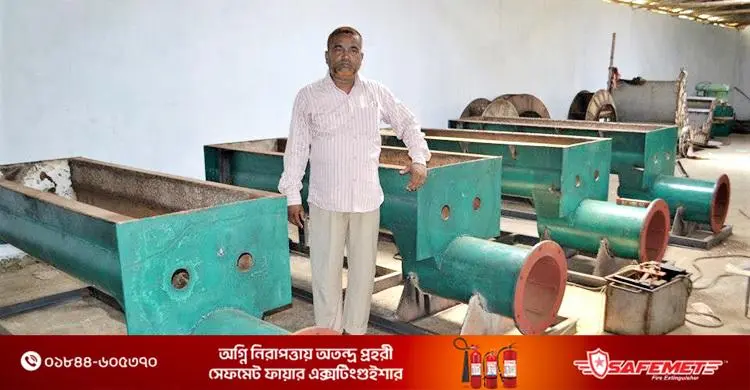
In a small workshop in Katnarpara, Bogura, Amir Hossain has built more than 50 agricultural machines, from close copies of modern equipment to his own designs. His machines have spread across the country's fields over many years. Cheap parts, easy repairs and reliable machines at low prices let farmers avoid expensive foreign brands, and the country saves hundreds of crores of taka a year in imports.
A self-taught innovator
As a teenager, Amir began learning in a garage next to his home, repairing motorcycles and irrigation pumps. He realised that foreign models did not fully solve farmers' problems because their designs did not match field conditions. He learned by taking machines apart and rebuilding them. He now runs two workshops, the main one in Katnarpara and another in Matidali on the edge of town.
Although he follows foreign designs on paper, none of his machines is an exact copy. Bangladesh's small plots, heavy mud, hard soil, low-powered engines and limited maintenance facilities are not considered in foreign designs. His workshop makes mini rice harvesters, rice threshers, potato diggers, multi-cultivators, improved rotary grass cutters, seed drills, maize shellers, rotavators, mat-making machines and dry mixers.
Adapted to the field
- Farmer Abul Kalam of Sonatala said foreign mini-harvesters cut too high for local mud; Amir lowered the blade, changed the wheel grip and adjusted the gear ratio so a low-power engine could run it, and strengthened potato digger tines for hard soil.
- Mansur Ali of Gaibandha said Amir changed the blade angle, fitted a shaft shield and added support to the gearbox, fixing his problem within days.
- Worker Monir Hossain said Amir redesigns overnight when farmers report problems, and designs machines so village blacksmiths can make or repair spare parts. Adjusting gear ratios and blade rotation has cut fuel use in some machines by 15 to 30 percent.
Field officer Aminul Islam said Amir designs from field needs, so his machines work where copies would only look alike.
A fraction of the price
- Mini-harvester: foreign Tk 2.5 lakh to Tk 3 lakh; Amir's Tk 60,000 to Tk 70,000.
- Potato digger: foreign Tk 1.2 lakh to Tk 1.5 lakh; Amir's Tk 35,000 to Tk 40,000.
- Multi-cultivator: foreign over Tk 1 lakh; Amir's Tk 30,000 to Tk 35,000, which breaks soil, removes weeds and prepares seedbeds in one pass.
- Rice thresher: foreign Tk 80,000 to Tk 1 lakh; Amir's Tk 20,000 to Tk 25,000.
According to the agriculture department, more than 20,000 of his machines have been used in northern districts over the past 10 years. At an average saving of Tk 30,000 each, farmers have saved more than Tk 60 crore, and local spare parts save another Tk 30 crore to Tk 40 crore a year in imports.
Recognition, but no scale-up
Amir received national awards in 2008 and 2011, and the Department of Agricultural Extension (DAE) trialled his rice thresher, mini-harvester, maize sheller and organic fertiliser mixer, which performed well. But none has been taken up for large-scale production. His workshop makes at most 8 to 10 machines a month with limited workers and hand-made parts, and many designs are not patented, which deters companies.
"What I make, farmers use with their own hands. That is my greatest reward," he said. "If I could produce on a large scale, machine prices across the country would halve and the country would save crores a year. But without government support, I cannot do it."
Source: Jagonews24. First published in Bengali on The Agro News.
Comments
(0)