
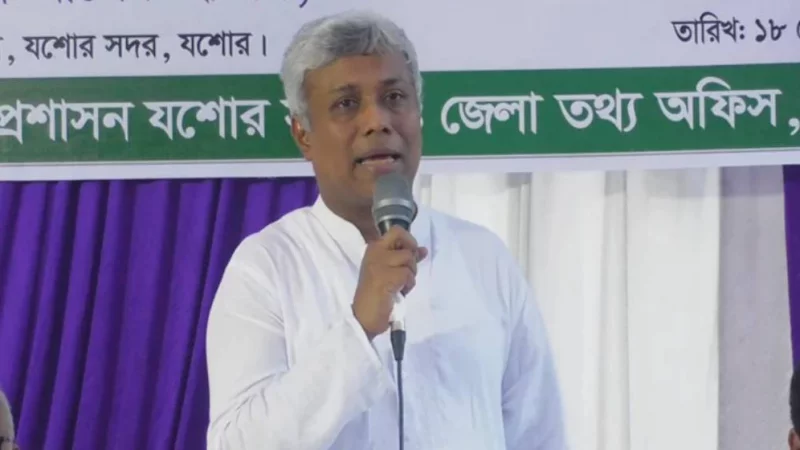
Every deep and shallow irrigation pump in Bangladesh will be converted in phases to run on solar power, State Minister for Power, Energy and Mineral Resources Anindya Islam Amit said on Saturday (19 September). He was chief guest at a courtyard meeting on the prime minister's priority programmes at Nadiar Mor, Barmanpara and Chanchra in Jashore Sadar, organised jointly by the upazila administration and the district information office.
Bangladesh imports gas and coal to generate electricity, he said, and since the outbreak of war in the Middle East the international price of gas has climbed from $8–9 a unit to $28, causing temporary strain on generation. As a lasting answer the government is turning to renewable sources — sun, wind and water — and has moved to put solar generation on the roofs of public and private buildings.
Every irrigation season, rising diesel prices and power shortages disrupt farmers' irrigation and push up production costs, the state minister said; hence the decision to convert all electric- and diesel-driven pumps to solar so that farmers can irrigate affordably even amid power deficits and dear diesel. In Lebutala union of Jashore Sadar the scheme is already in place, with one solar pump irrigating 50 to 60 bighas.
In the first phase about 36,000 pumps across the country, including those of the Barind project, are being identified for conversion, financed from the government's own budget or foreign assistance. Jashore Zila Parishad administrator Delwar Hossain Khan Khokon was special guest, and local representatives, officials and residents took part.
Most of Bangladesh's Boro-season irrigation runs on diesel and grid electricity; a switch on this scale, announced amid high gas prices and load shedding, would bear on both farmers' irrigation costs and the grid's peak-season burden.
Based on a BSS report as published by Desh Rupantor. Source: Desh Rupantor
Comments
(0)