
On a hill above the Spanish city of Granada stands the Alhambra, a palace and fortress that was once the seat of power and royal life for its Muslim rulers. Its walls, arches and courtyards still carry the art and architecture of medieval Muslim Spain. Drawing on the UNESCO World Heritage Centre and Granada's tourism department, Banglavision tells its story.
The palace complex took its present shape mainly in the 13th and 14th centuries. In 1238 Muhammad ibn Yusuf ibn Nasr, also known as al-Ahmar and founder of the Nasrid dynasty, set out to establish his seat of government in Granada. Under Yusuf I and Muhammad V, fine carving, decorated halls, pools and courtyards were added.
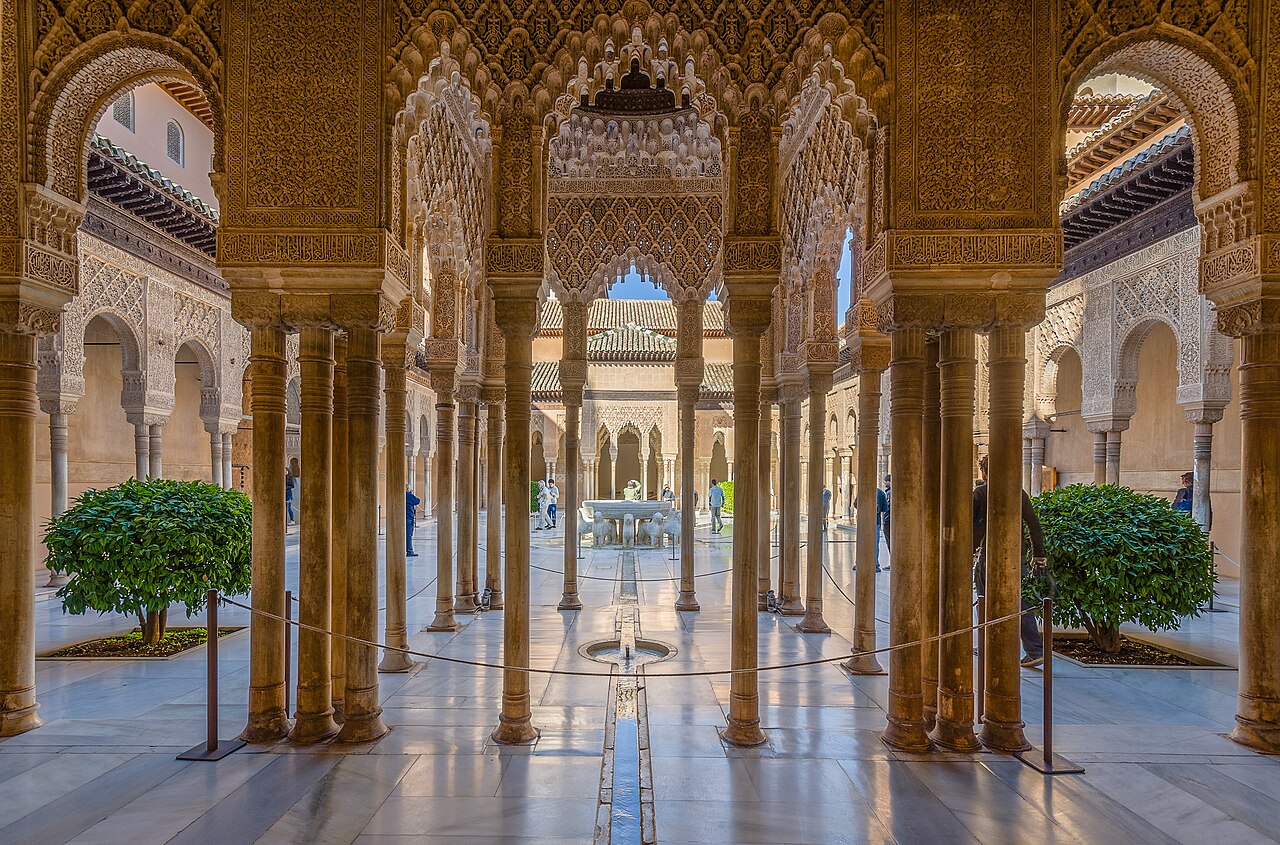
Its walls are covered with geometric patterns, plant-inspired ornament and Arabic calligraphy, and experts say its use of plaster, wood and ceramics makes it a landmark of Islamic art. Its best-known part is the Court of the Lions, built under Muhammad V in the 14th century, with a fountain ringed by twelve stone lions at its centre. The Comares Palace and its Court of the Myrtles are other highlights.
Much of the Alhambra's beauty lies in its water, fountains, pools and gardens, with water running through the courtyards to keep them cool. To the east, the Generalife was the rulers' retreat, its gardens and channels a record of medieval Andalusian garden art. UNESCO notes that this use of water and plants creates a unique bond between architecture and nature.
Granada fell to the forces of the Catholic monarchs Ferdinand and Isabella in 1492, closing the last chapter of Muslim rule in Spain. The Alhambra's use changed after that, and in the 16th century Emperor Charles V's palace added a new architectural style. The most important Muslim-era buildings have nonetheless been preserved.
The Alhambra, the Generalife and Granada's Albaicín quarter were inscribed on UNESCO's World Heritage List in 1984, and the site was extended in 1994. Today it is one of Spain's best-known historic sites and an essential place for anyone interested in the architecture and art of Muslim civilisation.
Photo: Tuxyso / Wikimedia Commons (CC BY-SA 3.0); the Court of the Lions
Source: Banglavision


Comments
(0)