
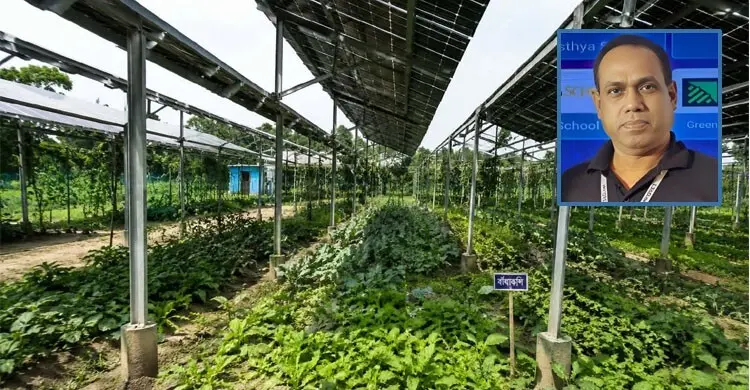
Climate change, a growing population, shrinking farmland and rising energy demand are challenges every country faces, and Bangladesh is no exception. Electricity demand is climbing fast while farmland is being lost and food security is getting harder to guarantee. Against this background, agrivoltaics, the production of food and electricity together on the same land, is gaining attention worldwide as a breakthrough solution.
How agrivoltaics works
In an agrivoltaic system, solar panels are mounted at a set height above farmland while cultivation continues underneath, so the same land produces clean power and crops at once. When panels are installed at around 5 to 6 metres, farm machinery, irrigation, crop care and harvesting can continue with little difficulty. Partial shade often protects crops from excessive heat and helps the soil hold moisture for longer, and lower temperatures and evaporation under the panels can reduce irrigation needs.
Agrivoltaics has already been implemented successfully in Japan, Germany, France, China, South Korea and the United States, where crops are grown on thousands of hectares under solar panels. Research shows that some vegetables, spices, medicinal plants and fodder crops yield better in partial shade, raising farmers' incomes alongside power generation.
Potential in Bangladesh
Large amounts of farmland are lost every year to infrastructure, industry and urban growth, while dependence on fossil fuels strains the economy. The writer sees bright prospects in the north, the chars, coastal areas and the land under large solar power plants, where chilli, coriander, Malabar spinach, taro, pulses, ginger, turmeric, aloe vera, medicinal plants and fodder grass could be grown. Much of the land beneath the country's existing large solar plants lies unused for long periods, which the writer calls a waste of national resources.
Adding Artificial Intelligence (AI), the Internet of Things (IoT), smart soil sensors, automatic weather monitoring and drones would make agrivoltaics even more effective, allowing real-time monitoring of soil moisture, nutrients, temperature, rainfall and pest risk and immediate advice to farmers. The model could also create local jobs, technical skills, women and youth entrepreneurs and small agro-industries, and give farmers new income as partners in power generation.
What must be considered
- Agricultural research on which crops suit which regions.
- Panel height, spacing and design that allow enough light and room for machinery.
- An integrated policy across the agriculture, power and environment sectors.
- Field pilot projects run jointly by universities, research institutes and the private sector.
Conclusion
Bangladesh has set a goal of significantly raising the share of renewable energy, and agrivoltaics could help by cutting carbon emissions while keeping land in production. In a country with limited land and a huge population, agriculture and energy cannot be treated separately. With policy support, research, field trials, private investment and farmers' participation, the writer argues, the model could strengthen both food security and renewable energy.
Source: Jagonews24. First published in Bengali on The Agro News.

Comments
(0)