
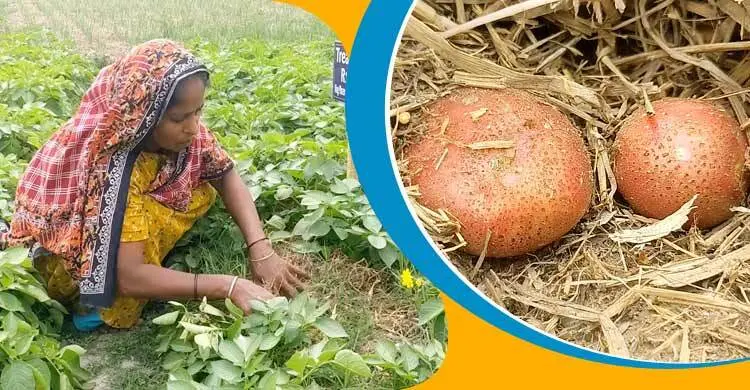
Zero-tillage potato farming is spreading in Patuakhali, giving farmers higher yields at lower cost. Farmers are also pleased with strong local demand and good prices, and the agriculture department says they planted more land this year than last.
A new crop for the coast
Patuakhali farmers lead in rice and pulses but have shown little interest in potatoes. In recent years they have started growing them, using high-yielding varieties and new technologies that cut costs and raise output.
This year 50 farmers in Nilganj union of Kalapara upazila grew potatoes without tillage. With support from the Bangladesh Agricultural Research Institute (BARI), they learned the new technology and got good yields.
How it works
Farmer Jalil Faraji of Kumirmara said that after the Aman harvest, while the soil is still soft, seed potatoes are laid in rows and covered with organic manure, ash, other fertilisers and straw. Little further care is needed and there is no ploughing cost. Salt often rises in the soil because of salinity, but this method carries no such risk. Abul Hossain Gazi grew potatoes on 15 decimals; while some fields suffered soft rot this year, his did not, and the yield was good.
Shahidul Islam, chief scientific officer in BARI's on-farm research division, said potatoes normally need four to five ploughings, but this method needs none. Salinity often prevents any crop after Aman, but because the potatoes grow on the surface under straw, the crop is protected. Potatoes need cool weather and winters are short here, so BARI Alu 72 and 73, suited to the area, were given to the 50 farmers; good weather and care kept pests and disease low and yields good.
Growing area
Md Khairul Islam Mallik, district training officer of the Department of Agricultural Extension (DAE), said potatoes were grown on 1,037 hectares in Patuakhali this year, much of it without tillage, and about 25,000 tonnes are expected. With no storage in the district and good local demand, farmers are selling at good prices, and spreading zero-tillage potatoes would cut production costs considerably.
Source: Jagonews24. First published in Bengali on The Agro News.
Comments
(0)