
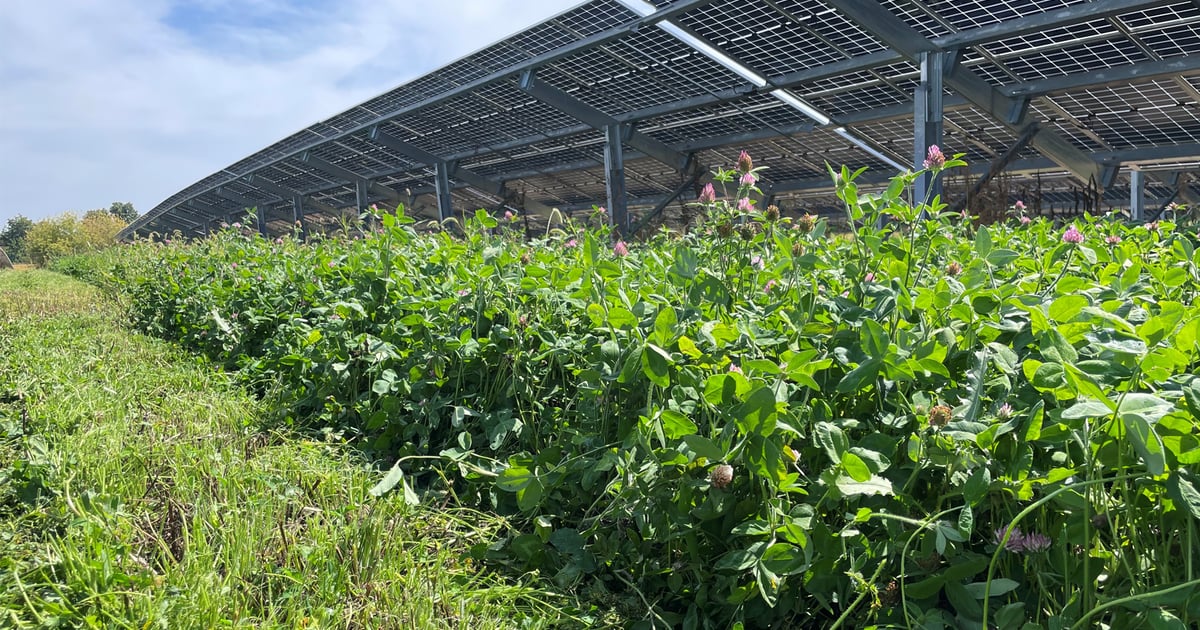
Pasture planted beneath solar panels in Wisconsin yielded less than open ground early in the season but overtook it by the third cutting, and alfalfa under sun-tracking panels out-produced the same crop in full sun by 25 per cent, according to first-year results from a University of Wisconsin-Madison Extension trial. The study is aimed at making solar grazing a real forage enterprise rather than a vegetation-management contract.
Land under solar arrays is mostly still zoned agricultural, and farming beneath the panels, known as agrivoltaics, is spreading: tomatoes and peppers grown with less water in the Southwest, sheep flocks on solar farms in the South, even panels over cranberry marshes in Massachusetts. In Wisconsin, a cattle state, sheep have led because utilities and developers judge cows a greater risk to the panels. In the usual arrangement the grazier is paid to keep vegetation short and airflow open, on turf or pollinator mixes chosen for anything but feed value.
The trial sits on a 16-acre Alliant Energy site at the Kegonsa Research Campus in south-eastern Dane County, which is unusual in carrying four racking systems, fixed-tilt panels at two spacings, single-axis trackers that follow the sun, and an elevated array, so that the same forage mixes can be tested under different shade patterns. Plots were established in spring 2025 with four treatments: orchardgrass, Kentucky bluegrass and red clover; meadow fescue, Kentucky bluegrass and red clover; alfalfa; and the developer's standard seed mix as the control.
Across this year's three cuttings, plots under the panels produced 70 to 88.5 per cent of the dry matter per acre of the full-sun plots. But the gap closed as the season went on: 77 per cent of the open-ground yield at the first cutting, 82 per cent at the second and 122 per cent at the third. Plots under the single-axis trackers were the most stable, with a third cutting averaging 72 per cent of their first, against 58 per cent for full sun.
Meadow fescue, shallower-rooted than orchardgrass, gained most from the shade of the narrower fixed-tilt spacing and the trackers, especially in the dry weeks before the third cut. Shaded plots also matured later, and their forage trended towards lower lignin and higher fibre digestibility, though crude protein and acid detergent fibre results were mixed.
Wisconsin does not have enough sheep to graze its largest solar sites, the author notes, but sites of tens of acres far outnumber those of thousands, and on those a grazier who plants productive forage could raise the stocking rate while still meeting the vegetation contract. The findings point to steadier yields under panels whose shade blunts the summer slump of cool-season grasses. Will Fulwider, the author, is a University of Wisconsin-Madison regional crops educator.
Source: Farm Progress
Comments
(0)