
Every year, on one night in the Islamic month of Rajab, mosques across Bangladesh and much of the Muslim world fill late into the evening. On that night, known in Bangladesh as Shab-e-Miraj, one name returns again and again in the sermons: Al-Masjid al-Aqsa. The place where, Muslims believe, Prophet Muhammad (peace be upon him) was carried in a single night from Makkah is a mosque in the south-eastern corner of Jerusalem's Old City. It stands thousands of kilometres from Dhaka, yet it is woven into the faith, feelings and sense of history of millions of people who will never see it.
Al-Aqsa is regarded as the third holiest mosque in Islam, after Al-Masjid al-Haram in Makkah and Al-Masjid an-Nabawi in Madinah. It is far more than a building of stone walls and domes. It carries the memory of the first Qibla, the direction Muslims first faced in prayer, and of the Night Journey and Ascension known as Isra and Mi'raj. It also carries nearly fourteen centuries of Muslim rule, architecture, loss and restoration.
To understand Al-Aqsa, a reader needs answers to a handful of questions. How does the Qur'an speak of it? Who built the mosque that stands today, and when? Which building is the famous golden dome? What was lost in the fire of 1969? And what is it like for worshippers trying to reach it today? This feature follows those questions through reliable sources.
Al-Aqsa in the Holy Qur'an
The most important reference to Al-Aqsa comes in the very first verse of Surah Al-Isra, also called Surah Bani Isra'il. The verse glorifies Allah, who took His servant by night from Al-Masjid al-Haram to Al-Masjid al-Aqsa, whose surroundings He had blessed, in order to show him some of His signs.
In Arabic, "aqsa" means "the farthest". Seen from Makkah, it was the distant mosque, and the name has stayed. In Muslim tradition the wider area is also called Bayt al-Maqdis, "the Holy House", and the city itself is known as Al-Quds, "the Holy". Al-Aqsa, Bayt al-Maqdis and Al-Quds therefore all point Muslims towards the same sacred ground.
That single verse is the foundation of the Islamic belief in Isra and Mi'raj. Isra refers to the Prophet's night journey from the Sacred Mosque in Makkah to Al-Aqsa in Jerusalem. Mi'raj refers to his ascension from there through the heavens.
According to Islamic tradition, the Prophet met earlier prophets on this journey and led them in prayer before his ascension. The hadith literature also links that night to the command of the five daily prayers. In other words, the five prayers that a Muslim in Dhaka, Jakarta or London performs each day are tied in their history to Al-Aqsa.
For this reason Al-Aqsa is not, for Muslims, simply an old building. It is a witness to one of the most profound spiritual events in the Prophet's life. The 27th night of Rajab is widely observed as the night of Mi'raj, although scholars have long differed on the exact date of the event.
The First Qibla of Muslims
The Qibla is the direction a Muslim faces in prayer. Today it is the Kaaba in Makkah for every Muslim on earth. In the earliest years of Islam, however, Muslims prayed facing Bayt al-Maqdis in Jerusalem. That is why Al-Aqsa is called the first Qibla.
Even after the Hijrah, the migration from Makkah to Madinah, the Muslim community continued to face Jerusalem for about sixteen or seventeen months. This is recorded in Sahih al-Bukhari, Hadith 4492, in the narration of the Companion Al-Bara ibn Azib (may Allah be pleased with him). He said that they prayed with the Prophet towards Bayt al-Maqdis for sixteen or seventeen months before the direction was turned towards Al-Masjid al-Haram.
The command to change the Qibla is found in the Holy Qur'an, Surah Al-Baqarah, verse 144, which directs the Prophet to turn his face towards the Sacred Mosque. A mosque in Madinah where, according to tradition, the change took place during a prayer is still known as Masjid al-Qiblatayn, the Mosque of the Two Qiblas.
The change of direction did not lessen Al-Aqsa's standing. In an authentic hadith, the Prophet named three mosques to which a special journey may be made for worship: Al-Masjid al-Haram, his own mosque in Madinah, and Al-Masjid al-Aqsa. In the Muslim mind, the three have been linked ever since.
How Old Is Al-Aqsa? What the Hadith Says
An important hadith in Sahih al-Bukhari speaks of Al-Aqsa's ancient origins. The Companion Abu Dharr (may Allah be pleased with him) asked the Prophet which mosque was first established on earth. The Prophet replied: Al-Masjid al-Haram. Asked which came next, he replied: Al-Masjid al-Aqsa. Asked how long lay between them, he said forty years. The narration is recorded as Hadith 3366.
One point needs to be kept clear. The hadith speaks of the earliest establishment of a sacred place of worship. The buildings that appear in photographs today are a separate matter. The present mosque took shape over many centuries of construction, collapse, rebuilding and restoration. The forty years in the hadith should not be read as the construction date of any building visible on the site now.
The Umayyad Caliphs and the Birth of Today's Architecture
Jerusalem came under Muslim rule in the seventh century, in the time of the second Caliph, Umar ibn al-Khattab (may Allah be pleased with him). Historical accounts describe him visiting the sacred enclosure himself and arranging for prayer there. From that point the city's religious and architectural importance grew quickly.
That first mosque was very plain. Late in the seventh century a Christian pilgrim from Europe named Arculf visited Jerusalem. His account describes a rectangular prayer house on one side of the enclosure, built of wooden planks and beams, large enough for about three thousand people to pray together. Today's great mosque began with that simple timber hall.
Major construction came under the Umayyad caliphs. Caliph Abd al-Malik ibn Marwan built the Dome of the Rock, known in Arabic as Qubbat al-Sakhra, on the raised platform at the centre of the enclosure. Historians date its completion to around 691 to 692 CE, which makes the golden-domed shrine one of the oldest surviving monuments of Islamic architecture.
Under his son and successor, Caliph al-Walid ibn Abd al-Malik, a large congregational mosque rose at the southern end of the compound. Architectural historians treat this Umayyad phase as the foundation of the main mosque building that stands today.
That building, however, suffered repeatedly from nature. Historical accounts record that a major earthquake in the mid-eighth century brought down much of the mosque, which the Abbasid caliphs then rebuilt. After another earthquake in the eleventh century it was reconstructed again under the Fatimid caliph al-Zahir, and parts of the mosaic decoration from that period can still be seen beneath the dome. Ayyubid, Mamluk and Ottoman rulers continued the work of repair and extension. As a result, today's Al-Aqsa carries the imprint of several eras at once rather than a single building campaign.
Al-Aqsa Mosque and the Dome of the Rock Are Not the Same
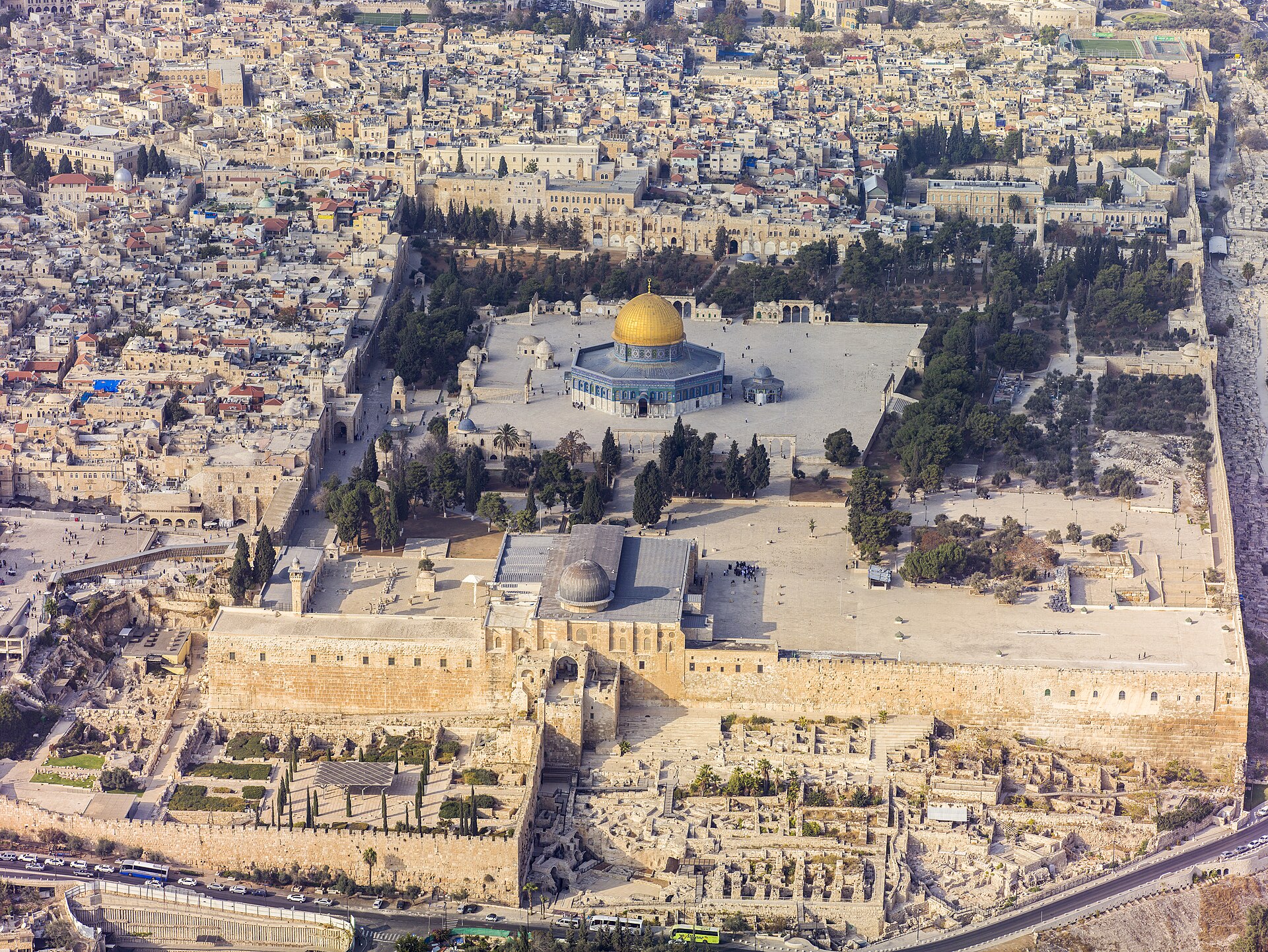
The most common misunderstanding about Al-Aqsa is that the building with the golden dome is the Al-Aqsa Mosque. The mistake turns up in newspapers, calendars and framed pictures on living-room walls. In fact the golden-domed Dome of the Rock and the main Al-Aqsa prayer hall are two separate buildings.
The whole sacred enclosure is called Al-Haram al-Sharif, the Noble Sanctuary. According to UNESCO documentation, it covers about 144 dunams, or roughly 144,000 square metres, an area about the size of twenty football pitches. Within it are the main mosque, the Dome of the Rock, open courtyards, gates, small domes, fountains, schools and many other historic structures.
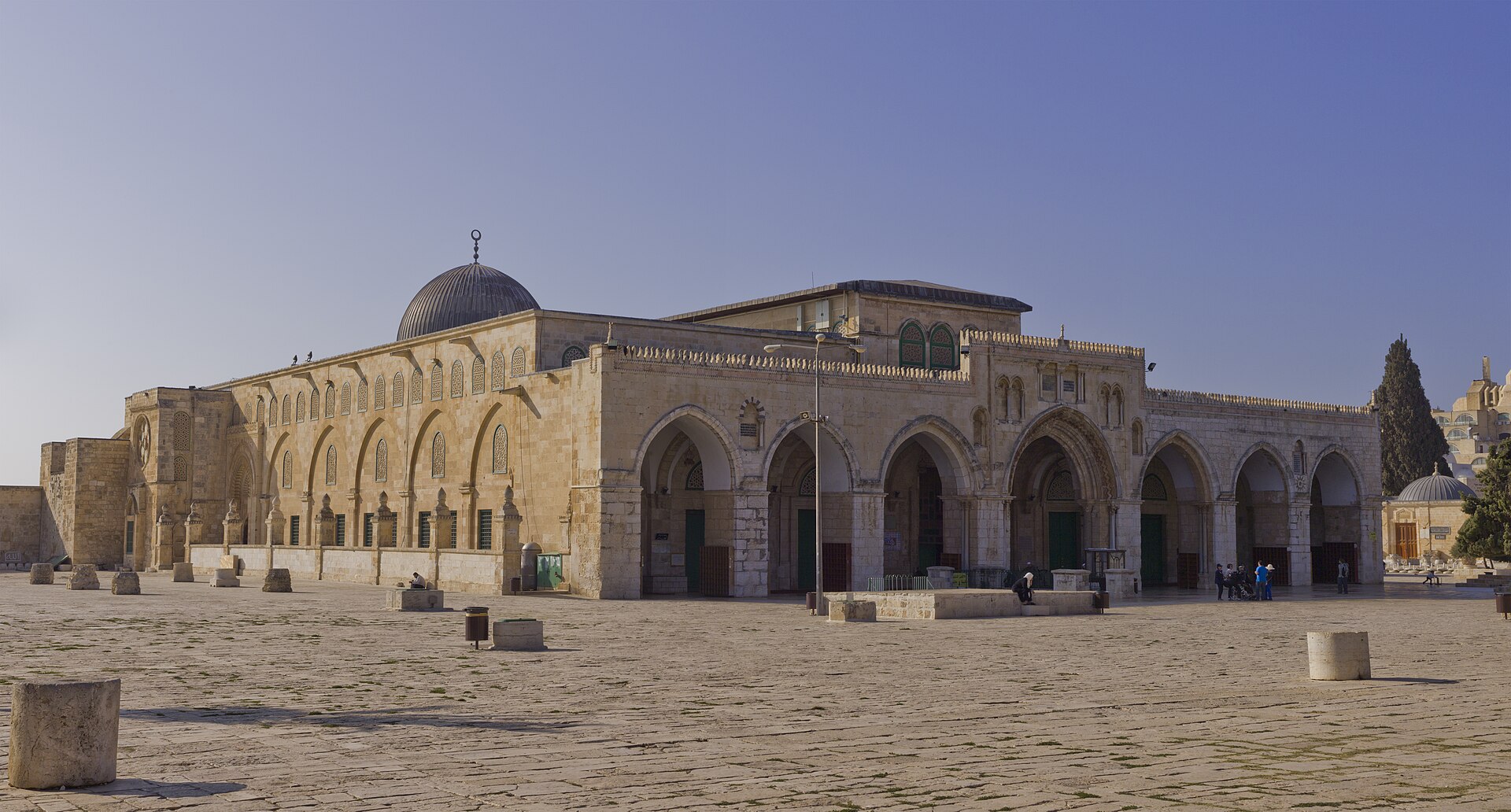
The main prayer hall stands on the southern side, towards the Qibla, and is called Al-Jami' al-Qibli, the Qibli Mosque. Its dome is covered in lead and looks grey or silver. The Dome of the Rock, with its gleaming golden dome, stands on a raised platform near the centre of the enclosure.
In Arabic, the name Al-Masjid al-Aqsa is often used for the entire compound. Many Islamic scholars hold that a prayer offered anywhere within the enclosure is a prayer in Al-Aqsa. In everyday speech, however, the name also refers specifically to the southern prayer hall. When reading or hearing about Al-Aqsa, it helps to ask whether the whole sanctuary or the one mosque building is meant.
Arches, Mosaics and Coloured Glass
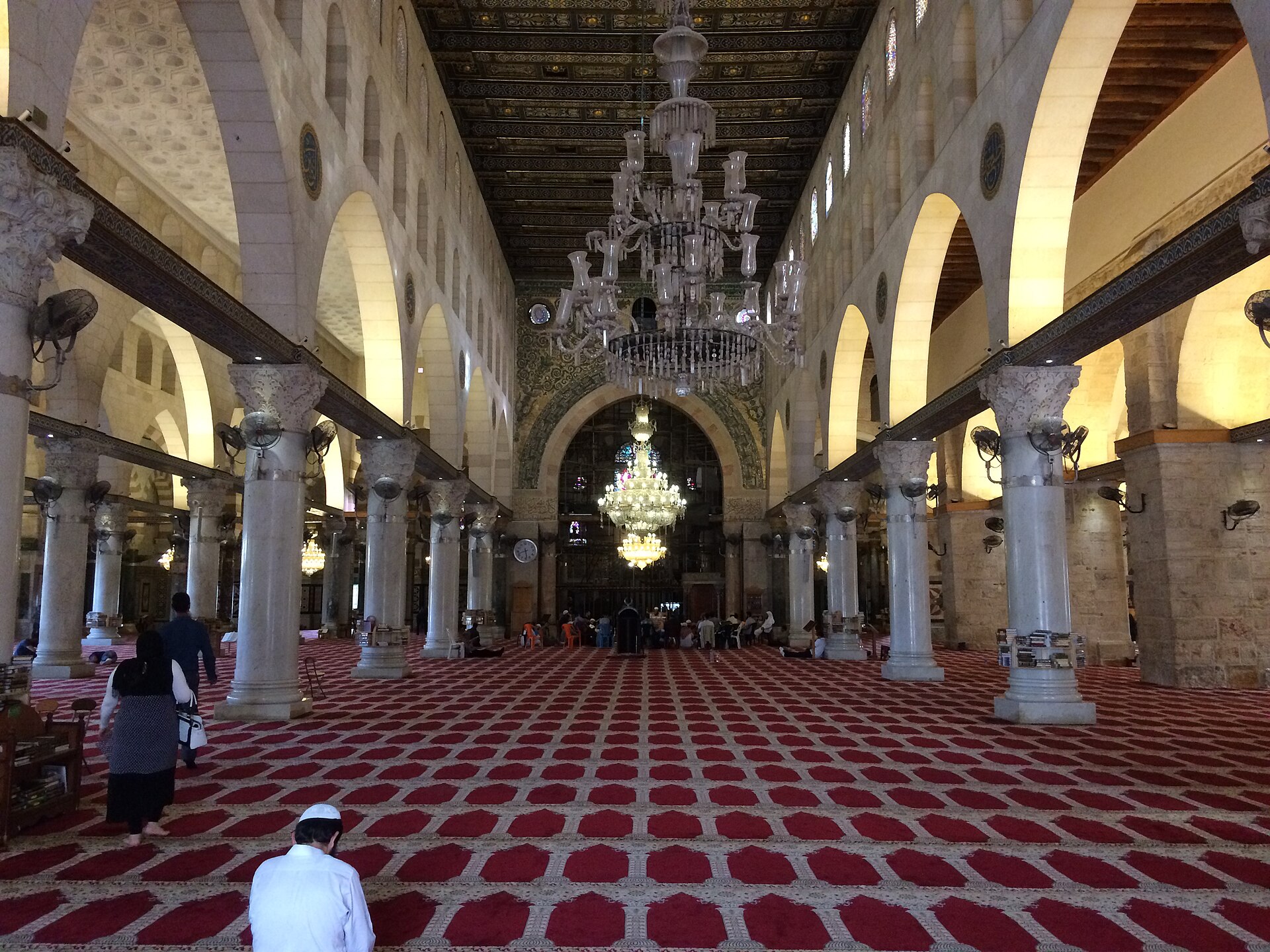
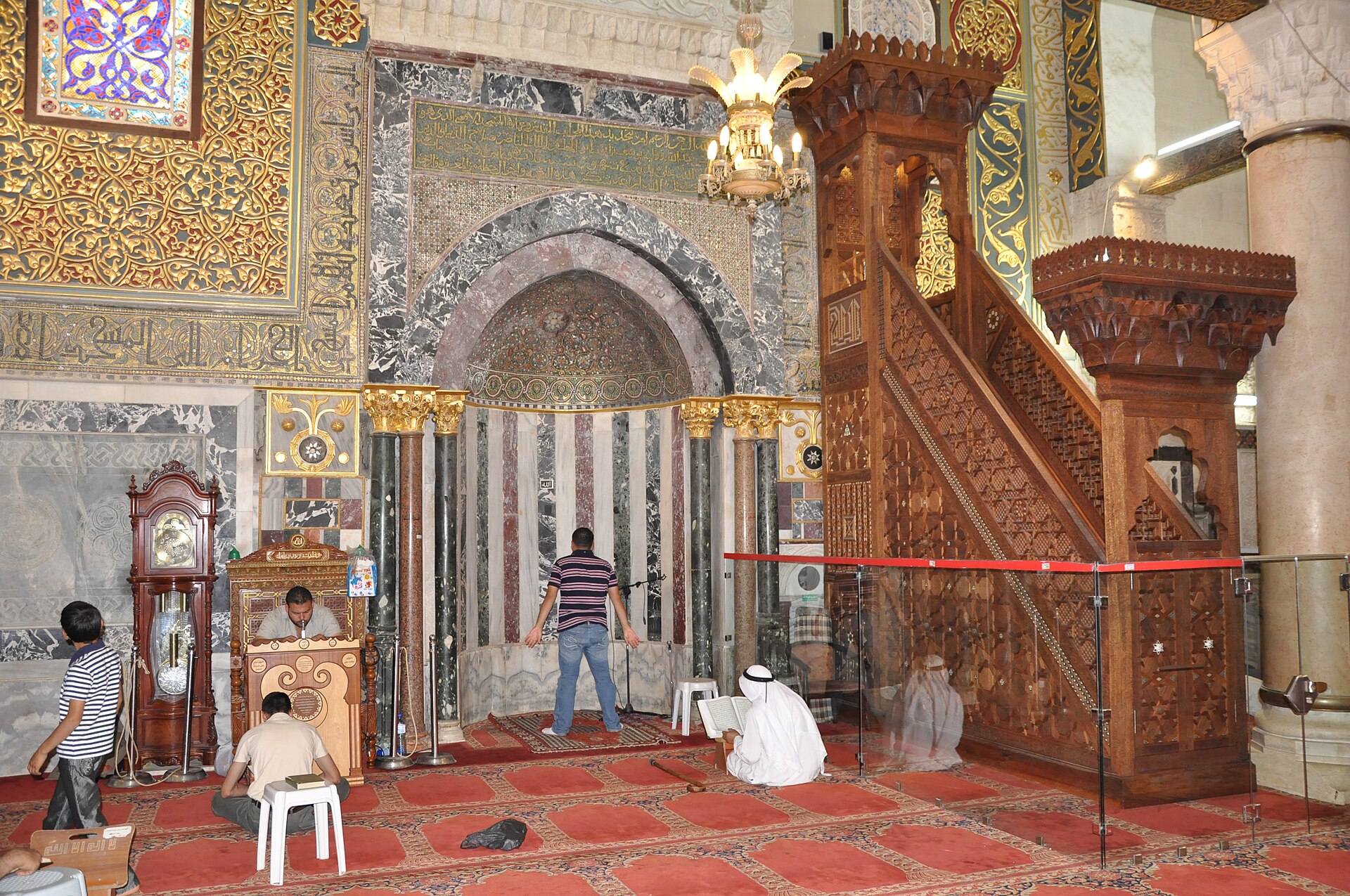
Step inside Al-Aqsa and the first thing that strikes the eye is the rows of columns and arches. Walk down the long central aisle and the mihrab lies ahead, with the minbar beside it. Large chandeliers hang overhead and red carpets cover the floor. Mosaics, carved wood and Arabic calligraphy on the walls and around the dome carry the handiwork of craftsmen from many different centuries.
The mihrab is the niche in the wall that shows the direction of prayer. The minbar is the stepped pulpit from which the imam delivers the Friday sermon. Every mosque in Bangladesh has both. At Al-Aqsa, each carries close to a thousand years of history.
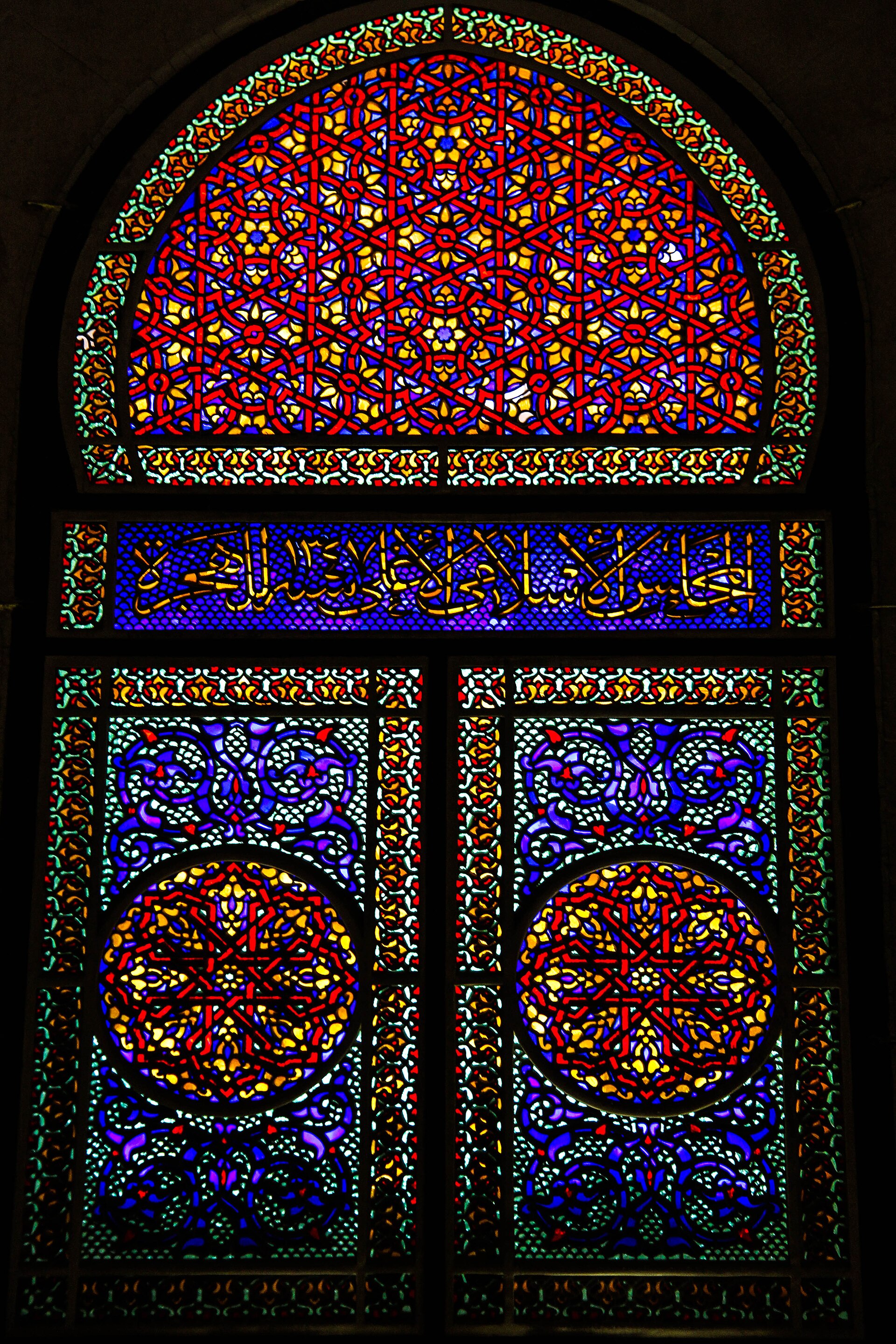
The coloured glass windows deserve a look of their own. When sunlight passes through them, patterns of red, blue and green spill across the floor. Set in carved plaster screens, the glass has been renewed during successive restorations, keeping an old craft tradition alive.
The Crusader Conquest and Salah al-Din's Return
In 1099, Crusader armies from Europe captured Jerusalem. During nearly ninety years of their rule, Al-Aqsa ceased to be a mosque. Historical accounts record that the building served first as a royal palace and later as the headquarters of the Knights Templar, a military religious order. The Dome of the Rock was turned into a church.
In 1187, after his victory at the Battle of Hattin, Sultan Salah al-Din Ayyubi regained Jerusalem. The traditional account holds that the city surrendered to him on the 27th of Rajab, the date associated with the Mi'raj. Al-Aqsa was then prepared once again for Muslim worship. Walls added by the Crusaders were removed, the mihrab was restored and the mosque was beautified.
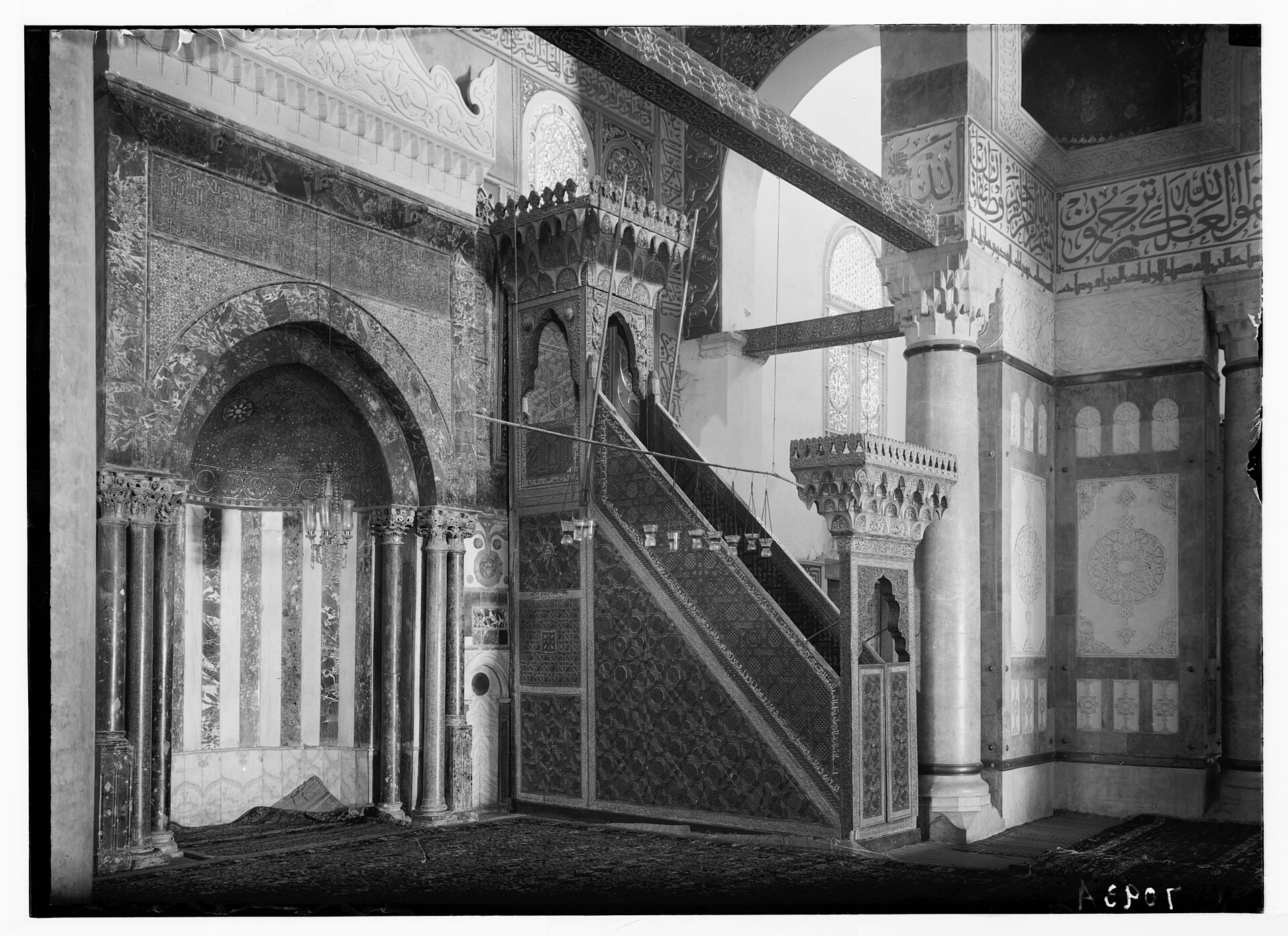
The best-known treasure of that time was a wooden minbar. Nur al-Din Zengi, the ruler of Syria, had commissioned it years earlier from craftsmen in Aleppo, in the hope that Jerusalem would one day be regained. He did not live to see it. After retaking the city, Salah al-Din brought the minbar from Aleppo and installed it in Al-Aqsa.
Assembled from thousands of small interlocking pieces of wood, with geometric patterns, carving and inlay, the minbar became one of the most celebrated works of Islamic decorative art. It stood in Al-Aqsa for nearly eight hundred years.
Mamluk and Ottoman rulers who followed also left their mark on the compound. New domes, fountains, gates, walls, schools and hostels for travellers added to its historic variety. In the time of the Ottoman Sultan Suleiman, Jerusalem's city walls were rebuilt, and they still encircle the Old City today.
The Fire of 1969
On 21 August 1969, a fire broke out inside Al-Aqsa Mosque. It damaged the south-eastern part of the building, sections of the roof, decoration inside the dome and many historic features. The greatest loss was Salah al-Din's wooden minbar, which was almost completely destroyed.
According to the historical account published by Jordan's Royal Hashemite Court, an Australian national, Dennis Michael Rohan, was responsible for the arson. He was later found by a court to be mentally ill and committed to a psychiatric hospital.
The fire caused deep anger and concern across the Muslim world. In response, leaders of Muslim countries met in Rabat, Morocco, the following month. That meeting gave birth to the Organisation of the Islamic Conference, known today as the Organisation of Islamic Cooperation, or OIC. Bangladesh is a member. A fire in one mosque, in other words, led to the founding of the largest grouping of Muslim-majority countries in the world.
Repairs began after the fire. Recreating the lost minbar was the hardest task. Using old photographs, measurements and years of research, craftsmen rebuilt it with traditional methods. According to the Royal Hashemite Court, the reconstructed minbar was installed in its historic place inside Al-Aqsa on 2 February 2007. Jordan has also supported further conservation work on walls, roofs, doors, windows, domes and other parts of the mosque and the wider compound.
Jerusalem: A Sacred City for Muslims, Christians and Jews
Jerusalem holds deep religious and historical significance for Muslims, Christians and Jews alike. Built on hills, the ancient city has watched empires rise and fall for thousands of years.
For Muslims, the city's special standing comes from Al-Aqsa Mosque, the first Qibla and the Night Journey of the Prophet. For Christians, Jerusalem holds sites connected with the life, crucifixion and resurrection of Jesus Christ. For Jews, the city has a central place in religious tradition and historical identity.
Within the small area of the Old City stand the Dome of the Rock, the Western Wall, which Muslims also know as the Al-Buraq Wall, and the Church of the Holy Sepulchre. Holy places of three faiths lie within a few minutes' walk of one another, and that closeness reflects Jerusalem's many layers of history.
On Jordan's nomination, UNESCO inscribed the Old City of Jerusalem and its Walls on the World Heritage List in 1981. Since 1982 it has been on the List of World Heritage in Danger, reflecting continuing concern about the protection of its monuments, its urban heritage and the safety of its holy sites.
Who Runs the Compound, and Who Gets In
Al-Aqsa remains one of the most sensitive religious and political issues in Jerusalem. After the 1967 war, Israel took control of East Jerusalem, including the Old City. The status of Jerusalem is disputed under international law, and many United Nations resolutions describe East Jerusalem as occupied territory.
The religious administration of the compound, however, has historically rested with Jordan. The Jerusalem Islamic Waqf, under Jordan's Ministry of Awqaf and Islamic Affairs, manages religious activities and daily affairs at Al-Aqsa. Jordan's Hashemite royal family regards itself as custodian of the Muslim and Christian holy sites of Jerusalem, a role reaffirmed in a 2013 agreement between King Abdullah II of Jordan and Palestinian President Mahmoud Abbas.
Under the long-standing arrangement known as the status quo, Muslims pray in the compound while people of other faiths may enter as visitors at set times. Security, access and administrative authority have nonetheless been disputed for decades among the Israeli authorities, Palestinian representatives and Jordan, and the disagreement often turns into tension.
That tension came to the fore again this year. According to Al Jazeera, after the United States and Israel went to war with Iran on 28 February 2026, access to the compound was completely prohibited or restricted to a few dozen worshippers. The month of Ramadan passed during that period.
At the end of March, the foreign ministers of the United Arab Emirates, Jordan, Türkiye, Egypt, Indonesia, Pakistan, Saudi Arabia and Qatar issued a joint statement, published by the UAE Ministry of Foreign Affairs on 31 March. They condemned the closure of the gates of Al-Aqsa to worshippers for thirty consecutive days, including during Ramadan. The ministers also stated that the Jerusalem Endowments and Al-Aqsa Mosque Affairs Department, under Jordan's Ministry of Awqaf, is the only authorised body to administer the mosque and regulate entry.
According to an Al Jazeera report on 9 April 2026, the compound reopened to Palestinian worshippers at dawn that day after about forty days. Some outlets counted forty-one. The report said around 3,000 worshippers attended the dawn prayer after the reopening.
Reports of tension over access continued in the months that followed. On 14 September 2026, a report citing Anadolu Agency and the Jerusalem Governorate said that 593 Israeli settlers had entered the compound that day. On 27 September, the second day of the Jewish festival of Sukkot, the Jerusalem Governorate put the number at 1,143, as reported by the International Business Times. Other outlets reported figures ranging from several hundred to more than a thousand on other days of the festival.
These figures come from local authorities and have not been independently verified, and different sources sometimes give different numbers for the same day. Readers should keep the source and date of each figure in mind, and weigh the positions of all parties on access, security and religious practice.
Protecting a Heritage That Belongs to Everyone
Al-Aqsa's importance is not confined to the religious feelings of Muslims. Its buildings, courtyards, walls, gates, domes and works of art, built up over centuries, are a treasure of human civilisation. Umayyad foundations, Fatimid mosaics, Salah al-Din's mihrab, coloured glass windows and Ottoman repairs together make it a long history book written in stone.
Keeping that heritage alive requires regular conservation, accurate historical records, responsible management and respect for religious rights. It also requires responsible journalism. When following news about Al-Aqsa, it is important to tell apart official statements, the claims of any party and facts that have been independently established.
For Muslims in Bangladesh and beyond, Al-Aqsa stands for faith, history and a deep spiritual bond with Jerusalem. Its link with the first Qibla and with the Night Journey of the Prophet gives it a place in Islamic tradition that no other site shares. When its name is spoken in a Bangladeshi mosque on the night of Mi'raj, it is not only a memory of the past but also a reminder to pay attention to the present.
Protecting the dignity of Jerusalem's holy places, conserving its historic buildings and securing safe and peaceful worship for people of every faith are responsibilities for the whole international community. Knowing Al-Aqsa's past, protecting its heritage and respecting the freedom to worship are duties that reach beyond any single nation or community.
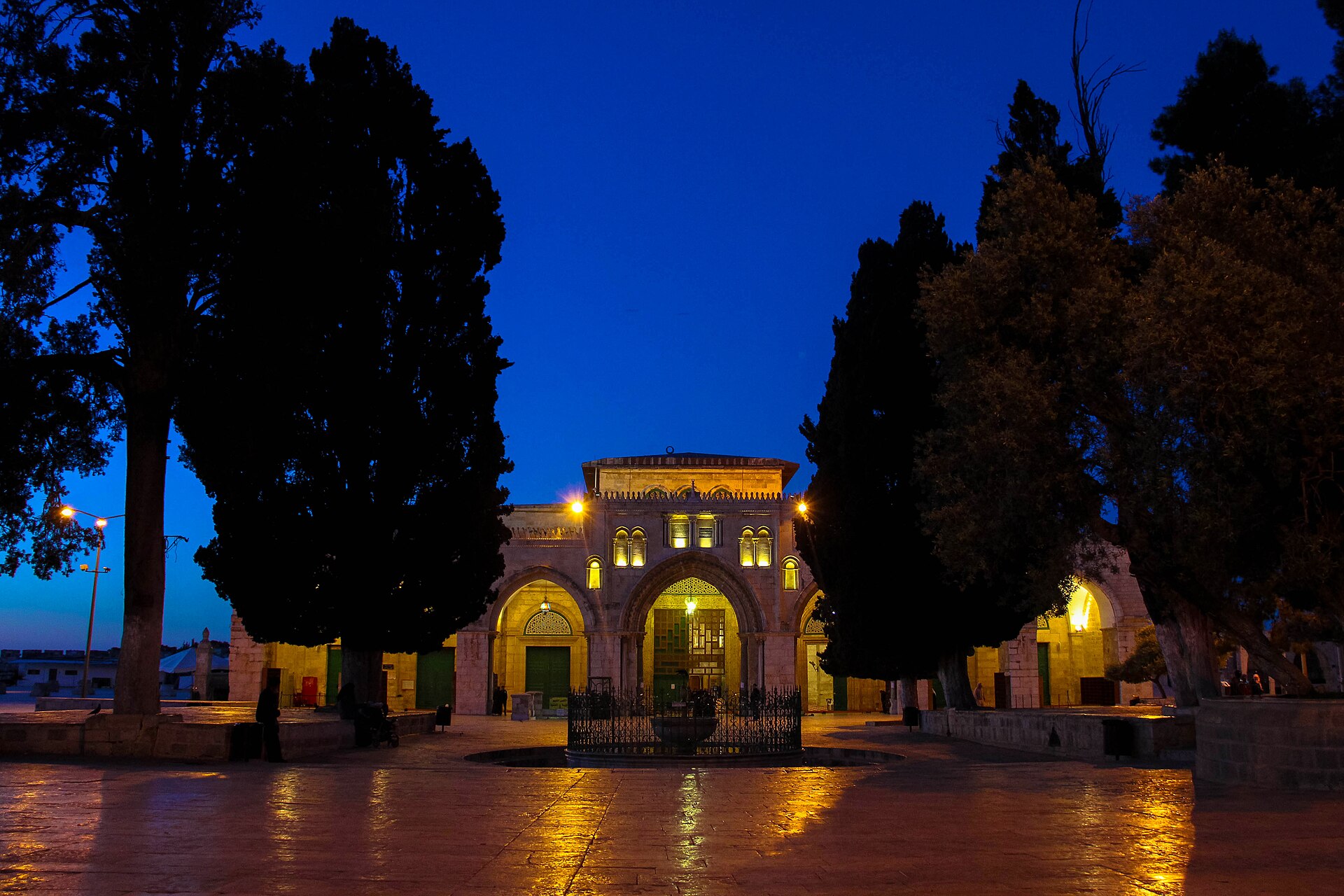
Cover photo: Al-Aqsa Mosque in Jerusalem, also called the Qibli Mosque. The grey, lead-covered dome marks the main prayer hall. Photo: Andrew Shiva / Wikimedia Commons (CC BY-SA 4.0)
Comments
(0)