
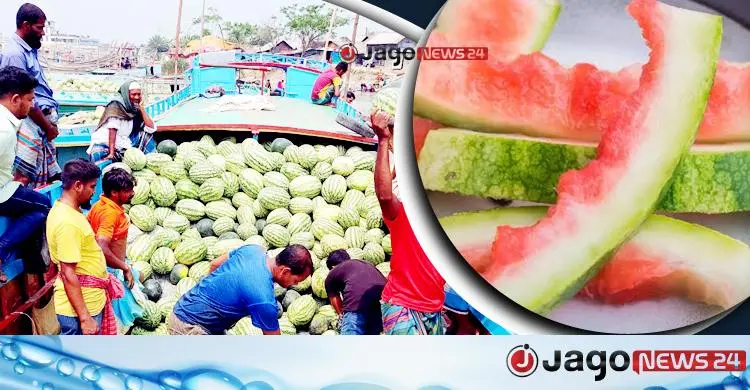
Southern Bangladesh produces huge amounts of watermelon every year, but much of the fruit is wasted at the end of the season. Once the red flesh is eaten, the rind becomes a large pile of waste. With planning and the right technology, a promising new industry could be built around it, researchers say.
About one-third of the watermelon grown in Barishal, Patuakhali, Bhola, Barguna and other southern districts is rind. Consumers usually throw it away, and it rots quickly, polluting the environment. Agriculture and food technology researchers say the amino acid citrulline, used in the pharmaceutical industry, can be extracted from the rind, pectin can be made from it, and oil or animal feed from the seeds. For lack of technology, all of this is now simply waste.
Dr. Md. Alimur Rahman, chief scientific officer at the Regional Horticulture Research Station in Dumki, Patuakhali, told Jagonews24 that rind and seeds make up a large part of each fruit; when discarded they rot, produce methane and smell, yet they have commercial uses in food processing and can be turned into value-added products.
What the rind and seeds can become
- **Pickles:** watermelon rind pickle is made in many countries, keeps for a long time and can be marketed.
- **Jam and morabba:** the fibre-rich white part can be made into morabba, jam and sweets.
- **Vegetable dishes:** the inner white rind can be used in curries, fries and soups.
- **Animal feed and compost:** rind that is not eaten can feed livestock or be composted.
- **Seeds:** roasted as a snack, ground into flour for bakery products and biscuits, pressed for edible oil (as in some African and Asian countries), and used as a protein-rich ingredient.
Farmers want more from their crop
Farmers say prices often fall in the season because of high output, and much fruit spoils for lack of storage. Nanna Gazi of Rangabali upazila said many watermelons go unsold for lack of storage, and commercial products from the rind would give farmers extra income. Delwar Hossain of Galachipa said industrial use of the fruit's different parts could bring much larger economic benefits.
Food technology researchers say small and medium industries based on the rind could reduce waste, raise farm incomes and create rural jobs. Md. Shahidul Islam, chairman of the Faculty of Nutrition and Food Science at Patuakhali Science and Technology University, said no research has yet been done on watermelon rind in the region, but the literature shows food ingredients and citrulline can be obtained from it.
Source: Jagonews24. First published in Bengali on The Agro News.
Comments
(0)