
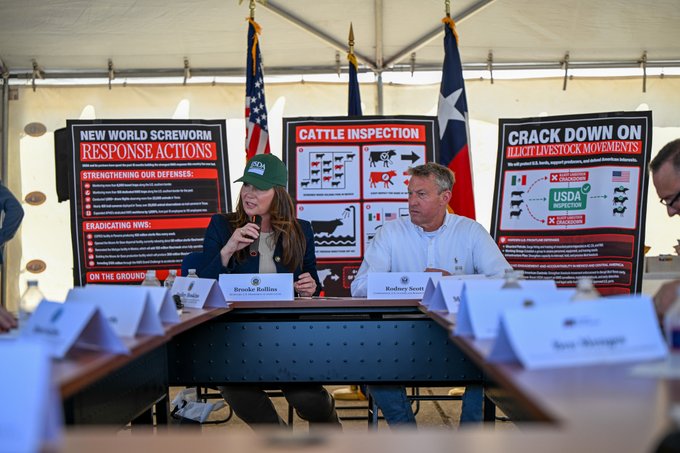
The U.S. Department of Agriculture and the Department of Homeland Security have signed a memorandum of understanding to protect the country's food, agriculture and veterinary systems from threats such as New World screwworm, Agriculture Secretary Brooke L. Rollins announced at an event at Moore Air Base in Texas on 10 August 2026. USDA published the announcement the following day.
U.S. Customs and Border Protection Commissioner Rodney Scott represented Homeland Security Secretary Markwayne Mullin at the event. USDA said the agreement builds on the National Farm Security Action Plan and aligns its animal health mission with DHS's border, security and inspection authorities so that the two departments can detect, assess and respond to agricultural threats more quickly.
The immediate target is livestock smuggling. USDA estimates that 800,000 head of cattle are smuggled each year from Central America into Mexico, an illicit trade worth roughly $320 million. Smuggled animals typically bypass sanitary inspection and traceability systems, so diseased or unmonitored cattle can move undetected across borders, threatening regional biosecurity and the progress made in eradicating screwworm.
USDA said it will work closely with Mexico to ensure that only fully documented, legally compliant cattle enter approved U.S. ports of entry, tightening adherence to its import requirements and screwworm safeguards.
"The MOU further aligns our animal health mission with DHS's border, security, and inspection authorities, so we are better positioned to detect, assess, and respond to agricultural threats like New World screwworm," Rollins said. Mullin said that "safeguarding American agriculture from threats abroad starts at our border."
Federal, state, tribal and local partners and industry stakeholders helped draft the agreement, according to USDA, which said the two departments will keep refining response tools and joint planning and will review the MOU periodically. For U.S. ranchers and feedlots, the agreement is aimed at keeping the pest out while cross-border cattle trade continues. More information is at Screwworm.gov.
Source: USDA
Comments
(0)