
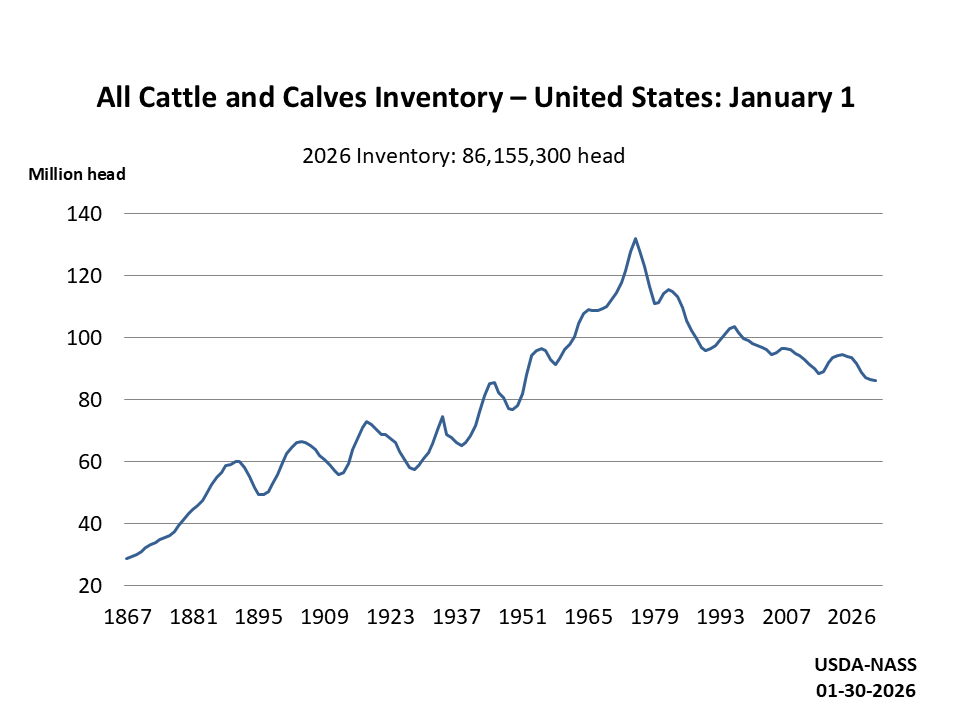
There were 86.2 million head of cattle and calves on farms in the United States on 1 January 2026, down slightly on a year earlier, according to the Cattle report published on 30 January by the Department of Agriculture's National Agricultural Statistics Service (NASS).
Of that total, all cows and heifers that have calved came to 37.2 million head — the breeding base from which the following year's supply is drawn.
The contraction is on the beef side. There were 27.6 million beef cows in the country on 1 January, down 1% on last year, and the calf crop was estimated at 32.9 million head, down 2%. Cattle on feed stood at 13.8 million head, 3% below 2025.
Dairy moved the other way: the number of milk cows rose to 9.57 million head.
To compile the figures NASS surveyed about 35,000 operators across the country during the first half of January, asking them to report inventories as of 1 January 2026 and their calf crop for the whole of 2025. Returns came in by internet, post, telephone and in-person interview.
A smaller beef herd and a smaller calf crop mean the American cattle cycle is still at its tight end, and that has two effects a reader here can watch: firmer world beef prices, and — because fewer cattle on feed eat less — slightly softer demand for the maize and soybean meal that Bangladesh imports for its own livestock.
Source: USDA National Agricultural Statistics Service



Comments
(0)