
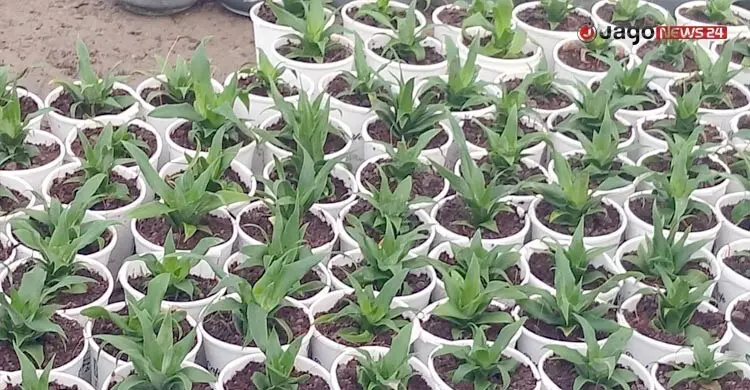
Thousands of disease-free seedlings can now be grown from a single tiny piece of plant tissue. Thanks to modern tissue culture technology, researchers at the Department of Agricultural Extension (DAE) are producing flower, fruit and horticultural seedlings at home, reducing dependence on imports.
DAE runs three modern tissue culture labs at its horticulture centres in Madaripur, Bogura and Mymensingh, built under the Tissue Culture Laboratory cum Horticulture Centre Establishment and Development Project. Five more are under construction at Balaghata in Bandarban, Rajalakh in Savar, Cumilla Sadar, Char Fasson in Bhola and Dhanbari in Tangail.
Output and prices
- In the past year the three labs produced 212,387 disease-free seedlings, of which 192,637 were sold to farmers and entrepreneurs. Once the other labs open, output is expected to exceed 500,000.
- Madaripur produced 90,237 seedlings, Bogura 62,500 and Mymensingh 59,650. G-9 banana, gerbera, strawberry and potato seedlings are most in demand, and production targets have been raised for next year.
- An imported gerbera seedling from India costs Tk 80 to Tk 100; the same quality from a government lab costs Tk 30. Improved gerbera, lilium and banana and strawberry seedlings cost less than half what they would in India or Pakistan.
- Madaripur has begun producing lilium by tissue culture for the first time, about 8,000 this year with a target of 20,000 next season, and stevia is being produced on a trial basis.
How it works
At the Madaripur lab every step takes place in a sterile, controlled environment, with technicians transferring tiny plant tissues at a laminar airflow cabinet. Agriculturist Md. Enamul Haque, in charge of the lab, said shoot tips taken from selected mother plants are sterilised and placed on a special nutrient medium, where plant hormones trigger cell division. After several rounds of sub-culture, thousands of plantlets can be produced from one piece of tissue. They are then hardened in a poly house before going to farmers. Each carries the mother plant's traits and, being disease-free, grows fast and usually yields well.
Why it matters
The project also supports university research, training, new technology and field extension, and thousands of agri-entrepreneurs have been trained; many now grow flowers, fruit and high-value crops commercially with tissue culture seedlings.
Agricultural scientist Prof. Dr. M. A. Rahim said the technique's effectiveness for virus-free, quality planting material is internationally established and is used successfully in Thailand, Vietnam, Cambodia and the Netherlands. When the new labs reach full capacity, he said, they will meet domestic demand and help develop export-oriented horticulture.
DAE director general Md. Abdur Rahim said quality, disease-free seedlings are essential for modern farming and more labs will improve availability across the country. Project director Talha Zubair Masrur said G-9 banana, MD-2 pineapple, gerbera and lilium once had to be imported but are now produced in government labs, cutting farmers' costs, strengthening the nursery sector and creating entrepreneurs.
Source: Jagonews24. First published in Bengali on The Agro News.
Comments
(0)