
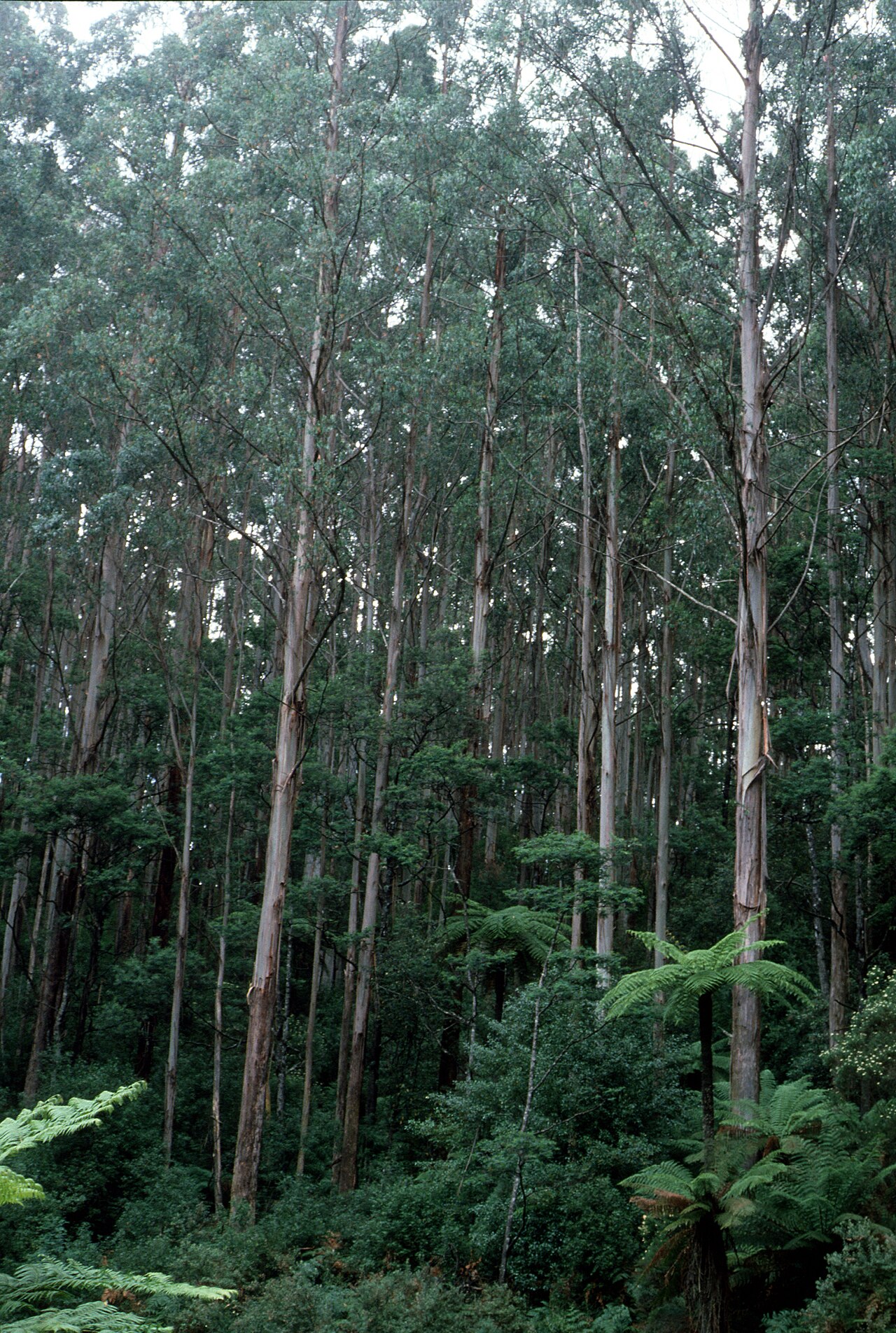
A forestry experiment in the mountain ash forests of Victoria, Australia, that was set up in the late 1980s and then left to grow unwatched has produced a result its founders did not look for: stands where most of the trees were cut now hold bigger trees, and as much carbon or more, than forest that was never harvested.
The trial, the Silvicultural Systems Project, was the Victorian government's answer to a long and bitter argument over clearfell logging, in which every tree in a block is cut down. Conservationists said clearfelling destroyed habitat for rare species; foresters said mountain ash is adapted to catastrophic bushfire and clearfelling is the forestry equivalent. In the mid-1980s the state restructured its timber industry and invested what is today the equivalent of A$26 million in testing alternatives.
Between 1987 and 1989 two sites were laid out, at Tanjil Bren in the Central Highlands and Cabbage Tree Creek in East Gippsland. They compared traditional clearfells 250 to 350 metres wide, small patch clearfells 50 to 140 metres wide and heavy thinnings that removed 50 to 70% of the trees, with large areas of unharvested forest kept as benchmarks. At Tanjil Bren, dense regrowth from the 1939 fires, hundreds of plots were surveyed and thousands of seedlings followed. By the early 2000s the answer seemed settled: mountain ash regenerated best on clearfelled ground. Then the findings were published, the access road grew over and the experiment was forgotten.
Researchers returned to the site in 2014 while teaching a University of Melbourne subject on silviculture in native forests. The clearfelled areas were still full of vigorous young mountain ash, but the thinned stands stood out. The trees left behind, only about 80 years old, averaged well over a metre in diameter at chest height, some more than 1.5 metres, and the largest were 20% bigger in diameter than those in the unharvested control areas.
In carbon terms, the heavily thinned forest had recovered everything taken out at harvest within 30 years and had gained as much again as the untouched controls. Bigger trees survive fire better and are more likely to form hollows, a declining habitat for the greater glider and Leadbeater's possum. Camera traps found Leadbeater's possums in every harvested treatment plot surveyed and in none of the unharvested areas; the acacia that grew back after cutting is used by the possums to forage and move.
The authors, Kaitlyn Hammond, Craig Nitschke, Patrick Baker and Raphael Trouve, draw three lessons: long-term forestry experiments are irreplaceable and many lie forgotten; thinning need not be a trade-off between wood, carbon and wildlife, which matches studies of conifer forests in North America; and there is no single right way to manage a forest. They caution that thinning cannot and should not be done everywhere, but say it may help create more variety in tree ages and sizes in forests hit by clearfelling or severe fire.
The account was written by the researchers for The Conversation and carried by ScienceDaily.
Photo: CSIRO / Wikimedia Commons (CC BY 3.0)
Source: ScienceDaily (The Conversation)


Comments
(0)