
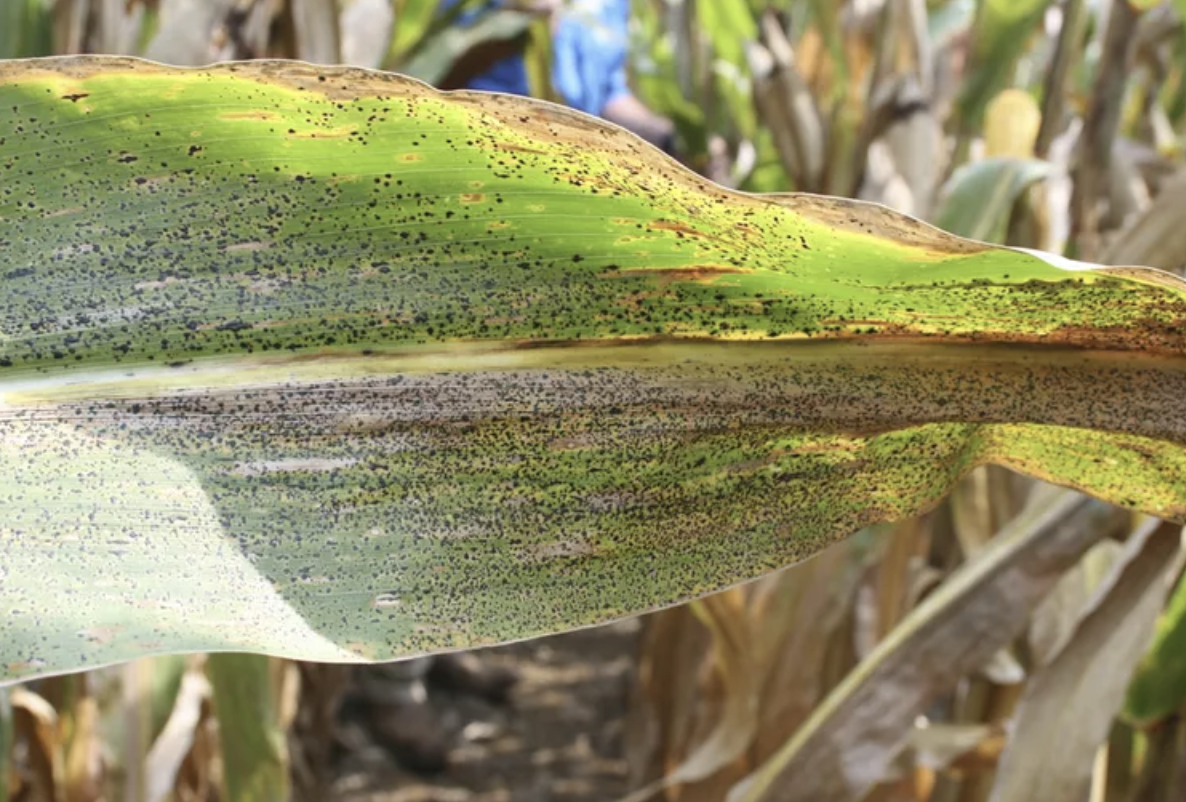
Tar spot, the fungal leaf disease that has spread across the US Corn Belt over the past decade, has been confirmed in North Carolina for the first time. The Crop Protection Network's latest map records the find in Randolph County on 28 August.
The state joins a long list for 2026. Cases have been reported this year in Delaware, Georgia, Illinois, Indiana, Iowa, Kansas, Kentucky, Maryland, Michigan, Minnesota, Missouri, Nebraska, New York, Ohio, Pennsylvania, South Dakota, Virginia and Wisconsin.
Daisy Ahumada, field crop and strawberry pathology specialist with North Carolina State University Extension, said recent rain and cooler temperatures had probably encouraged the disease. Tar spot develops best at 60 to 80 degrees Fahrenheit with humidity above 85% and leaves wet for more than seven hours a day, she said, and continued scouting would be important if the wet weather went on.
The timing limits the damage. Ahumada said the best window for a single fungicide application is between tasselling (VT) and the milk stage (R3), which is when it suppresses disease, protects yield and pays for itself. "When disease develops late, especially after R4-R5, yield impacts are often minimal," she said.
Growers scouting for it should look for the fungus's small, round to irregular, raised black stromata on both sides of the leaf, and sometimes on sheaths, husks and tassels. Physoderma brown spot, common and southern rust and insect frass can all be mistaken for it.
North Carolina's corn is already well along. USDA's Crop Progress report of 8 September said 95% of the crop had dented and 80% was mature, three points behind the five-year average, with 38% harvested against a normal 36%. The crop has had a hard year, rated 22% very poor, 33% poor, 32% fair, 10% good and 3% excellent. Reporting by Kacey Birchmier.
Source: Successful Farming


Comments
(0)