
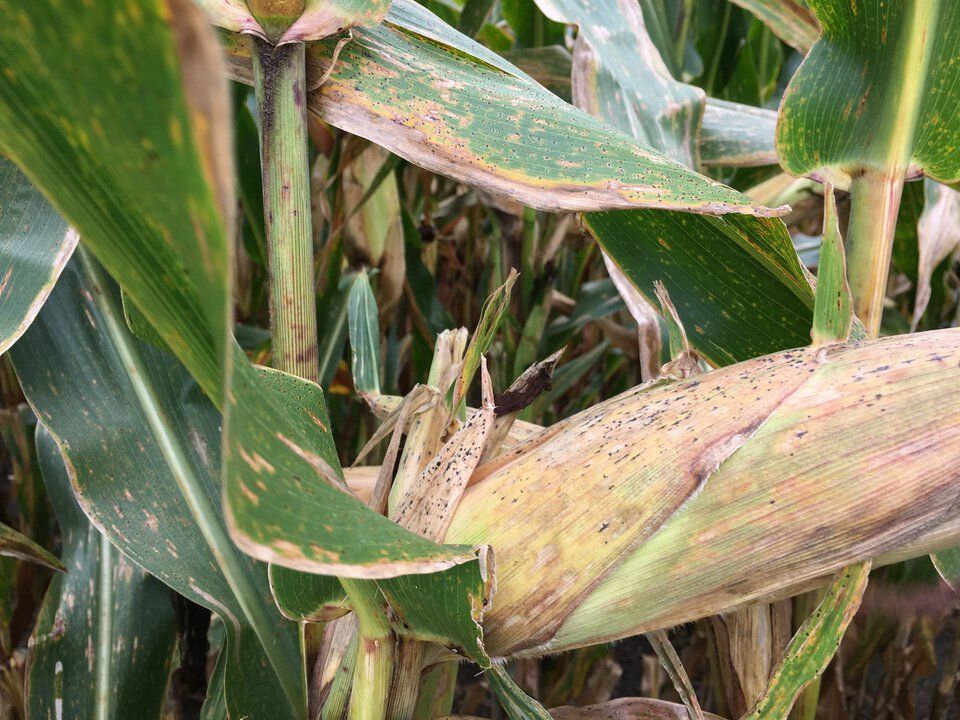
The corn disease tar spot has made its first appearance of the season in South Dakota. The Crop Protection Network's map shows confirmed cases in Union, Clay, Yankton, Lincoln, Turner and Minnehaha counties, all in the south-east corner of the state. The first find was in Clay County on 2 September, followed by Union, Yankton and Turner on 4 September and Lincoln and Minnehaha on 9 September.
Since the disease was first detected in South Dakota in 2022, 46 of the state's 66 counties have recorded it. This year it has also been reported in Delaware, Georgia, Illinois, Indiana, Iowa, Kansas, Kentucky, Michigan, Minnesota, Maryland, Missouri, Nebraska, New York, North Carolina, Ohio, Pennsylvania, Virginia and Wisconsin.
Madalyn Shires, plant pathologist at South Dakota State University, said the infections she had seen were easy to find but light: one or two lesions on a few leaves per plant, "kind of widespread, but very low incidence and severity across fields." Further north the disease was harder to find and the cases were clearly early ones.
The weather set it up. Like much of the Great Plains, South Dakota was in drought until four to six weeks ago; around the first week of August humidity rose and periodic rain arrived, and the south-east corner, with close to 5 inches of rain since 1 August according to the Iowa Environmental Mesonet and temperatures that peaked in triple digits, was primed for an outbreak. "We kind of expected tar spot to start showing up, and it did," Shires said.
Her advice for this season is to do nothing. "We're so late in the season, much of our corn has already dried down. I don't think we're going to see any yield losses due to it," she said, adding that recent tornadoes and hail were a far bigger threat to the crop. Farmers should still note where it appears, especially in corn-on-corn fields, because it could return next year.
USDA's Crop Progress report of 8 September said all of South Dakota's corn had reached the dough stage, 72% had dented and 22% was mature, well ahead of the 13% five-year average. Harvest had not started. Condition was rated 9% very poor, 17% poor, 32% fair, 36% good and 6% excellent, worse than the national crop, and the August Crop Production report had put the state's yield at 151 bushels an acre, 20 below 2025, with a new estimate due on 11 September. Reporting by Natalina Sents Bausch.
Source: Successful Farming

Comments
(0)