
The writer recalls the 1980s, when rural farmers were surprised by the idea of farming fish in ponds, which were used for washing and bathing. A filler about "Hakim Ali's fish farming", made for Bangladesh Television to encourage fish farming, became very popular, and a fish farming revolution followed. Bangladesh is now third in the world in fish production, and scientists have developed new fish varieties.
Fish farming's growth and problems
According to the Department of Fisheries, Bangladesh has become self-sufficient in fish, producing 4.134 million tonnes in 2017. Production rose from 754,000 tonnes in 1983-84 to 4.134 million tonnes in 2016-17, about 5.5 times in 33 years, and daily fish consumption per person rose from 60 grams to 62.58 grams, according to the Bangladesh Bureau of Statistics. Yet fish farmers raise the same problems again and again, including at the "Krishi Budget Krishoker Budget" programme: labour shortages, rising ammonia in the water, falling oxygen, high feed prices and feed that lacks the promised nutrients. About 90 percent of fish farmers report these complaints.
The invention
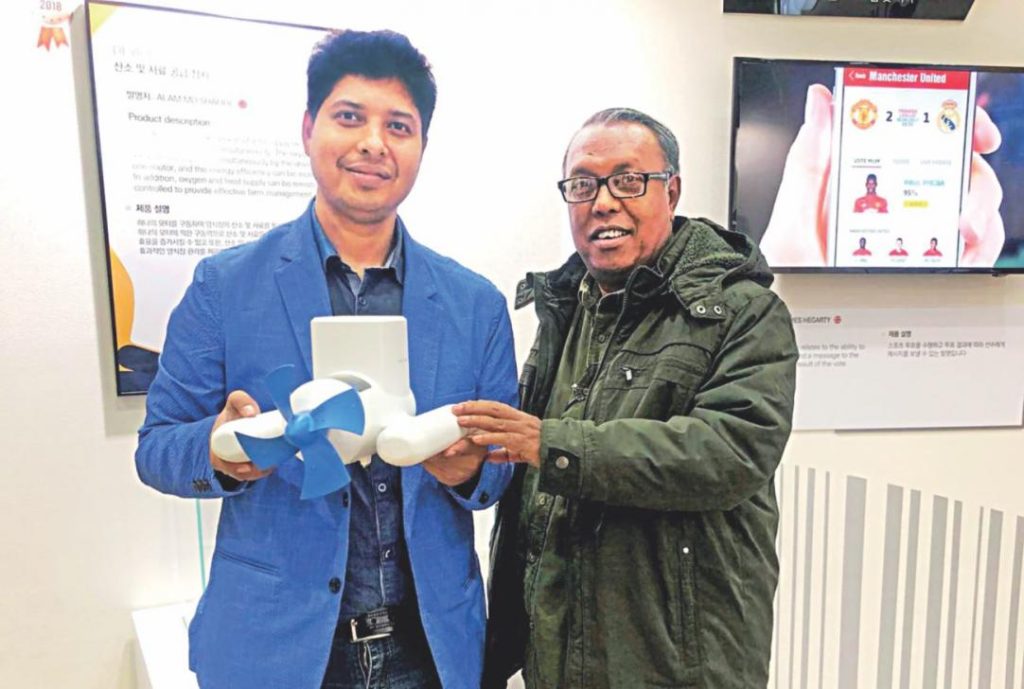
A farmer's son, software engineer Shafiul Alam, has come up with a solution. The writer met him in early December at Asia's largest annual invention fair at COEX in Gangnam, Seoul, South Korea, where only 40 of 606 innovations from 33 countries were selected for display. The event was supervised mainly by Korea's Ministry of Justice with support from the World Intellectual Property Organization and the International Federation of Inventors' Associations. Shafiul's was the only agriculture-based innovation.
Shafiul, whose father and grandfather were farmers, said the television programme "Mati O Manush" inspired him to dream about agriculture. He and his wife, Tania Chowdhury, both software engineers, developed a smart device that:
- works automatically as an aerator, with two propellers churning the water to add oxygen;
- supplies feed and oxygen;
- reports ammonia levels in the water and the movement of the fish;
- has automatic charging, making it convenient to use.
The project won a scholarship as an international participant of the Korea Invention Promotion Association (KIPA) and Korea Productivity Center (KPC) and a bronze award in the "A Big Think" competition before reaching the fair, where it won a silver medal. Because of these arrangements, the commercial rights will belong to Korea.
Reactions
Jaypurhat farmer Rafiqul Islam Chowdhury called the invention timely, and Bangladeshi researchers Obaidullah Ovi and Swapan Kumar Roy at Chungbuk National University in Korea said they were proud. Park Young-jun, director of Korea's Fisheries Information and Content Technology Association, called it a major scientific achievement important for fish farmers in South Korea, Bangladesh and worldwide, and said it would receive a patent by the middle of next year, after which commercial production would begin. Korea is expanding smart technology across agriculture, fisheries and livestock and is looking to young scientists and startups worldwide; Shafiul works at the state-backed Hyundai Card Black Studio, which supports award-winning inventors.
The writer argues that Bangladesh's government ICT sector should properly value innovators like Shafiul, and that policy preparation is needed so that the country keeps its achievements at home, noting that although Bangladesh can be proud of this technology, Korea has obtained its commercial rights.
Source: Bangladesh Pratidin. First published in Bengali on The Agro News.

Comments
(0)