
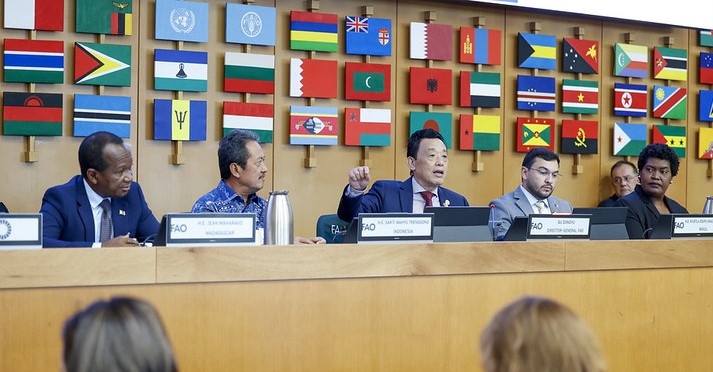
The third Small-Scale Fisheries Summit was held at the headquarters of the Food and Agriculture Organization of the United Nations in Rome from 4 to 6 September 2026, bringing together fishers, Indigenous Peoples, government representatives and researchers to set priority actions for a sector on which nearly half a billion people depend directly or indirectly.
Small-scale fisheries account for at least 40 percent of global fish catches and about 90 percent of the world's employment in capture fisheries value chains, FAO Director-General QU Dongyu told a ministerial session on the final day.
"Small-scale fisheries are critical to food security, livelihoods, poverty eradication, and sustainable development around the world," he said. "Both marine and inland small-scale fisheries provide nutritious food for many families and society as a whole, often associated with identity, local traditions and way of life."
Addressing ministers from Brazil, Indonesia, Cabo Verde and Madagascar, Qu argued that the Voluntary Guidelines for Securing Sustainable Small-Scale Fisheries, adopted in 2014, remain the key instrument. Their effective implementation, he said, "addresses sustainable resource management with social development, to ensure that the sub-sector is inclusive, equitable, and environmentally, socially and economically sustainable."
Delegates worked through panels on how to carry the guidelines further and how to roll out National Plans of Action. Countries around the Mediterranean and the Black Sea, where sustainability pressures have been especially intense, have agreed a Regional Plan of Action, and seven countries have launched national plans through a participatory process.
Much remains undone. Coastal fishing communities face deteriorating environments, shifting fishing patterns, disrupted breeding grounds, severe weather, biodiversity loss, pollution and climate variation, as well as competition from other economic sectors for the same water and coastline.
The summit was organised by FAO with the International Planning Committee for Food Sovereignty working group on fisheries, SwedBio and the International Collective in Support of Fishworkers, funded by Sweden, Norway, Germany and FAO, including the EAF Nansen Programme, the European Union's Fish4ACP programme and UK charities Synchronicity Earth, Turning Tides and Blue Ventures.
It was deliberately scheduled immediately before the 37th Session of the Committee on Fisheries, so that the conclusions of small-scale fishers reached FAO's governing body while it was sitting. Small-scale fishers are often underrepresented in such rooms, yet they are stewards of the ecosystems they work in and their traditional knowledge matters for conservation and sustainable use.
Source: FAO Newsroom
Comments
(0)