
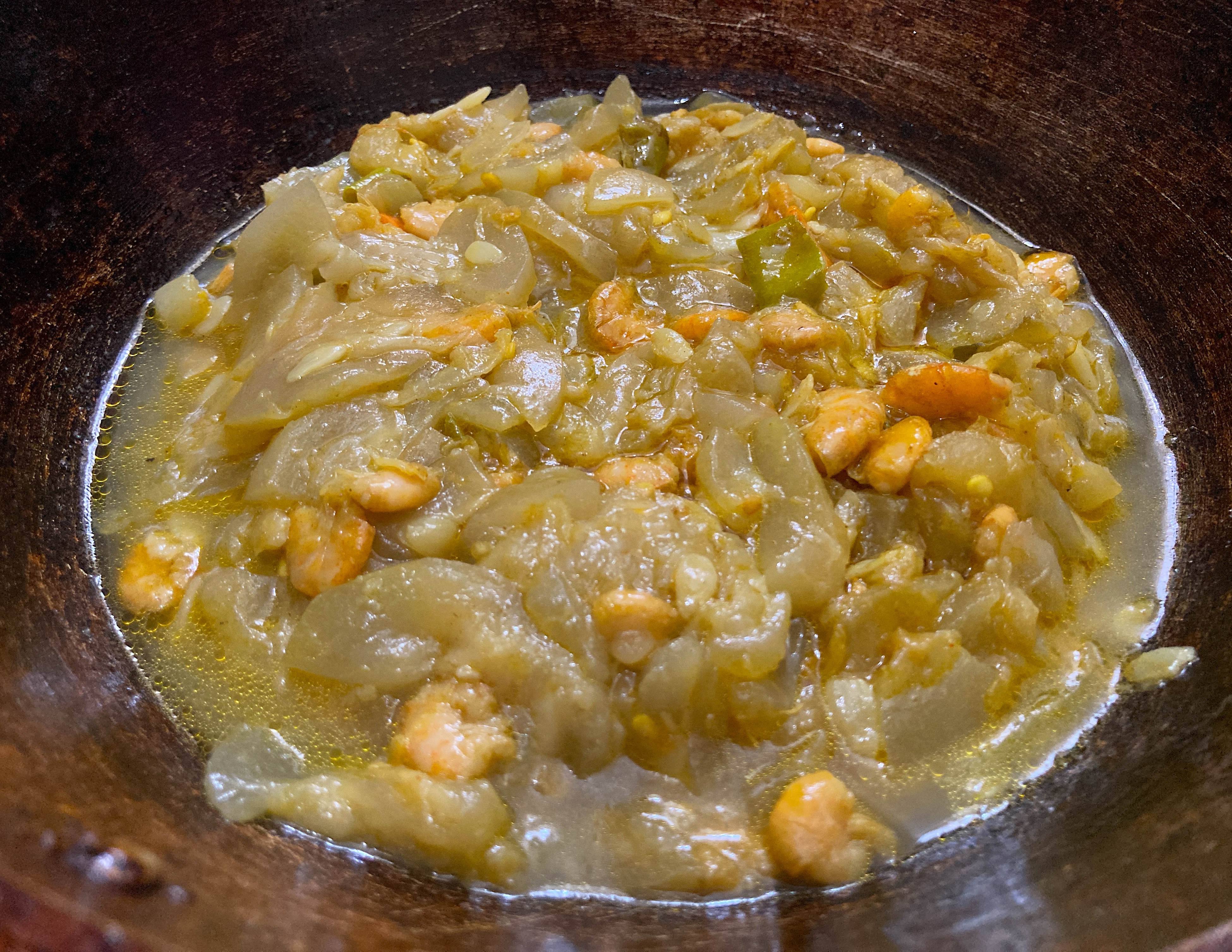
On 5 April 2026, which fell on 21 Chaitra 1432 in the Bengali calendar, the lifestyle desk of the Bangladeshi news site Jagonews24 published a home recipe for chingri diye lau shaker jhol, a thin curry of shrimp and bottle gourd leaves cooked with only a few spices. The recipe opened by noting that the hot days had begun and that in this season many people look for food that is light, nutritious and easy to digest. It presented the dish as home cooking from rural Bengal, in which the soft gourd leaves and the flavour of the shrimp come together, and said the curry is simple to make with little spice and goes well with rice.
This report sets out the recipe as the publisher gave it, with its quantities. It then explains the season in which the recipe appeared, the bottle gourd plant whose leaves are the main vegetable, the shrimp of Bangladesh's rivers, floodplains and farms, and the other ingredients that come from the country's fields, using the official figures that had been published by April 2026. The last sections give the nutrient values that Bangladesh's own food composition table lists for gourd leaves and shrimp, and the handling, allergy and safety advice that food and health authorities give for cooking shrimp at home.
The ingredients
Jagonews24 listed the following ingredients. It did not say how many people the dish serves.
- Bottle gourd leaves (lau shak): 4 cups
- Medium-sized shrimp: 2 cups
- Potatoes: 1 cup
- Chopped onion: 1
- Chopped garlic: 1 teaspoon
- Green chillies: 4 to 5
- Turmeric powder: half a teaspoon
- Red chilli powder: half a teaspoon
- Salt: to taste
- Oil: 2 tablespoons
- Water: as needed
Two details differ between the list and the method that follows. The list gives the garlic as chopped, while the method asks for garlic paste; and the list says only oil, while the method names mustard oil. The first step of the method also uses a little salt and turmeric to rub on the shrimp, in addition to the amounts listed for the curry.
How the curry is cooked
The publisher's method has five stages: preparing the leaves and the shrimp, frying the shrimp, making the spice base, cooking the leaves with the potatoes, and finishing the curry with the shrimp. Step by step, as Jagonews24 gave it:
- Wash the gourd leaves well and cut them. Clean the shrimp, rub them with salt and turmeric and set them aside for 5 to 10 minutes. According to the recipe, this removes the raw smell of the shrimp and improves the taste.
- Heat mustard oil in a karai, a deep cooking pan, fry the shrimp lightly and lift them out. Do not fry them too long, the recipe warns, or they may turn tough.
- In the same oil, fry the chopped onion until it is light brown. Then add the garlic paste and stir for a while, so that its raw smell goes.
- Add the turmeric powder, red chilli powder and salt and fry the spices. Add a little water and let the masala cook well.
- When the oil separates from the masala, add the gourd leaves and the potatoes. The leaves release water as they cook, so there is no need to add much water at the start.
- When the leaves and potatoes are soft, add the fried shrimp and the green chillies. Add a little water if needed, cover the pan and cook for 5 to 7 minutes.
- Keep the curry thin and light, which the recipe says makes it tastier. When it is done, serve it hot with rice.
The recipe ends with a short note headed "why you should eat it". It calls the dish both tasty and healthy and says that shrimp is a good source of protein that gives the body energy; that statement agrees with the protein values in Bangladesh's food composition table, set out below. The note also made two traditional claims about the effects of gourd leaves on the body. This report could not confirm them from any health authority or food table and has left them out.
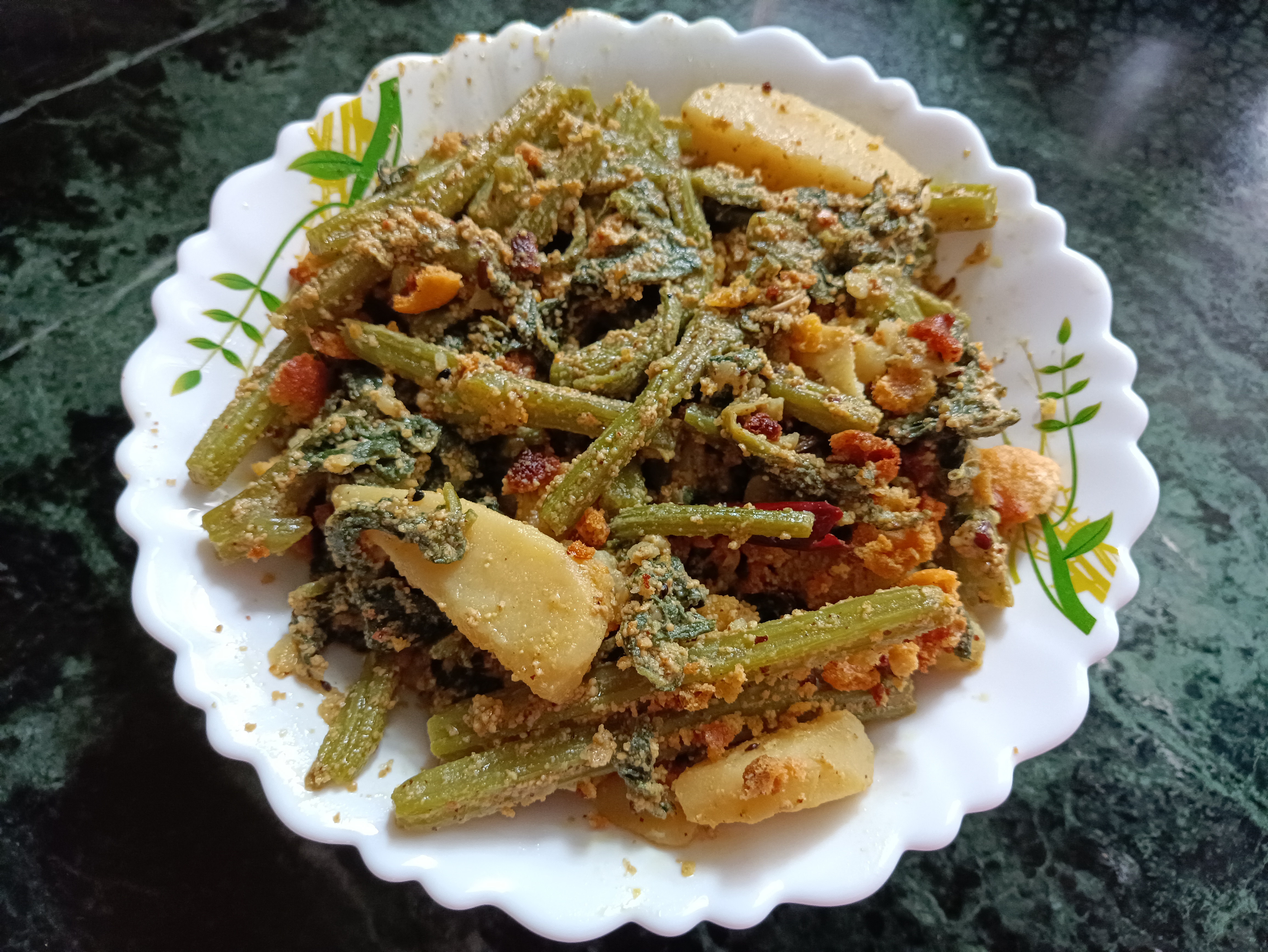
A dish for the start of the hot season
The recipe's opening line, that the hot days had begun, fits the calendar. Banglapedia, the national encyclopedia of Bangladesh, explains that the Bengali calendar traditionally divides the year into six seasons of two months each, but that the country in practice has three distinct seasons: a pre-monsoon hot season from March through May, a rainy monsoon season from June through October, and a cool, dry winter from November through February.
In the Bengali calendar, spring (basanta) spreads over Phalgun and Chaitra, from mid-February to mid-April, and is the last of the six seasons. The recipe appeared on 21 Chaitra, in the closing weeks of that season. Summer (grisma) comprises Baishakh and Jyaistha, from mid-April to mid-June, and the Bengali year begins with it on Pahela Baishakh, the Bangla New Year; but, Banglapedia notes, the influence of summer is usually felt from mid-March. It describes the pre-monsoon season as one of high temperatures and thunderstorms and calls April the hottest month in the country, when the mean temperature ranges from 27 degrees Celsius in the east and south to 31 degrees Celsius in the west-central part. The heat dries up water bodies, including rivers, canals and wetlands, and violent storms known as kalbaishakhi, or nor'westers, occur.
The recipe answers that season with a short spice base, turmeric and red chilli powder with onion and garlic, a few green chillies added at the end, and a gravy kept deliberately thin and light rather than thick.
Lau: the bottle gourd and its leaves
Lau is the bottle gourd, a vine of the gourd family, Cucurbitaceae. Banglapedia's article on gourds names the white-flowered bottle gourd and the yellow-flowered pumpkin as the most popular gourds in Bangladesh, and notes that both have a long association with people and were never found in a truly wild state. In rural Bangladesh, it says, gourds are largely grown in homestead gardens on bamboo-framed platforms or on thatched roofs. It describes the bottle gourd as generally a winter crop, rich in carotene, calcium and vitamin C, grown by direct sowing or by transplanting seedlings 15 to 20 days old, and ready for harvest within 55 to 60 days. Among its varieties the encyclopedia names BARI Lau-1, Khetlau and Hazari. The fruit is mainly cooked in curries with different fishes, the tender gourd is also made into sweet dishes with sugar and milk, and the leaves and vines are used as vegetables.
Bangladesh's official statistics count the leaves as a crop in their own right. The Yearbook of Agricultural Statistics of Bangladesh 2024, published by the Bangladesh Bureau of Statistics (BBS), lists both watergourd (lau) and lau shak among the winter vegetables. In the 2023-24 fiscal year, it says, lau was grown on 50 thousand acres, with a yield of 6,257.53 kilograms per acre and a production of 313 thousand tonnes, against 284 thousand tonnes in each of the two previous years. Lau shak was grown on 17 thousand acres in 2023-24, with a yield of 1,944.22 kilograms per acre and a production of 34 thousand tonnes.
The same yearbook's crop calendar gives the sowing time for watergourd as mid-July to early November and the harvest as early January to early March, with 250 grams of seed needed for an acre.
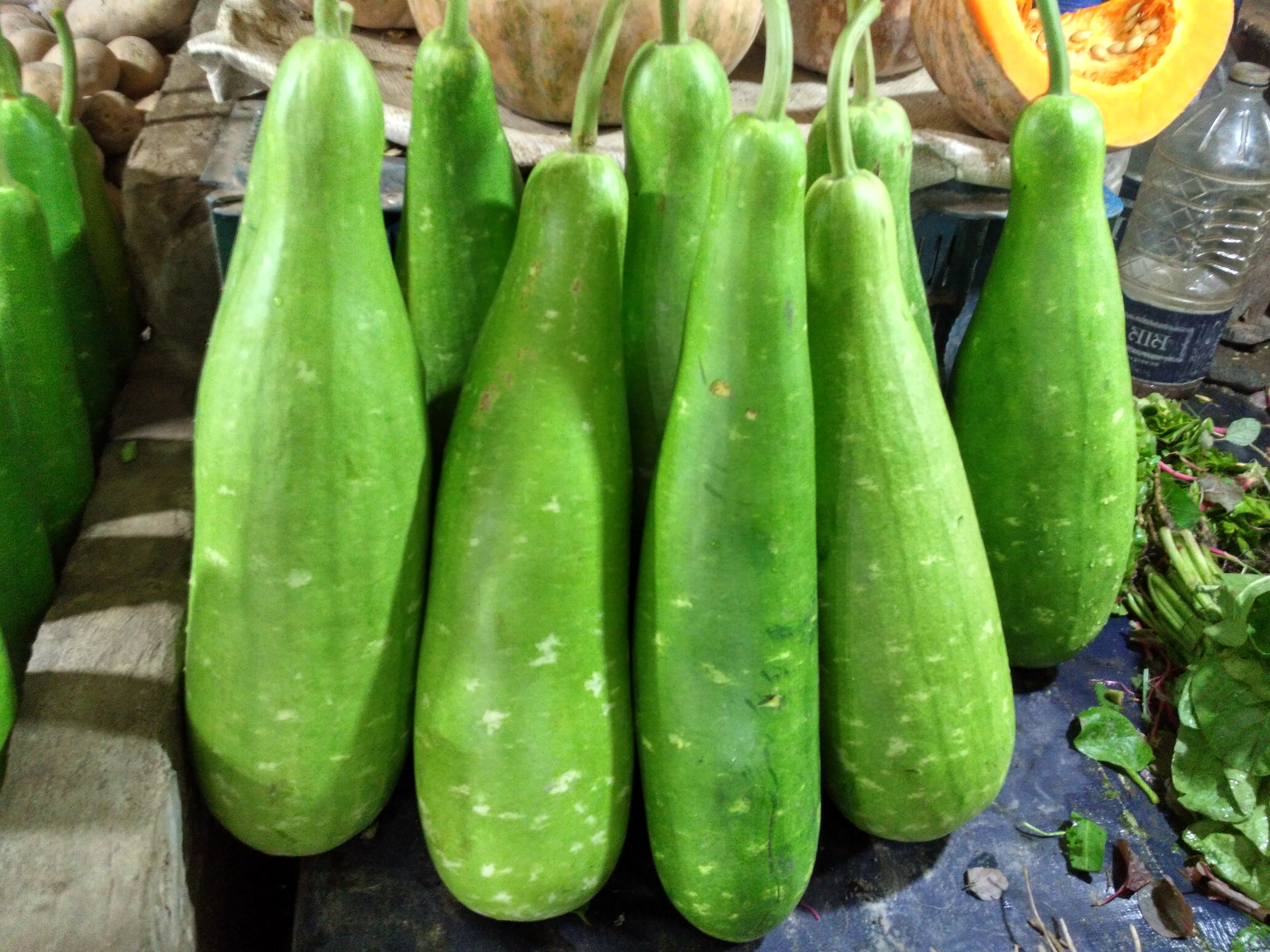
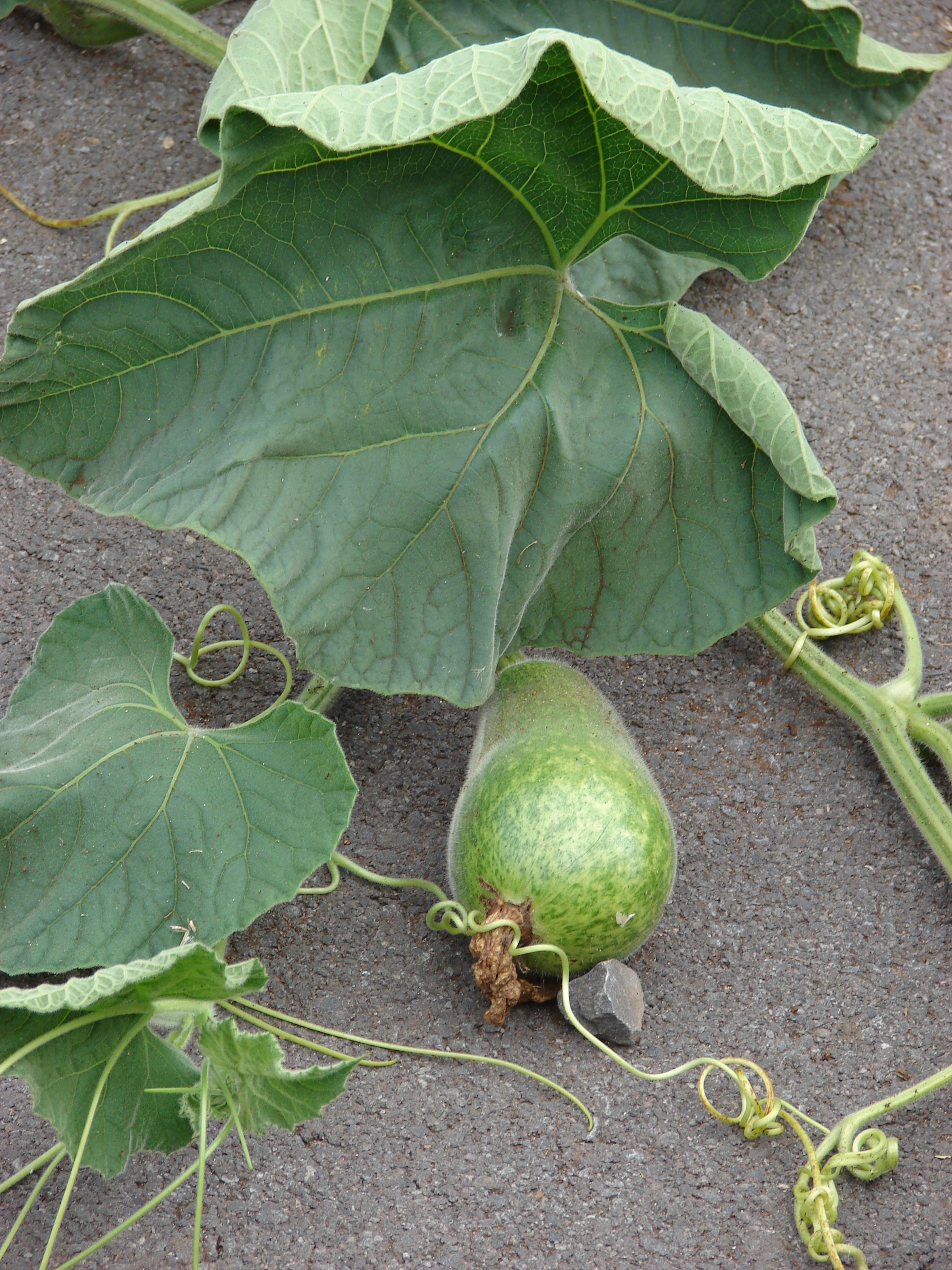
Encyclopedic references describe the plant in more detail. The English-language Wikipedia, in its article on the calabash, Lagenaria siceraria, says the bottle gourd can be harvested young and eaten as a vegetable, or harvested mature and dried for use as a ladle, bowl, container or musical instrument, and that it was one of the world's first cultivated plants grown not primarily for food but for use as a container. Archaeological finds of the gourd in China and Japan date to about 8,000 to 9,000 years before the present.
The plant, the same article says, prefers well-drained, moist soil rich in organic matter, needs plenty of moisture in the growing season and a warm, sunny position sheltered from the wind, and can be grown in a pot and trained over a trellis or a roof; in rural areas many thatched roofs are covered with gourd vines. The stems grow very fast and can reach 9 metres in summer, and farmers sometimes cut off the tip of the vine when it is 2 metres long to force side branches that bear more flowers and fruit. The flowers are white and open at night.
Chingri: the shrimp of Bangladesh
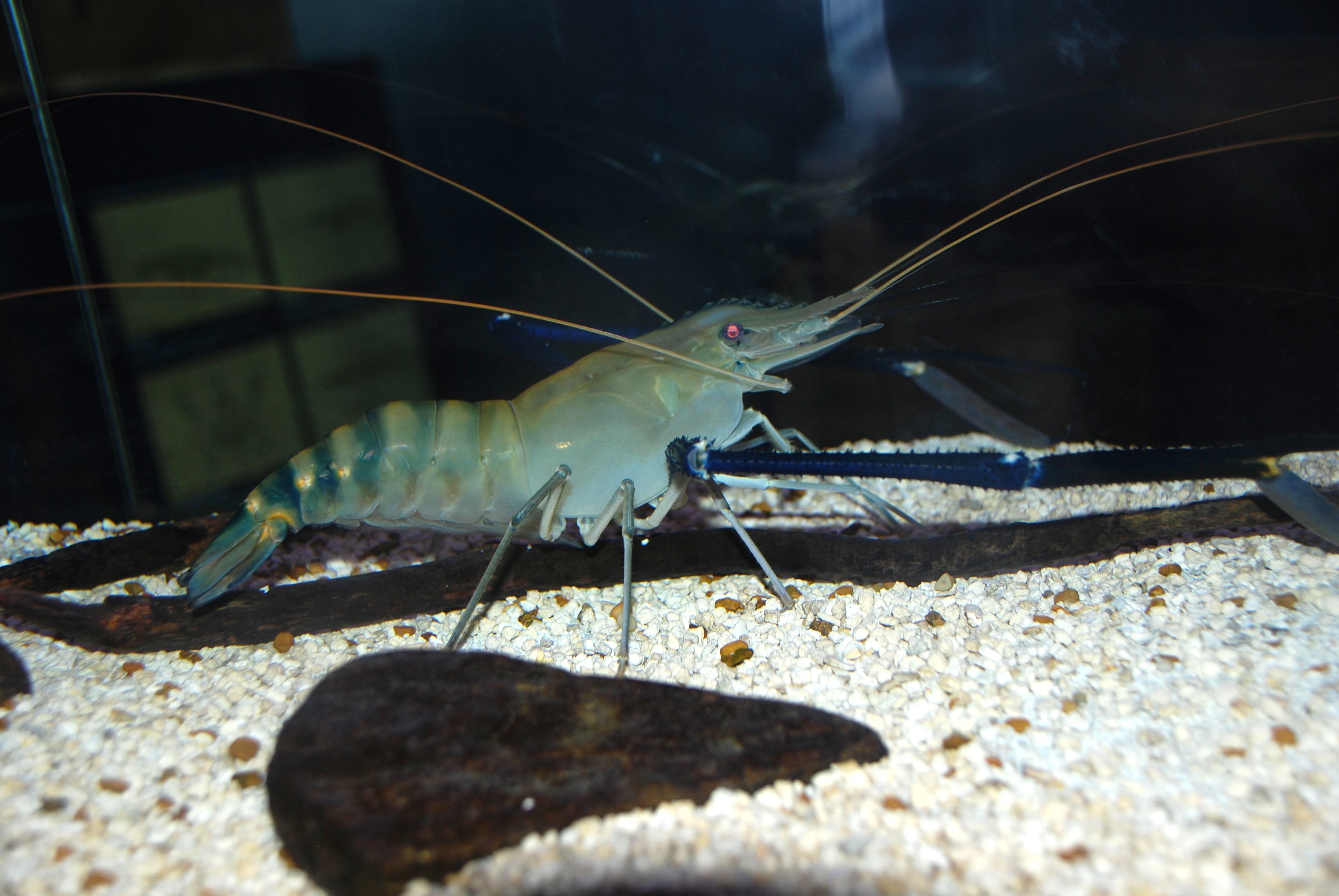
Chingri is the Bengali word for both prawns and shrimps. Banglapedia describes them as crustaceans related to crabs and lobsters, of the order Decapoda, found in all types of water bodies, ranging in size from 2.5 to 30 centimetres. Bangladesh, it says, has a very rich source of prawns in the Bay of Bengal, its estuaries and fresh water: a total of 56 species have been reported, of which 37 live in salt water, 12 in brackish water and 7 in fresh water. They belong to six families, and the freshwater species are included in the family Palaemonidae.
The Department of Fisheries (DoF) sorts the national catch into two groups. Its Yearbook of Fisheries Statistics of Bangladesh 2023-24 counts galda, bagda, harina and chaka as big shrimp and prawns, and all other small chingri as small shrimp and prawns. In the 2023-24 fiscal year the country produced 260,486 tonnes of shrimp and prawns: 67,716 tonnes of galda, 77,624 tonnes of bagda, 12,482 tonnes of harina, 5,422 tonnes of chaka and 97,242 tonnes of other shrimp and prawns. Of the small kinds, the inland waters gave 77,084 tonnes, including 46,108 tonnes from floodplains, 14,991 tonnes from rivers and estuaries and 4,555 tonnes from beels, and the sea a further 20,158 tonnes. The Jagonews24 recipe asks only for medium-sized shrimp and does not say which kind.
Banglapedia gives the habitat and breeding season of the main species. The galda, Macrobrachium rosenbergii, the giant freshwater prawn, lives in rivers, tributaries, canals and river mouths and breeds from January to July. The bagda, Penaeus monodon, the giant tiger shrimp, lives in the Bay of Bengal and its estuaries and breeds from November to March. The encyclopedia says the bagda is cultivated in ghers and ponds on coastal and tidal land in Satkhira, Khulna, Bagerhat and Cox's Bazar, including Chakaria and Teknaf, and the galda in ponds and paddy fields mainly in Bagerhat, Khulna, Jessore, Patuakhali, Barisal and other districts, in monoculture, in polyculture with fish such as mullets, carps and tilapia, and together with paddy.
Shrimp in the country's fisheries
Shrimp is one part of a large fisheries sector. The DoF yearbook puts Bangladesh's total fish production in 2023-24 at 50.18 lakh tonnes, of which aquaculture accounted for 59.34 percent. It says fish supplies about 60 percent of the animal protein that the country's people eat, with a per capita supply of 67.80 grams a day against a target of 60 grams, that the fisheries sector made up 22.26 percent of the agriculture sector in 2023-24 according to BBS, and that around 12 percent of the population depends directly or indirectly on fisheries for a living.
The yearbook calls shrimp one of Bangladesh's major export items. Total shrimp and prawn production, including capture, was 2.60 lakh tonnes in 2023-24, a fall of 3.99 percent on the year before. Of the 260,486 tonnes, inland waters gave 234,217 tonnes, of which shrimp and prawn farms produced 147,824 tonnes, and the sea 26,269 tonnes.
Galda, bagda, harina and other shrimp are among the main fishery exports, the yearbook says, along with marine fish, crab, cuchia, dry fish, fish scales and shrimp shells, sold to more than 50 countries, with the countries of the European Union the major importers. In 2023-24 Bangladesh exported 77,407.94 tonnes of fish and fishery products worth Tk 4,531.86 crore, 0.91 percent of national export earnings; frozen shrimp and prawns made up 19,131.35 tonnes worth Tk 2,117.67 crore. The yearbook also records that the country's tiger shrimp has a Geographical Indication registration under the name Bangladesh Tiger Shrimp.
Potatoes, onion, garlic, spices and mustard oil
The other ingredients of the curry are major field crops in Bangladesh. The potato, Solanum tuberosum, is described by Banglapedia as one of the staple foods of the country; it is widely cultivated in all districts during winter, and most varieties are harvested in February and March. The BBS yearbook puts the total potato area in 2023-24 at 1,133 thousand acres and production at 10,601 thousand tonnes.
The onion, Allium cepa, possibly originated in western Asia, according to Banglapedia, which names Faridpur as the largest producing district and notes that the bulb is used as a fresh vegetable, as a spice and as an ingredient of curries. Garlic, Allium sativum, is native to Central Asia and southern Europe and is planted in November and December. For 2023-24 the BBS yearbook gives onion production as 2,917 thousand tonnes from 513 thousand acres, garlic as 528 thousand tonnes from 174 thousand acres, and turmeric as 244 thousand tonnes from 66 thousand acres. It counts chillies in two seasons: 186 thousand tonnes of kharif chillies from 53 thousand acres and 562 thousand tonnes of rabi chillies from 191 thousand acres.
Mustard oil, which the method names for frying, has a long history in the Bengali kitchen. Banglapedia notes that only a few decades ago it was the exclusive cooking oil in Bangladesh, and that in many places the oil was squeezed from the seed in a traditional mill called a ghani, turned by a bull through long hours, a trade carried out by people known as kolu; today electric mills do the work. The encyclopedia adds that the country's mustard meets only a fraction of its cooking oil needs, so large quantities of soybean and sunflower oil are imported. In 2023-24, according to the BBS yearbook, rape and mustard, a rabi crop, were grown on 1,144 thousand acres and produced 638 thousand tonnes.
What Bangladesh's food composition table says
The Food Composition Table for Bangladesh, published in June 2013 by the Institute of Nutrition and Food Science (INFS) of the University of Dhaka with the support of the National Food Policy Capacity Strengthening Programme of the Ministry of Food, the Food and Agriculture Organization of the United Nations (FAO) and the United States Agency for International Development (USAID), gives values for the main ingredients of this curry. All the figures below are for 100 grams of the edible portion of the raw food.
Raw bottle gourd leaves (lau shak) contain 26 kilocalories, 90.2 grams of water, 2.5 grams of protein, 0.6 grams of fat, 0.6 grams of available carbohydrate and 4.4 grams of total dietary fibre. The table lists 94 milligrams of calcium, 3.1 milligrams of iron, 69 milligrams of magnesium, 276 milligrams of potassium and 41 milligrams of sodium, as well as 198 micrograms of vitamin A, 73 micrograms of folate and 47.7 milligrams of vitamin C. For comparison, the raw bottle gourd fruit contains 34 kilocalories, 90.8 grams of water, 1.1 grams of protein and 6.8 grams of available carbohydrate.
The table lists several kinds of chingri. Per 100 grams raw, the giant river prawn (galda) contains 102 kilocalories and 20.9 grams of protein with 2.0 grams of fat; the giant tiger prawn (bagda) 92 kilocalories, 16.5 grams of protein and 2.9 grams of fat; the hairy river prawn, listed in Bengali simply as chingri, 75 kilocalories, 17.6 grams of protein and 0.6 grams of fat; and the Indian white prawn 95 kilocalories, 16.4 grams of protein and 3.3 grams of fat. None of them contains carbohydrate, and vitamin C is present only in traces. For galda the table gives 116 milligrams of sodium and 441 milligrams of potassium, and for bagda 117 and 423 milligrams.
These values are for the raw ingredients only. The finished curry also carries the 2 tablespoons of oil, the salt and the potatoes, and the amount in a serving depends on how many people share the dish, which the recipe does not state. Anyone following a diet set by a doctor, for example to limit salt, fat or potassium, should ask a doctor or a registered dietitian how such a dish fits into their meals.
Handling shrimp safely, allergy and bitter gourds
Shrimp spoils quickly, and food safety agencies give specific advice for it. The United States Food and Drug Administration (FDA), in its guidance on selecting and serving seafood safely, says to buy seafood only when it is refrigerated or displayed on a thick bed of fresh ice, and that shrimp flesh should be clear with a pearl-like colour and little or no odour. Seafood to be used within two days of purchase should be kept in a clean refrigerator at 40 degrees Fahrenheit or below; otherwise it should be wrapped tightly and frozen. Frozen seafood is best thawed gradually in the refrigerator overnight or, if needed quickly, sealed in a plastic bag and put in cold water.
On cooking, the FDA says most seafood should reach an internal temperature of 145 degrees Fahrenheit, and that shrimp is done when the flesh becomes firm, pearly and opaque. Spoiled seafood can smell sour, rancid, fishy or of ammonia, these odours grow stronger after cooking, and seafood that smells this way should not be eaten. Hands should be washed for at least 20 seconds with soap and warm water after handling raw food, and cutting boards, dishes, utensils and counters should be washed with soap and hot water between preparing raw seafood and cooked food. In hot weather the FDA's serving rule matters most: seafood and other perishable food should not stay out of the refrigerator for more than 2 hours, or more than 1 hour when the temperature is above 90 degrees Fahrenheit, because the bacteria that cause illness grow quickly at warm temperatures.
Shrimp is also a common allergen. The FDA lists nine major food allergens: milk, eggs, fish, crustacean shellfish, tree nuts, peanuts, wheat, soybeans and sesame, and shrimp is a crustacean shellfish. Symptoms of an allergic reaction usually appear within a few minutes to a few hours of eating the food and can include hives, flushed skin or rash, a tingling or itchy mouth, swelling of the face, tongue or lips, vomiting or diarrhoea, abdominal cramps, coughing or wheezing, dizziness, swelling of the throat, difficulty breathing and loss of consciousness; a severe, life-threatening reaction is called anaphylaxis. People with a known food allergy who notice such symptoms should stop eating the food at once and seek medical attention, the FDA advises.
A separate warning concerns the gourd itself. In October 2010 the Department of Health Research at the Indian Council of Medical Research (ICMR) set up an expert committee after reports of illness linked to bottle gourd juice. Its findings, published in the Indian Journal of Medical Research in 2012, recorded three deaths after people drank extremely bitter bottle gourd juice and 26 people admitted to hospital with abdominal pain and vomiting after drinking freshly prepared juice. The committee explained that members of the gourd family contain toxic compounds called cucurbitacins, which cause the bitter taste, and recommended that bitter-tasting bottle gourd juice should not be consumed and that anyone who feels unwell after drinking it should be taken to a hospital at once. The warning concerned raw juice of the fruit; the Jagonews24 recipe uses cooked leaves and no juice.
The World Health Organization sums up the same principles for every kitchen in its Five Keys to Safer Food: keep clean, separate raw and cooked food, cook thoroughly, keep food at safe temperatures, and use safe water and raw materials.
Photo: Nahid Sultan / Wikimedia Commons (CC BY-SA 4.0)
Sources: Jagonews24, Institute of Nutrition and Food Science, University of Dhaka (Food Composition Table for Bangladesh, 2013), Department of Fisheries (Yearbook of Fisheries Statistics of Bangladesh 2023-24), Bangladesh Bureau of Statistics (Yearbook of Agricultural Statistics of Bangladesh 2024), Banglapedia (Gourd, Prawn, Season, Potato, Onion, Garlic, Mustard), Indian Council of Medical Research (Indian Journal of Medical Research, 2012), US Food and Drug Administration, World Health Organization, Wikipedia (Calabash)



Comments
(0)