
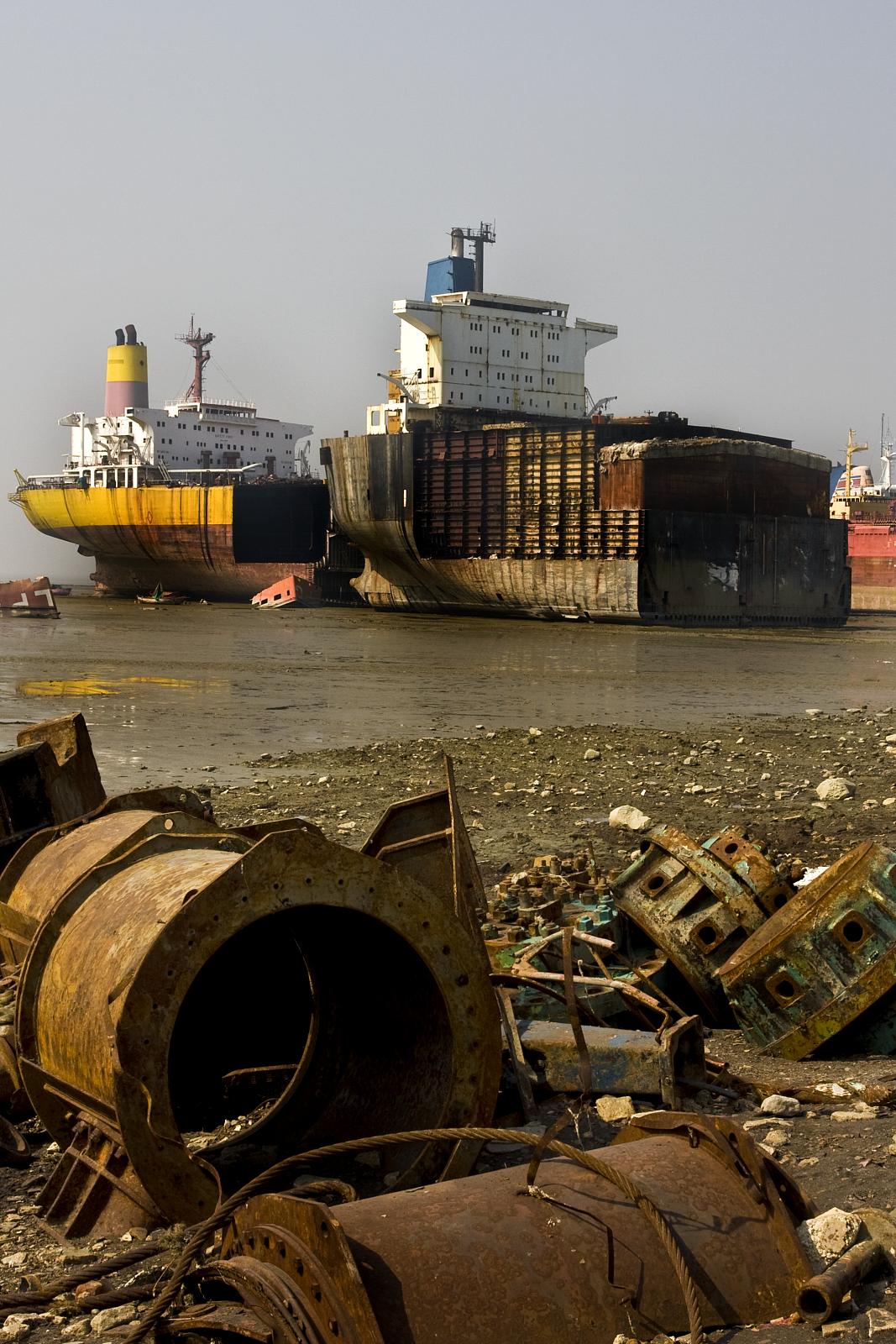
The government has decided to move ship breaking from the red to the orange category of the Environment Conservation Rules. The decision was taken on 29 September by a committee formed by the Prime Minister's Office and chaired by the Minister for Environment, Forest and Climate Change, Abdul Awal Mintoo. Its members include the industries minister, the state minister for shipping and several secretaries, but no environmental organisation or expert.
Under the Environment Conservation Rules 2023, both ship-breaking work and yards are in the red category. A new yard first needs an environmental impact assessment (EIA), a public consultation, a site clearance and then an environmental clearance, about 90 days in all. In the orange category an initial environmental examination filed with the divisional office will do; that office may recommend an EIA but the recommendation will not be binding, and it will give the final approval itself.
Owners say the delays of the red category cost them money. The environment minister said that under the Hong Kong Convention the country has 15 to 20 green yards, each with an investment of about Tk 150 crore; asked whether pollution risks would rise, he said both the environment and industry must be saved. Industries Secretary Abdun Naser Khan said 6,500 ships worldwide will be ready for breaking by 2030, and more green yards would win Bangladesh a large share.
Several Department of Environment officials, speaking on condition of anonymity, said the change will make it impossible to know how much a yard pollutes and will weaken oversight. According to the department, the yards of Sitakunda in Chattogram break 150 to 200 ships a year, each taking six months, and employ 30,000 to 35,000 workers.
Environmentalists point out that the International Labour Organization calls ship breaking one of the most dangerous industries, and that the marine ecosystem, soil and air of the South Asian beaches where ships are broken are badly polluted. An EIA is mandatory for yards in India and Pakistan as well.
Syeda Rizwana Hasan, chief executive of the Bangladesh Environmental Lawyers Association (BELA), said relaxing the rules conflicts with pending cases and court verdicts and orders on ship-breaking pollution, and that the court was not told before the decision. Recalling the deaths of 10 workers in a gas leak in August, she said the decision would put workers' lives at greater risk.
The report was filed by Mostafa Yousuf of Prothom Alo.
Photo: Ship-breaking yard at Bhatiari, Sitakunda, Naquib Hossain / Wikimedia Commons (CC BY-SA 2.0)
Source: Prothom Alo

Comments
(0)