
September 2026 was the second-warmest September on record, and the second month in a row in which the global average temperature was more than 1.5 C above pre-industrial levels, according to the Copernicus Climate Change Service (C3S), Down To Earth reports.
The global average for the month was 16.27 C, 0.82 C above the 1991-2020 average and 1.63 C above the 1850-1900 level, and 0.11 C cooler than September 2023, the warmest. August 2026, at 1.65 C above pre-industrial levels, was the joint hottest month on record.
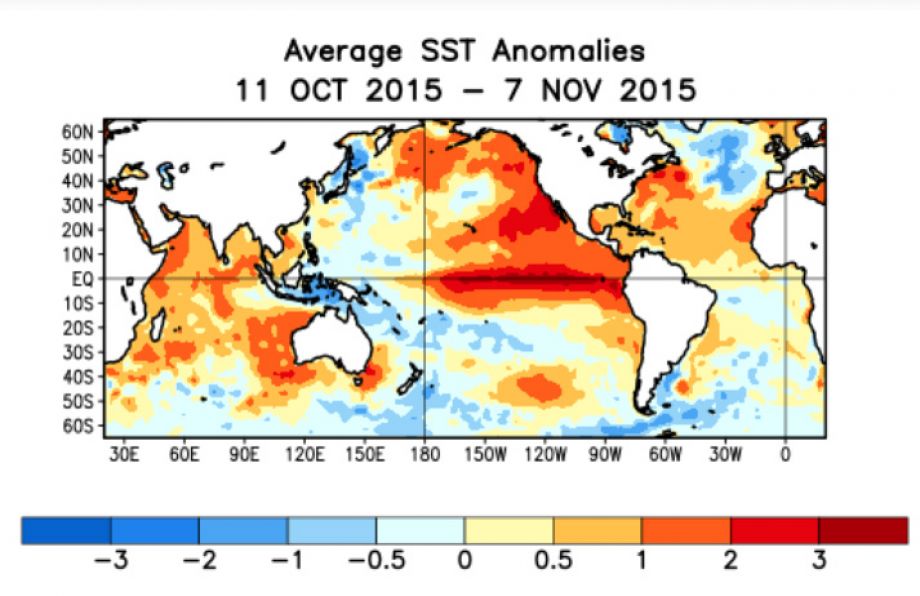
The average sea surface temperature outside the polar regions set a new record of 21.05 C, beating the 20.92 C of 2023. In the Nino 3.4 region of the Pacific, used to track El Nino, the monthly sea temperature reached an all-time high of 29.70 C, above the peaks of the very strong El Nino events of 1982-83, 1997-98 and 2015-16, which C3S said underlines the exceptional strength of the present event.
Many regions were drier than normal, C3S said, including much of southern and northeastern North America, the Maghreb, part of the Horn of Africa, Siberia, large parts of central Asia, Pakistan, parts of China and South America, and southeastern Australia. Large parts of the US and Canada, central Asia north of the Indian subcontinent, eastern China, Japan and other regions were wetter than normal, with floods in several places.
"We are in a new run of months above 1.5°C, and with a strong El Nino still intensifying it is likely to last into 2027. Crossing the Paris Agreement's long-term limit is only a matter of time," said Carlo Buontempo, director of C3S.
Photo: NOAA / Wikimedia Commons (Public domain)
Source: Down To Earth




Comments
(0)