
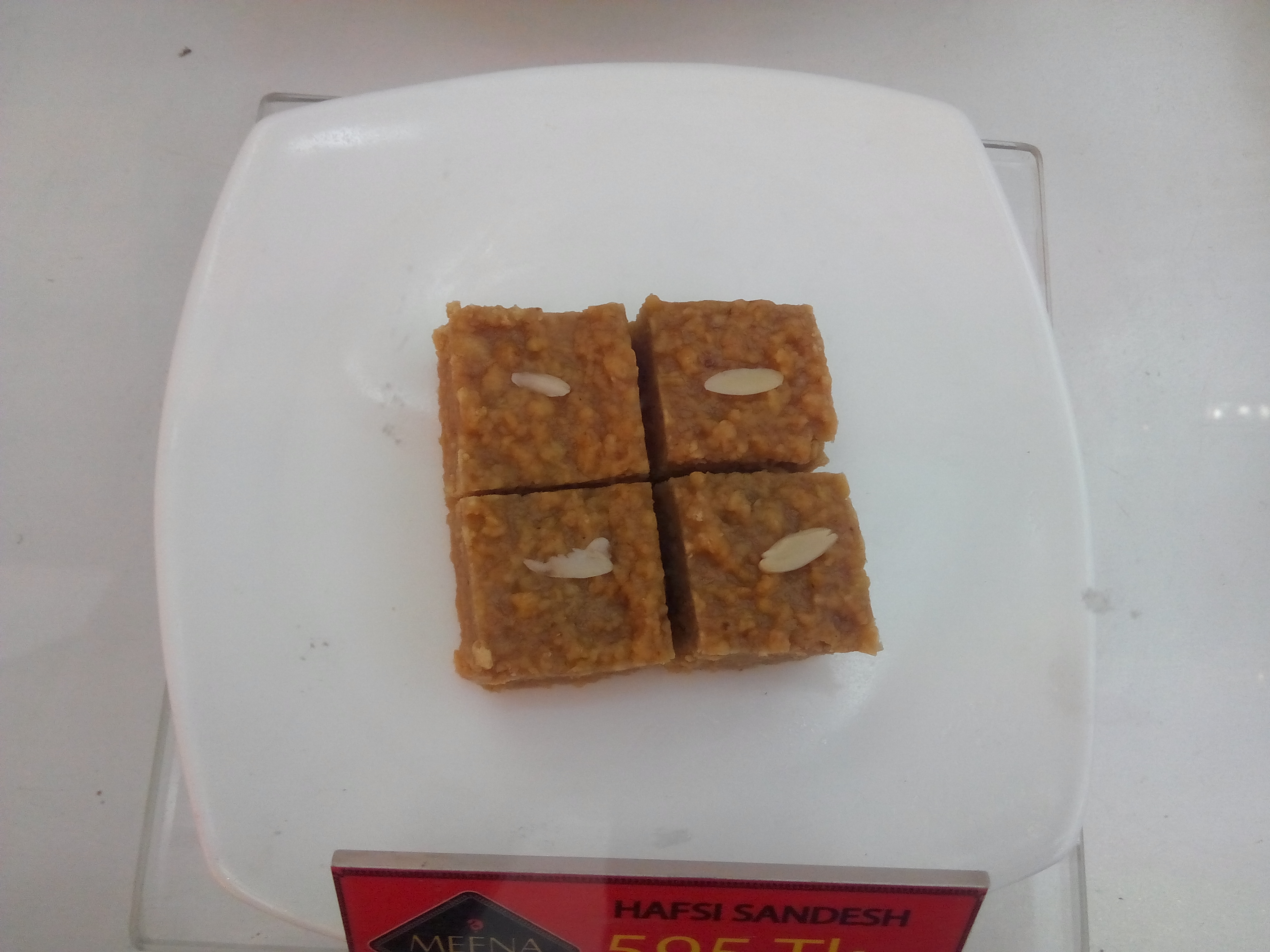
Jagonews24's lifestyle desk published a home recipe for ripe mango sandesh on 11 July 2026, in the middle of Bangladesh's mango season. The sweet is made from the pulp of ripe mangoes cooked in ghee with sugar, milk powder and mawa, a thickened milk solid, until the mixture is firm enough to shape. The paper presented it as a soft, melt-in-the-mouth sweet that needs only a few ingredients kept at home, and that suits guests as well as the whole family on a hot day.
Sandesh is usually made from chhana, the fresh curd of milk. This version takes another route: it builds its body from mawa and milk powder, with mango for flavour and colour. The recipe below keeps the quantities and steps exactly as the original gives them. The sections after it explain the ingredients, where sandesh comes from, and the state of the mango crop in the season the recipe appeared.
Ingredients
- Ripe mangoes: 2
- Mawa: 100 grams
- Milk powder: 1 cup
- Ghee: 2 teaspoons
- Sugar: 1 tablespoon
The original does not name a mango variety, give a cooking time or say how many pieces these quantities make.
Method
- Peel the ripe mangoes and cut them into small pieces.
- Blend the pieces into a smooth puree.
- Heat the ghee in a pan, pour in the mango puree and cook it lightly for a few minutes, stirring.
- Add the sugar, milk powder and mawa together.
- Lower the heat and keep stirring all the time, so that the mixture does not stick to the bottom of the pan.
- When the mixture thickens and ghee starts to separate at the sides of the pan, turn off the stove and take the pan off.
- Once it has cooled a little, shape it as you like, arrange and serve.
The recipe judges doneness by two signs rather than by the clock: the mixture has to thicken, and ghee has to begin to separate from it at the edges of the pan. Low heat and constant stirring are the two instructions it gives for getting there without the mixture catching on the base of the pan.
What sandesh is
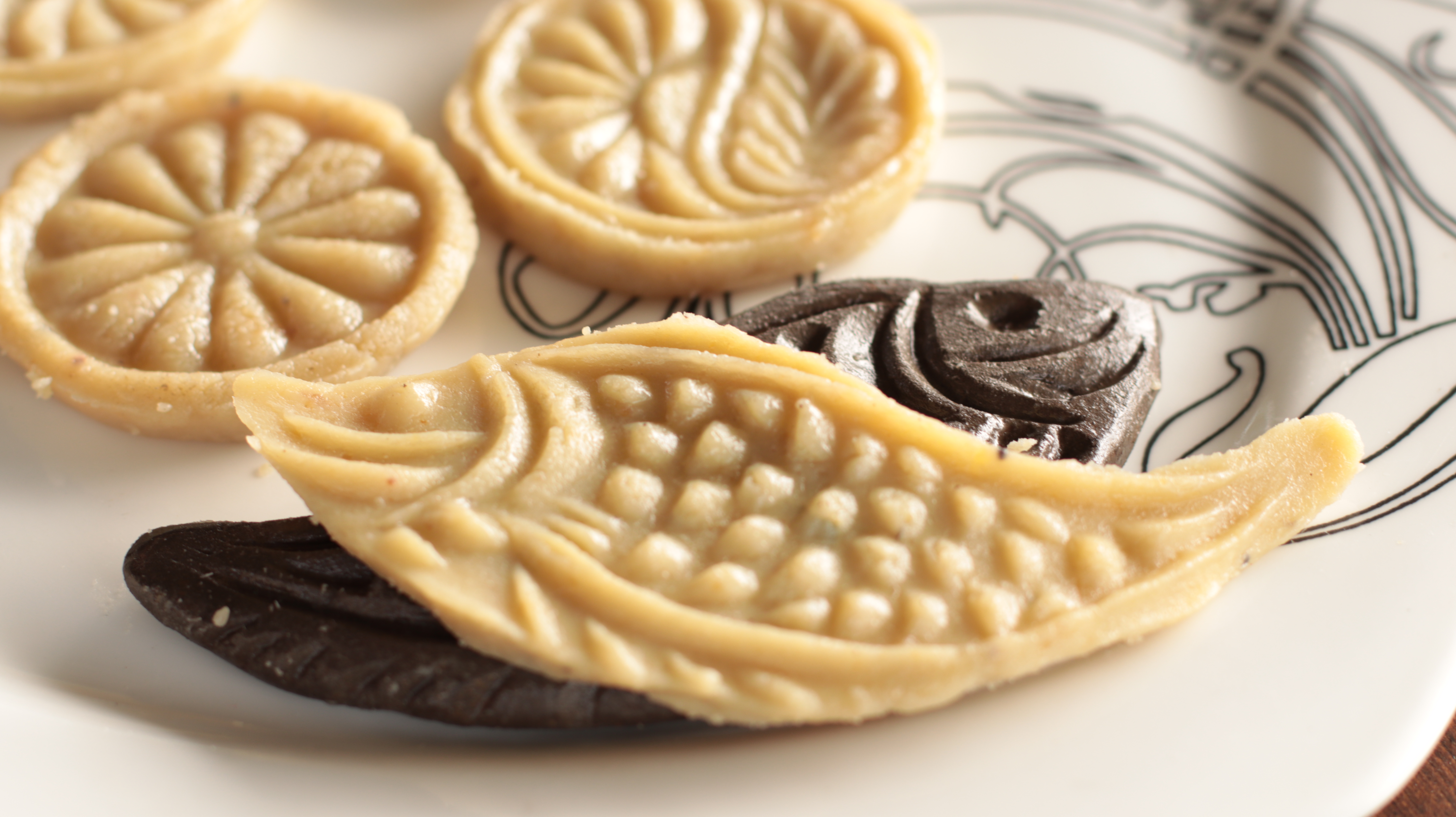
Banglapedia, the national encyclopedia of Bangladesh published by the Asiatic Society of Bangladesh, describes sandesh as a form of sweetened cottage cheese and notes that moulds are used to give sweets attractive designs and shapes, especially sandesh. Its article on sweetmeats explains that, unlike the sweets of northern India and Pakistan, which are made from ksir (thickened milk), Bengali sweetmeats are made from curdled milk. The discovery of the process of curdling milk dates back to the Middle Ages and, in the encyclopedia's words, revolutionised the sweet culture of the Bengalis. Cassia leaves, cardamom powder, raisins, cashew nuts and orange rind are used for flavour, variety and decoration.
The Food and Agriculture Organization of the United Nations (FAO), in its 1990 study "The technology of traditional milk products in developing countries", describes sandesh as a chhana-based sweet with a somewhat firm body and a smooth texture. In the method it outlines, chhana and sugar are mixed, kneaded together and heated in a shallow vessel after colour and flavour are added. The heated mass goes straight into moulds to take its shape, or it is spread in a tray, cooled and set, and then cut or moulded. FAO also records two types of sandesh on sale: a drier variety made from older chhana, which is the normal quality and keeps longer, and a softer, more expensive variety made from fresh chhana.
The same study mentions a seasonal sandesh, nalin sandesh, made with date jaggery (date gur) between November and February, which it calls a delicacy that commands a much higher price. Banglapedia names soft sandesh of Bangladesh too: Muktagachha in Mymensingh is known for manda, a kind of soft sandesh, and Dhaka for pranhara, a soft sandesh made by mixing mawa and essence with chhana. Pranhara shows that mawa already has a place in the sandesh family; the mango recipe goes a step further and leaves the chhana out.
Chhana, the usual base of sandesh
FAO describes chhana as acid-coagulated milk solids used to make many milk-based sweets, widely used in the eastern parts of India and in Bangladesh. It differs from paneer in that no pressure is applied to remove the whey. Cow milk is preferred because it gives a soft-bodied, smooth-textured chhana suited to high-grade sweets. Buffalo milk yields a larger amount, but its chhana has a slightly hard body and a greasy, coarse texture and, according to FAO, does not make good quality chhana sweets.
Chhana from cow milk is light yellow, with a moist surface, a soft body and a smooth texture; chhana from buffalo milk is whitish. Both have a pleasant, sweetish, mildly acid taste. FAO gives the composition of cow-milk chhana as 53 per cent fat in dry matter, 37 per cent protein, 4.6 per cent lactose and 4.4 per cent ash; for buffalo-milk chhana the figures are 61, 30, 4.8 and 4.1 per cent. The study notes that chhana is also made in rural milk sheds and carried to cities by road and rail in wicker baskets, which let more whey drain away, and that chhana handled this way is used for sandesh.
Banglapedia's article on food habits lists sandesh among the chhana sweets of the country's sweetmeat industry, together with rasgolla, rasmalai, pranhara, mohanbhog, khirmohan and kalajam, and describes that industry as a major consumer of milk, milk powder and sugar. Its article on the moyra, the traditional confectioners, says they prepare chhana and ghee as well as sweets such as sandesh, rasogolla, matichur, mihidana, jilapi, khaja, barfi and halua.
Mawa, or khoa: the base of this recipe
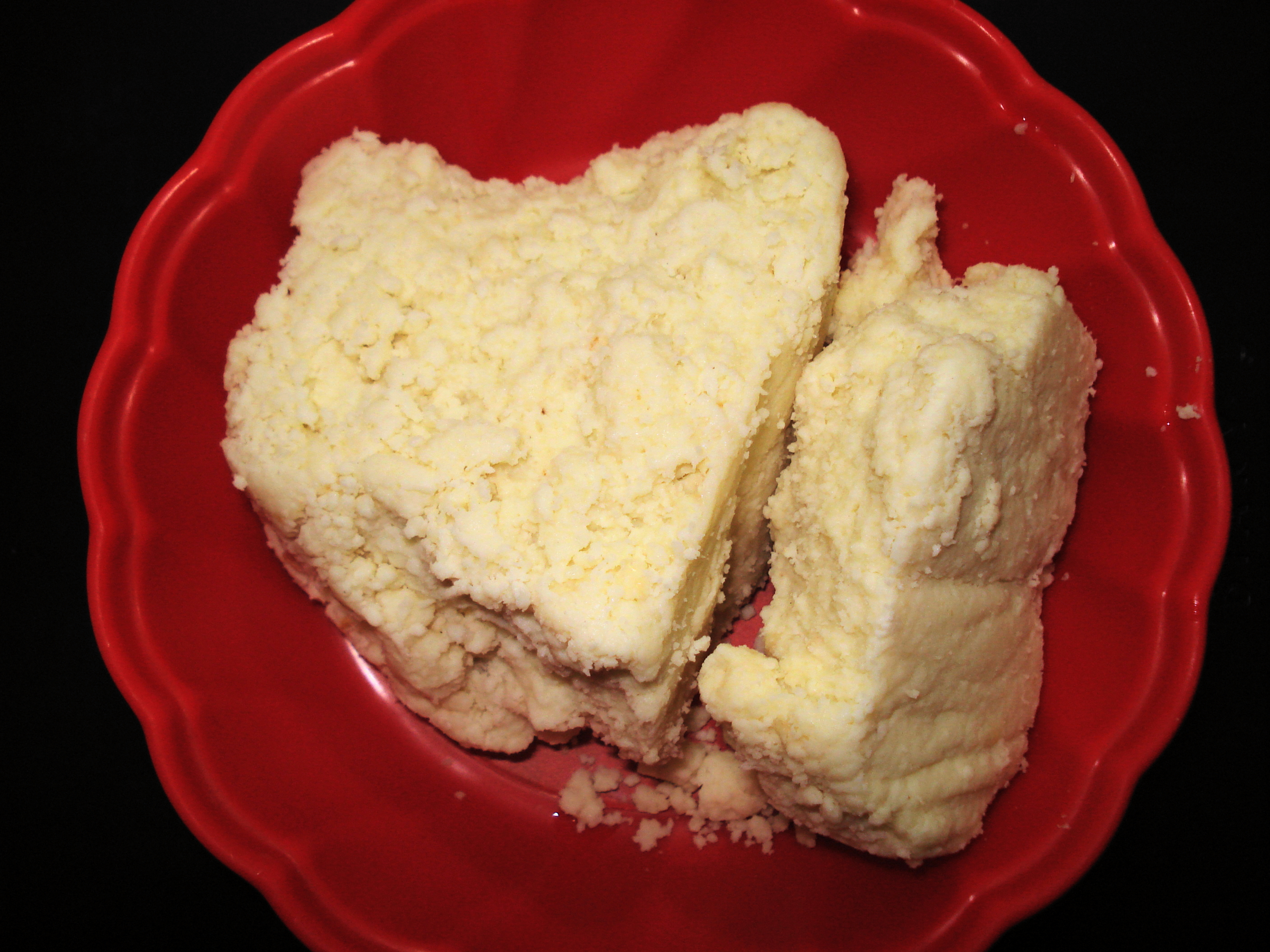
Mawa is the product FAO calls khoa, also written khawa or mawa: it is obtained from cow, buffalo or mixed milk by evaporating the milk in an open pan until it holds 65 to 70 per cent solids. FAO says about five times concentration of the milk is normally needed, and that khoa is the base material for a variety of sweets of the subcontinent; its origin is not known, but it has been prepared for centuries. Making khoa, the study adds, has been the easiest way to preserve milk produced in villages in the flush season.
Good khoa, in FAO's description, has a uniform whitish colour with a tinge of brown, a slightly oily or granular texture, and a rich nutty flavour with a mildly cooked, sweet taste that comes from its high concentration of lactose. FAO gives its composition from cow milk as 25.6 per cent moisture, 25.7 per cent fat, 19.2 per cent protein, 25.5 per cent lactose and 3.8 per cent ash; khoa from buffalo milk has less moisture, 19.2 per cent, and more fat, 37.1 per cent. Cow milk usually yields 18 per cent of khoa and buffalo milk 20 per cent.
The trade divides khoa into three types by use: pindi, used for burfi and peda; dhap, used for gulabjamun and pantooa; and danedar, a granular khoa used for kalakand. FAO notes that milk of high acidity produces the granular danedar type, and that at least 4 per cent fat in cow milk and 5 per cent in buffalo milk is needed for khoa to have a desirable body and texture; lower fat gives a hard body and a coarse texture. Banglapedia mentions mawa in several Bangladeshi sweets: granules of mawa or dried milk are sprinkled over the chamcham of Porabari in Tangail, and the raskadam of Rajshahi is made of chhana mixed with mawa.
Ghee and milk powder
Ghee is the cooking fat of this recipe. FAO calls it a very important traditional milk product in Africa, the Middle East, India and neighbouring countries, whose main use is for frying food. Its advantage over butter, from which it is traditionally made, is its far better keeping quality: boiling drives off moisture and brings the water content well below one per cent, which prevents microbial growth. In the traditional method, unsalted butter is heated to about 110 to 120 degrees Celsius with constant stirring over a low fire until practically all the moisture has gone; the residue settles as it cools and the clear fat is poured off.
FAO gives typical ghee as 99 to 99.5 per cent milk fat with 0.2 to 0.5 per cent moisture. Cow ghee is deep yellow, while ghee from buffalo milk is white with a yellowish or greenish tinge; both have a pleasant, cooked and rich flavour. The name, the study says, comes from a Sanskrit word meaning bright, and ghee originated in the subcontinent long before recorded history.
Milk powder supplies the rest of the milk solids. Banglapedia's article on food habits states that milk is scarce in Bangladesh, that the shortage is met by imports of dried milk powder, and that the sweetmeat industry is a major consumer of milk and milk powder as well as sugar. In this recipe, milk powder and mawa take the place that chhana holds in a classic sandesh, so no curdling step is needed.
The mango, an old fruit of the region
Banglapedia describes the mango, Mangifera indica of the family Anacardiaceae, as a fruit whose origin is lost in antiquity. According to some authorities, its cultivated forms derive from a species considered indigenous to the eastern region of the subcontinent, including Bangladesh, Assam and Myanmar. One of its Sanskrit names, am, means stored food or provisions. The Chinese traveller Hiuen Tsang, who visited India between 632 and 645 AD, is credited with first bringing the mango to the attention of the outside world, and the Mughal emperor Akbar, who ruled from 1556 to 1605, planted about 100,000 mango trees in an orchard at Lakh Bagh near Darbhanga, considered the first organised mango orchard of the subcontinent.
Mango trees grow throughout Bangladesh, mostly in homesteads. Banglapedia divides the country's mangoes into superior varieties, propagated by grafting, and local seedling mangoes known as deshi or guti am, which have no recognised variety names and whose taste is not assured. There are nearly 100 cultivars in the country. The elite varieties, grown mostly in Rajshahi, Nawabganj and Dinajpur, include Fazli, Langra, Gopalbhog, Himsagar, Khirsapat, Ashwina, Kishanbhog, Kohitoor, Lakshmanbhog, Mohanbhog and Misribhog. The encyclopedia calls the mango the king of fruits, says it is best eaten fresh, and notes that both ripe and green fruit are made into jam, jelly, squash, chutney and pickle.
Grafted trees, Banglapedia says, start bearing in the fourth year after planting and stay productive up to about the 45th year, while seedling trees take several years longer to bear but may fruit for 60 years or more. Fruit setting suffers if fog, rain or cloudy weather comes during flowering in January to March, and storms, hailstorms in particular, can make immature fruit drop. On 15 November 2010 the government decided to declare the mango tree the national tree of Bangladesh, bdnews24.com reported that day.
The 2026 mango season
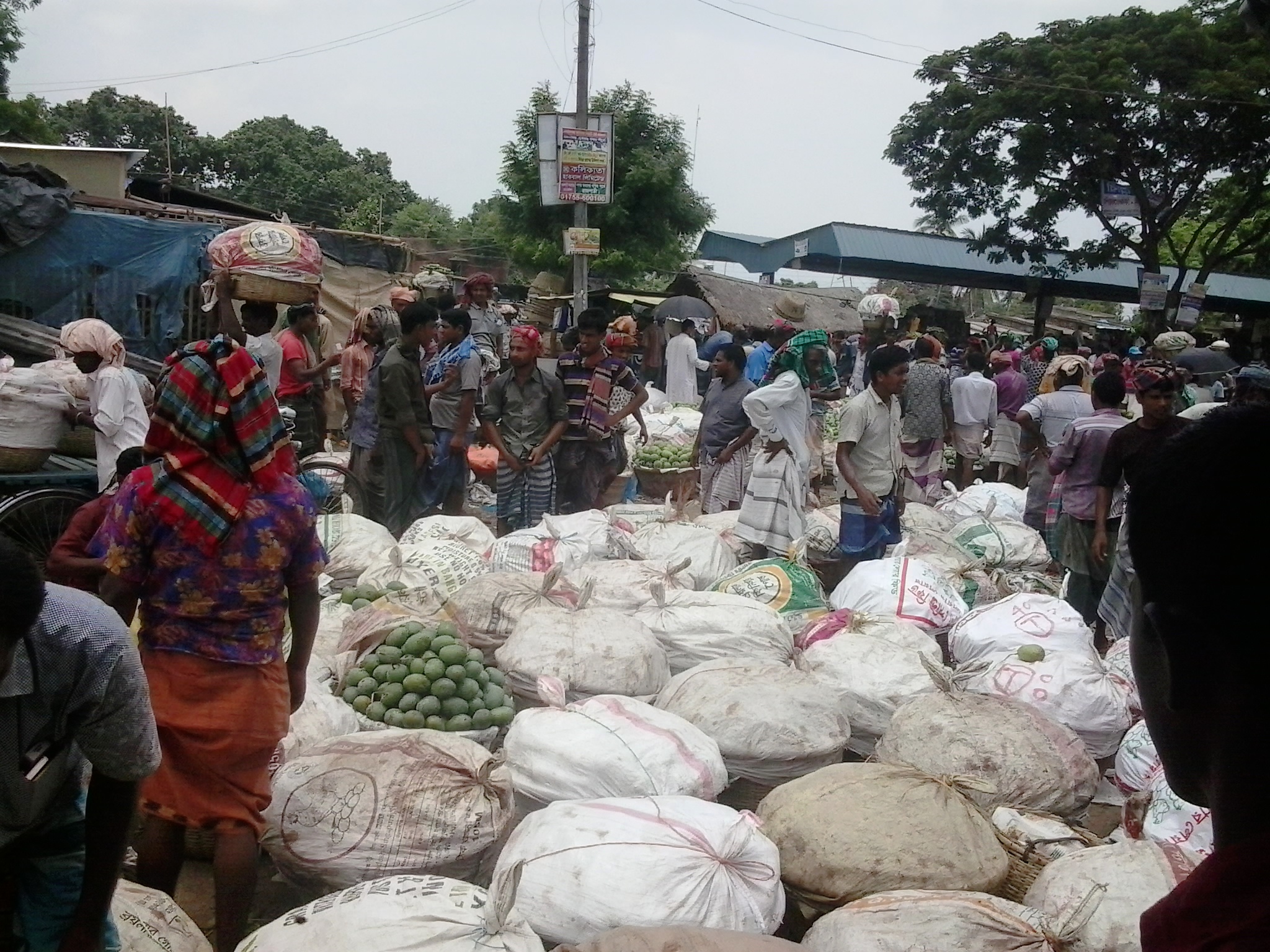
The recipe appeared in the middle of a large harvest. On 21 April 2026 Bangladesh Sangbad Sangstha (BSS), the national news agency, reported that mango had been cultivated on about 204,000 hectares that season, according to the director of the Department of Agricultural Extension (DAE)'s Exportable Mango Production Project, and that production could reach about 27 lakh tonnes if the weather held. DAE data cited in the same report put production in the 2024-25 fiscal year at 26.70 lakh tonnes, with exports of 2,194 tonnes to 38 countries. Harvesting was expected to run from May to mid-October, with Chapainawabganj, Rajshahi, Satkhira and Dinajpur the major producing districts.
To keep unripe fruit off the market, the Rajshahi district administration announced a mango calendar on 10 May 2026. Under it, guti mangoes could be picked from 15 May, Gopalbhog from 22 May, Ranipasand and Lakshmanbhog from 25 May, Himsagar or Khirsapat from 30 May, Langra and Banana Mango from 10 June, and Amrapali and Fazli from 15 June. Later varieties followed: BARI Aam-4 from 5 July, Ashwina from 10 July and Gourmoti from 15 July, while Katimon and BARI Aam-11 could be harvested throughout the year. Guti mangoes that ripened early could be picked sooner with the approval of the upazila agriculture officer, and the deputy commissioner warned of legal action against anyone who picked and marketed mangoes before the set time.
When harvesting began on 15 May, BSS reported that the DAE put Rajshahi district's mango area that season at 19,063 hectares, with a production target of about 243,993 tonnes worth more than Tk 780 crore. Guti mangoes sold at Tk 800 to 1,200 a maund on the first day at Baneshwar Haat, Rajshahi's largest mango market. By 11 July, the day the recipe was published, the calendar had opened the harvest of every variety on its list except Gourmoti, due from 15 July.
Sweets in Bengali social life
Banglapedia says sweetmeats hold an important place in the diet of Bengalis and at their social ceremonies. Sweets are distributed at the end of Muslim milads, and it is an old Hindu custom to distribute them at pujas; families share them with neighbours and relatives at births, engagements, weddings and success in examinations. The encyclopedia links the growth of the sweetmeat industry to these occasions, and notes that competition and changing tastes have created many new sweets and carried the industry abroad.
Before chhana sweets, the encyclopedia explains, Bengali sweets grew around rice and sugarcane. Guests were entertained with gud made from sugarcane, palm or date juice, mixed with coconut and chira or muri, and sweets were also made from powdered pulses with coconut and gud, as many still are at home. Its article on food habits adds that a visit to a relative's house is unthinkable without a packet of sweets, and that sweets are offered at births, birthdays, examination results, promotions, weddings and the opening of a new house or business.
Places are known for their own sweets. Banglapedia lists the chamcham of Porabari in Tangail, the manda of Muktagachha in Mymensingh, the pyada and rasmalai of Comilla, the malaikari of Faridpur, the kanchagolla of Natore, and the amriti, jilipi and pranhara of Dhaka. The moyra, it says, no longer come from a single caste: large investment has turned many into wage workers in the industry, and Muslims work in large numbers in Bangladesh's modern urban sweetmeat industry. In households, too, many sweets and pithas are made with rice flour, molasses, oil, ghee, date juice and palm juice.
Photo: Aashaa / Wikimedia Commons (CC BY-SA 4.0). The top picture shows a sandesh from Bangladesh, as background; it is not the mango sandesh of the recipe.
Sources: Jagonews24 (11 July 2026), Food and Agriculture Organization of the United Nations (The technology of traditional milk products in developing countries, 1990), Banglapedia (Sweetmeats, Food Habits, Moyra, Mango), Bangladesh Sangbad Sangstha (21 April, 10 May and 15 May 2026), bdnews24.com (15 November 2010)


Comments
(0)