
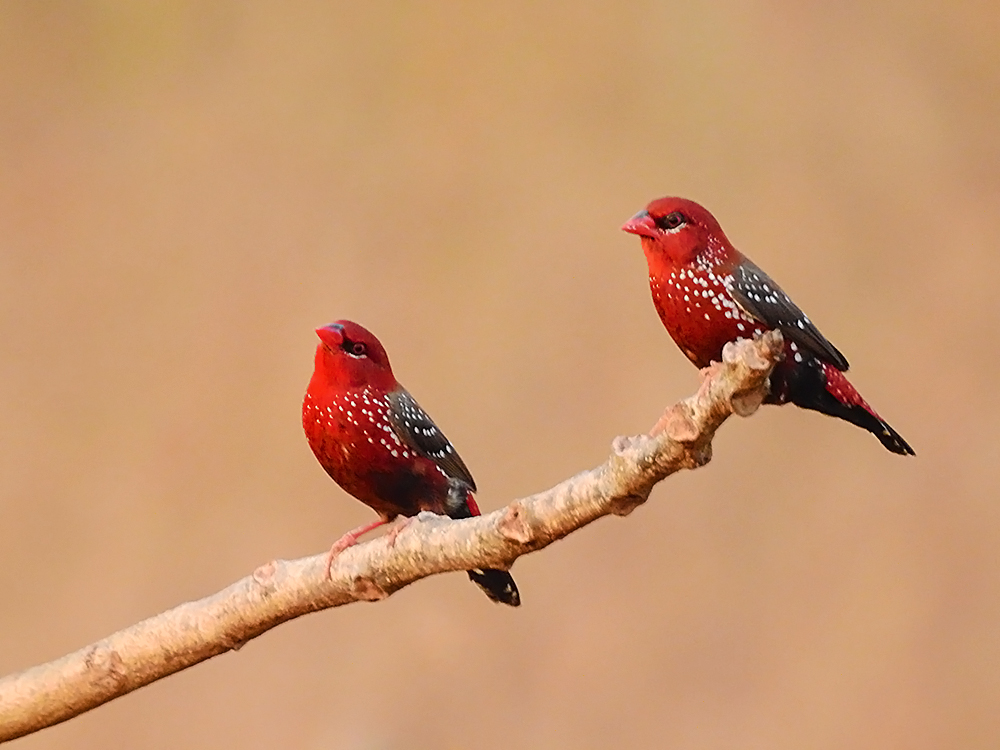
In autumn the empty plots of Aftabnagar in Dhaka, beside the Balu river, turn white with kans grass flowers, and into them comes a crimson bird to breed: the red avadavat, or red munia, which bird photographers fondly call 'laltu'. In a piece in Desh Rupantor, Professor Dr A N M Aminur Rahman, a specialist in bird and wildlife breeding and veterinary care, describes going in search of it.
He went on the afternoon of 24 October with naturalist and photographer Captain Kawsar Mostafa. Other photographers told them at least 50 pairs had come at 1 pm. At a quarter to five two or three females arrived, and the males came after 5 pm, four or five times in 45 minutes but never more than five or six pairs. With autumn over, the kans grass was already being cut in places.
The red avadavat (Amandava amandava) is a resident bird of Bangladesh, also known as ranga munia, alta munia or sonamune, found across the Indian subcontinent and tropical Asia. It is 10 cm long and weighs 9 g. In the breeding season the male turns crimson all over, with white spots on the wings and belly, bright red eyes and a coral-red bill. Females and non-breeding males are brown with a deep red rump.
Though found almost everywhere in the country, it is scarcer than other munias. Shy and gentle, it moves in small flocks through grassland, wetland and scrub beside ploughed fields, eating grass and kans seed as well as rice, foxtail millet, sesame, mustard, proso millet, lentils and peas, and insects too.
It breeds from August to October. The male sings from grass or reeds to attract a mate, and the pair weave a round nest in reeds, hogla, cogon grass, kans or bamboo, with a base of fine grass and rice leaves, kans flowers round the outside, a lining of kans fluff or cotton and a narrow hidden entrance. Four to seven pearl-white eggs hatch in 12 to 16 days, and the chicks fly and leave the nest at 19 to 24 days.
The writer's worry is that red munias and other munias are now being sold at pet-bird markets, especially the one at Mirpur 1. Yet catching, caging, selling or keeping wild birds is a punishable offence in Bangladesh. Unless people become aware of this, he warns, the laltu may one day vanish from the wild.
Photo: Shantanu Kuveskar / Wikimedia Commons (CC BY 4.0)
Source: Desh Rupantor


Comments
(0)