
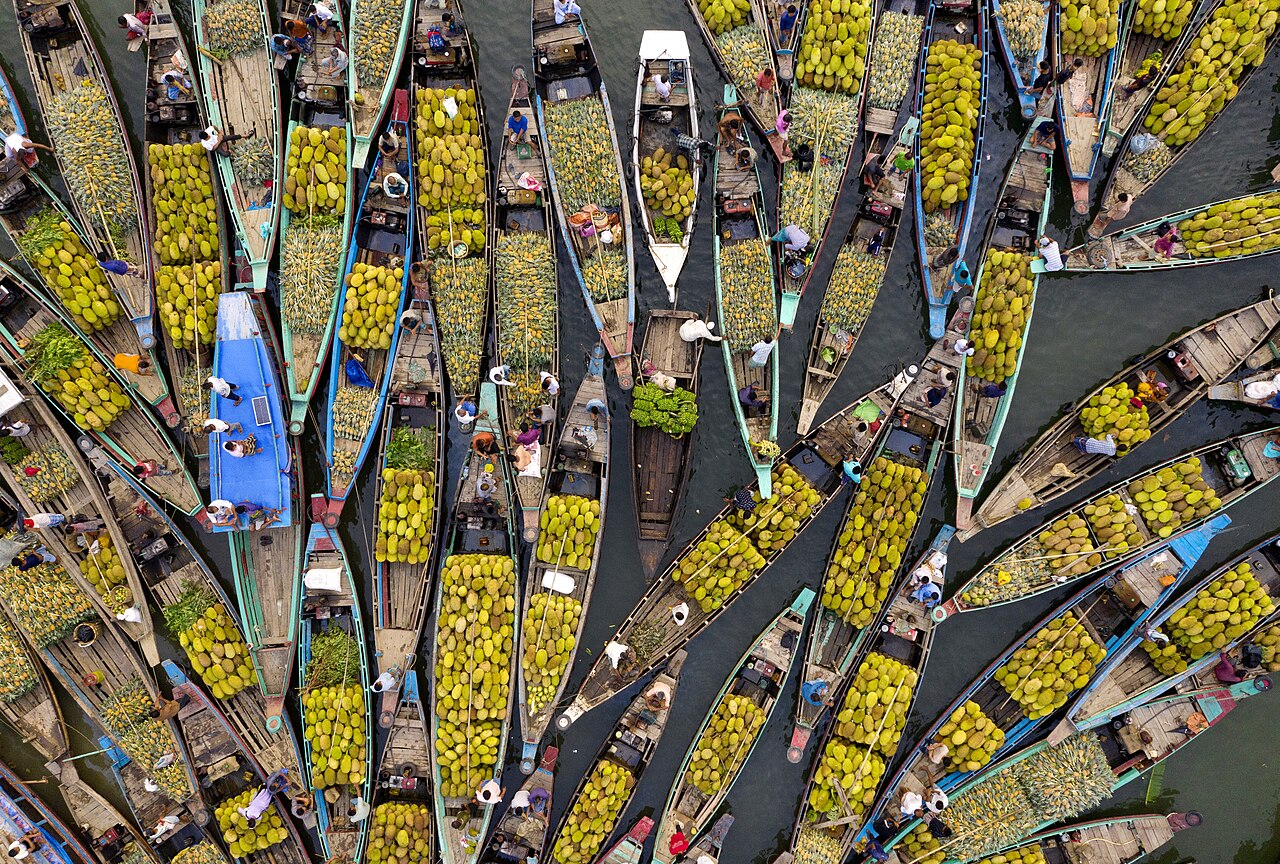
From dawn every Saturday and Wednesday, half a kilometre of road between College Gate and Sadar Hospital in Rangamati town becomes a hill market. Sellers come by engine boat from remote villages with vegetables, fruit and other produce they have grown themselves. Traders at the market put the value of goods changing hands on a market day at Tk 10 lakh to Tk 15 lakh (Tk 1 million to Tk 1.5 million).
Twenty to thirty boats come on each market day from villages on the shores of Kaptai Lake, among them Kainda, Bandukbhanga, Balukhali, Basantapara, Maischari, Naniarchar and Burighat, each carrying 15 to 20 people. Most of the sellers are women, who gather whatever the jhum plots are yielding that season and bring it to town.
The stalls carry sabarang leaves, bamboo shoots, marfa cucumber, dhainna chillies, taro stems, banana stems and flowers, jhum pumpkin, aubergine and taro, bitter aubergine and many kinds of greens. Fruit includes dragon fruit, hill malta, olives, tamarind, pomelo and pineapple. Bananas get a section of their own, dominated by the Bangla variety. Fish from Kaptai Lake, curd set in bamboo and milk brought in bottles from the villages also sell well.
A jhum bottle gourd sells for Tk 30, large taro for Tk 70 a kilo, a bunch of radish or red amaranth greens for Tk 30, a banana flower for Tk 20 and dhainna chillies for Tk 200 a kilo. Nanibala Chakma was selling snails at Tk 250 a kilo and cucumbers at Tk 80.
Chakma, Marma, Tanchangya and Tripura people trade here alongside Bengalis. Buyers Abdul Khalek and Nurul Absar said they come for vegetables they regard as fresh and free of chemicals. For growers on the lake, a market that puts jhum produce directly in front of town buyers is a route to cash income.
The report was filed by Moin Uddin Bappi, Banglanews24's district correspondent.
Photo: MOHAMMAD SHAJAHAN Bangladesh / Wikimedia Commons (CC BY-SA 4.0)
Source: Banglanews24

Comments
(0)