
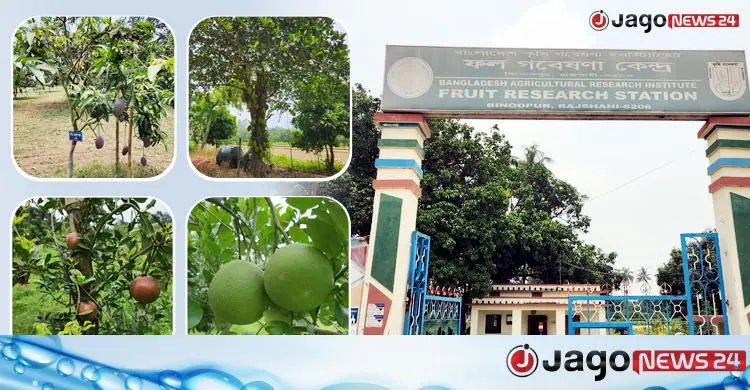
A quiet revolution is under way at the Fruit Research Station in Binodpur, Rajshahi. Known for mango, litchi and jujube, the station does not stop at breeding new varieties: it works to make Bangladesh's fruit sector richer and more modern, from export-quality mangoes and disease-resistant fruits to adapting foreign fruits to local soil and weather.
Run by the Bangladesh Agricultural Research Institute (BARI), it is considered one of the most important of the country's six crop research centres. Its aims are to find scientific solutions to fruit-growing problems, breed improved high-yielding varieties, raise fruit quality and give farmers modern technical support.
Varieties bred here
The station has developed improved varieties of mango, falsa, rose apple (jamrul), litchi, pummelo and BARI jujube, including BARI Litchi-1, BARI Shahi Papaya-1, BARI Kul-1, 2 and 3, BARI Jamrul-1, BARI Pummelo-3, BARI Falsa-1 and BARI Mango-14. BARI Mango-14, an attractive coloured mango, has created export potential, while BARI Jamrul-3 is sweeter, softer and tastier than the usual rose apple.
Using germplasm collected from around the world and local fruit diversity, researchers are developing new hybrid and improved varieties. Grapes, pomegranate, custard apple, dragon fruit and strawberry are under regular study alongside mango and litchi.
Mango and litchi research
All 18 BARI mango varieties, from BARI Mango-1 to BARI Mango-18, are conserved and studied here, along with germplasm such as Surjapuri, King Chakapat, Chiang Mai, Kiew Sawoei, Miyazaki, Dudhsor and Mallika, and popular varieties such as Khirsapat, Langra, Gopalbhog, Banana Mango, Katimon and Haribhanga. Scientific officer Ridwanul Karim said these are used as parent material for hybridisation, and seedlings of good fruit are given to farmers free.
For litchi, BARI Litchi-1 to 5 and Bombai litchi are being compared, and work covers tree height control, modern pruning and yield technology. Ridwanul Karim said correct pruning after each harvest keeps litchi yield and size, but many farmers do not know about it.
Services and challenges
Farmers bring disease, pest and production problems to the station, where plant pathologists diagnose them. Modern technology is increasingly used for disease identification, variety selection, hybridisation, germplasm conservation and yield evaluation.
The biggest problem is a shortage of staff; without enough researchers and technicians, the budget cannot be fully used, officials say.
Chief scientific officer Dr Shafiqul Islam said the station's main goal is high-yielding, disease-resistant, market-ready fruit varieties to raise farmers' incomes, and that work on new hybrids and adapting foreign fruits continues.
Source: Jagonews24. First published in Bengali on The Agro News.
Comments
(0)