
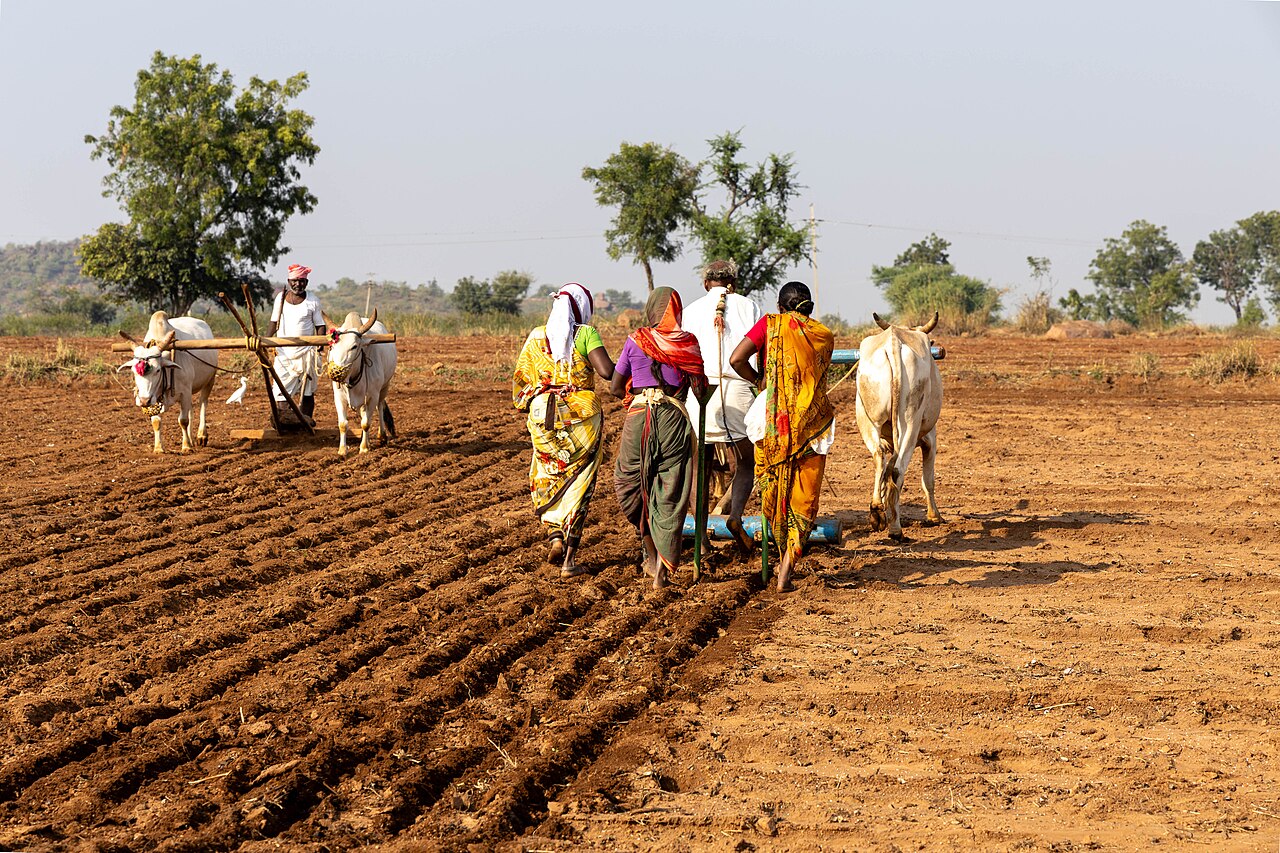
In the rainfed drylands of Karnataka's Raichur district, a handful of farmers still practise Akkadi, an indigenous mixed-cropping system in which as many as eight crops share one field. In a World Food Day column for Down To Earth, Lokappa Nayak argues that the system's decline shows what was lost when farming was simplified around a few high-yielding crops.
Under Akkadi, main crops such as red gram, sorghum or pearl millet (bajra) are interspersed with green gram, cowpea, moth bean, gongura (mesta), castor and field beans. Many of these need less water than the crops now common in the region. The mixed canopy helps keep moisture in the soil, roots draw water from different depths, and if one crop fails to drought, heavy rain or pests, others can still yield. Raichur has been formally declared drought-affected this year.
Today, Nayak writes, farming in the area is dominated by monocropping of cotton, red gram and pearl millet, because of labour scarcity, ease of cultivation and economies of scale, and most produce is grown for sale. Exploratory field observations suggest only a small share of farmers still practise Akkadi. Among them are Hanamesh Nayak, Hire Hanamanth and Goudappa Kateger of Kannal village in Maski taluk.
Goudappa grows red gram, pearl millet, green gram, cowpea, field beans, mesta, moth bean and castor on one acre. In an average year he harvests around 400 kg of bajra, selling 250 kg and keeping 150 kg, plus about 2,000 kg of fodder; of 300 kg of red gram he sells 280 kg. Smaller harvests, such as 8 kg of green gram, 17 kg of moth bean and 12 kg of field beans, go to the household. Judged by yield or sales alone, the author notes, such farmers may not look successful, but the system also supplies food, fodder, mulch and compost.
The column links the shift to high-yielding crops with the loss of local varieties such as Bogapur Jola, 70 Jola and Bagavath Jola (sorghum) and Marasajje (pearl millet), fewer farm-saved seeds and pressure on soil fertility. It does not argue against hybrid seed, inputs or machines, which it says have brought real benefits.
Nayak proposes measuring farm performance by household nutrition, fodder, soil health, income and risk as well as yield; documenting traditional crop combinations; testing local varieties beside improved ones; strengthening community seed banks; developing machinery for mixed cropping; and creating markets for minor millets and pulses. He calls for Akkadi to be scientifically evaluated in the field. The views are the writer's own.
Photo: Nanditha Gogate, WELL Labs / Wikimedia Commons (CC BY-SA 4.0)
Source: Down To Earth

Comments
(0)