
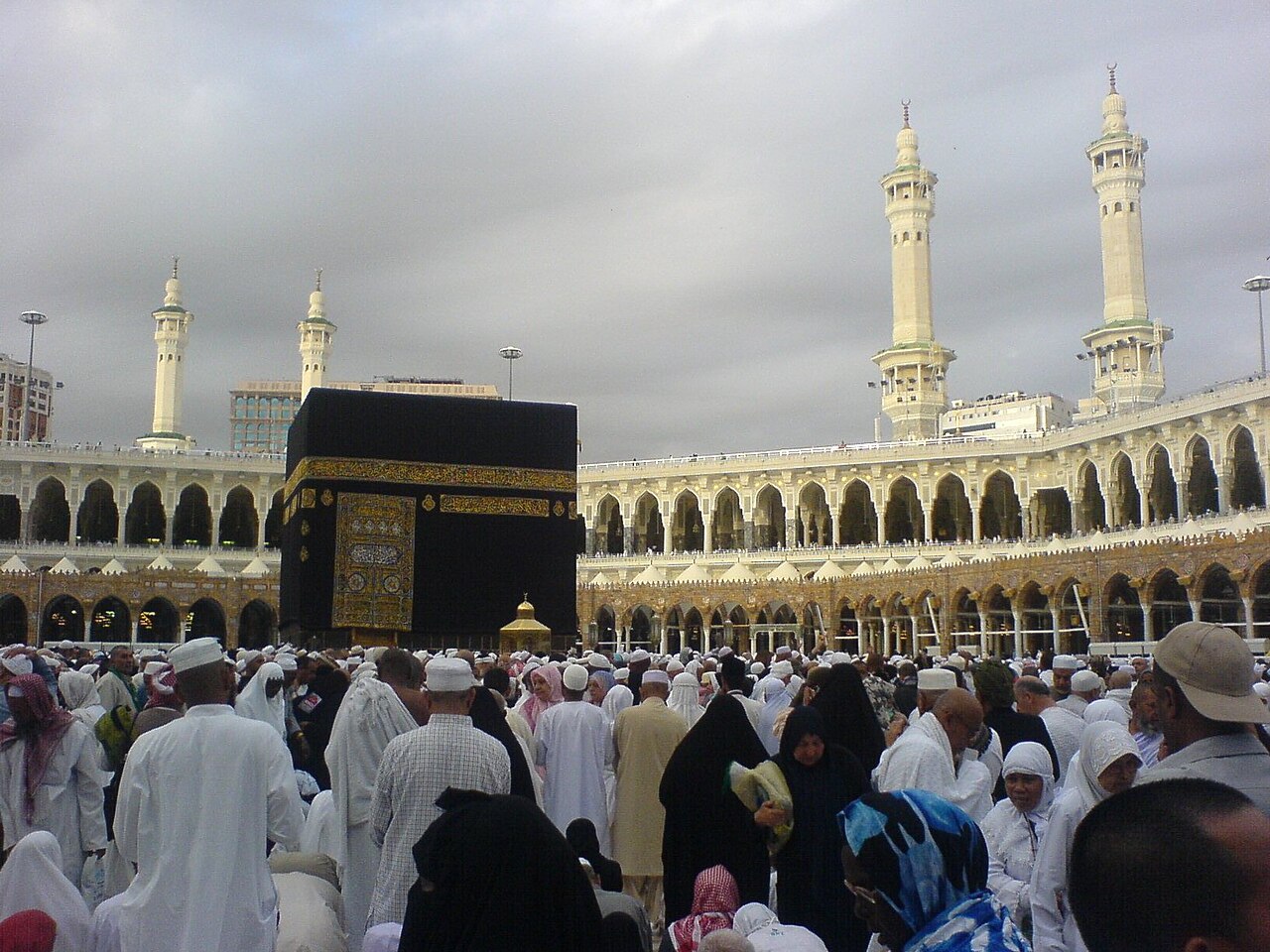
Around 605 CE, five years before he received prophethood, the rebuilding of the Kaaba in Makkah set the Quraysh clans against each other so fiercely that they almost took up arms. Muhammad (peace be upon him), then 35, resolved the crisis with a simple solution. Manzurul Haque tells the history in Prothom Alo, drawing on the sirah and hadith collections.
Since the time of Ismail (peace be upon him) the Kaaba had stood nine cubits high, about four and a half metres, with dry-stone walls and no roof. A spark from incense carelessly handled by a Quraysh woman set fire to its covering and structure; a flash flood from the high ground to the north then cracked the south and west walls, and the treasure kept in a pit inside the roofless building was stolen. The Quraysh decided to rebuild it to a new design with a roof and a raised door.
The Quraysh leader Walid ibn al-Mughira bought timber from a Byzantine ship wrecked at the Red Sea port of Shuaiba, and a Roman builder and carpenter among its passengers, Baqum, became the Kaaba's chief builder. The Quraysh resolved to spend only lawfully earned money on the work; the shortfall this caused left about six cubits on the north side outside the walls. The four walls were divided among four groups of clans, and Muhammad (peace be upon him) carried stones on his own shoulders, Sahih al-Bukhari records.
When the walls reached the height for the Black Stone, every clan claimed the honour, and some swore oaths of blood. On the proposal of an elder, Abu Umayya ibn al-Mughira al-Makhzumi, they agreed that the first man to enter the sanctuary gate the next morning would decide. It was Muhammad (peace be upon him), and the leaders said, 'This is al-Amin; we accept his judgement.'
He spread his Yemeni cloak, placed the Black Stone in the middle, and asked one representative of each group of clans to hold a corner and lift it together. When the cloak reached the right height he set the stone in the wall with his own hands. In the writer's view, the episode established him as an arbiter respected by every clan of Makkah.
The rebuilt Kaaba rose to eighteen cubits, about 27 feet, with its first wooden roof on six wooden pillars. The western door was closed and the eastern door set about six feet above the ground, and a wooden spout, later called the Mizab al-Rahmah, was fitted for rainwater. The area left outside became today's Hijr Ismail, or Hatim. In 64 AH Abdullah ibn al-Zubayr rebuilt the Kaaba on Ibrahim's foundations with the Hatim inside, but in 73 AH al-Hajjaj ibn Yusuf, on the orders of Caliph Abd al-Malik, restored the Quraysh structure, which stands to this day.
Photo: Muhammad Mahdi Karim / Wikimedia Commons (CC BY-SA 2.5)
Source: Prothom Alo


Comments
(0)